Qwen-AgentWorld Is Building a Simulated Internet for AI Agents
A deep dive into the Qwen project that turns environment dynamics into the product, using world modeling, robust parsing, and judge-based evaluation to train and test agents without touching real systems.
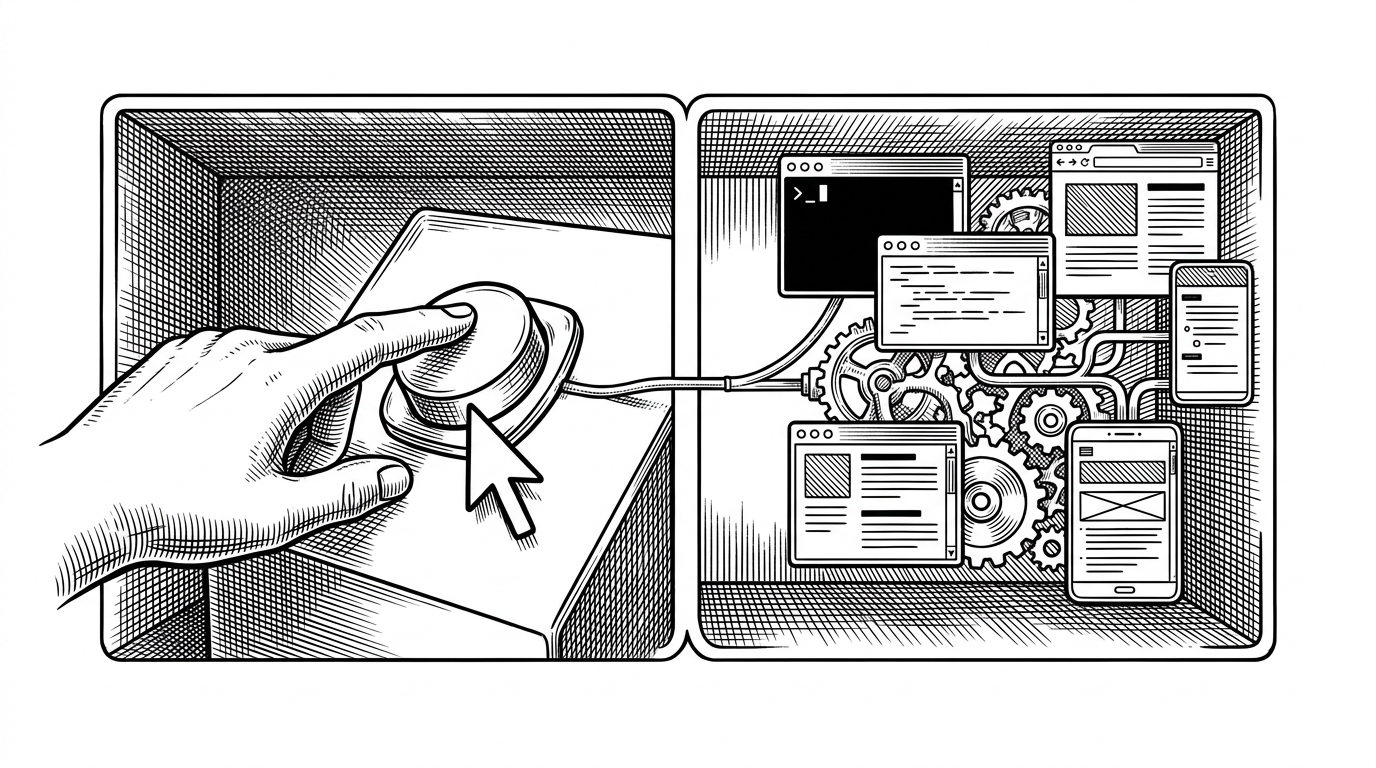
- Qwen-AgentWorld is not mainly an agent runner, because its real product is a controllable world model that predicts how digital environments respond to action.
- The repo makes evaluation cheaper and safer by moving failure away from live systems and into repeatable simulation loops.
- Its parser stack is doing serious work, because messy reasoning traces and malformed judge output are treated as normal inputs, not edge cases.
- The project competes less with orchestration frameworks than with static benchmarks, since it turns environment testing into something generative.
The Agent Stack, Reversed
Most agent projects spend their energy on the actor. Qwen-AgentWorld spends it on the stage. That is the inversion that matters here. It does not ask how to make an agent smarter in the abstract. It asks what would happen if the environment itself could be modeled, replayed, and scored.
That shift changes the economics of experimentation. If your agent can fail inside a simulator, you stop paying the real world every time it misclicks, hallucinate a terminal command, or wanders into a dead end. The repo is therefore less like an orchestration framework and more like a lab for agent behavior.
Qwen-AgentWorld is an open-source project designed for multi-agent simulation and collaboration.
Why Simulating the World Beats Retrying the Agent
The appeal is practical, not philosophical. Real browser sessions cost time, API calls, and patience. Real Android interactions are brittle. Real terminal runs can break in ways that are hard to replay. A world model gives researchers a way to run the same trajectory again, perturb it, and measure what changed.
| Dimension | Qwen-AgentWorld | LangChain | AutoGPT | AutoGen | BabyAGI |
|---|---|---|---|---|---|
| Primary purpose | Simulate environment dynamics | Build LLM applications | Run autonomous tasks | Coordinate multi-agent conversations | Execute task loops |
| Core focus | What the world does back | How to wire tools and prompts | How agents act | How agents collaborate | How tasks decompose |
| Model specificity | Qwen-optimized | Model-agnostic | Mostly GPT-centered | Model-agnostic | Model-agnostic |
| Best use case | Synthetic environments and evaluation | Production LLM apps | Autonomous demos | Agent orchestration | Minimal agent experiments |
| Evaluation style | Judge-based realism and consistency scoring | Application-specific | Task success | Conversation or task completion | Task completion |
That is why Qwen-AgentWorld does not belong in the same mental bucket as agent frameworks like LangChain or AutoGen. Those projects help an agent act. This one helps you simulate the consequences of acting. It is closer to a synthetic environment engine than a tool router.
How the Evaluation Loop Works
The repo's core workflow is a closed loop: infer, judge, score. A trajectory goes in. The world model predicts the next state of the interface. A judge model then evaluates whether that transition was realistic, consistent, factual, well formatted, and overall useful. The output is not a vague judgment. It becomes structured metrics.
infer -> judge -> score

1. load JSONL trajectory
2. generate predicted next state
3. strip reasoning noise and repair formatting
4. ask judge model to score the transition
5. parse rubric into structured metrics
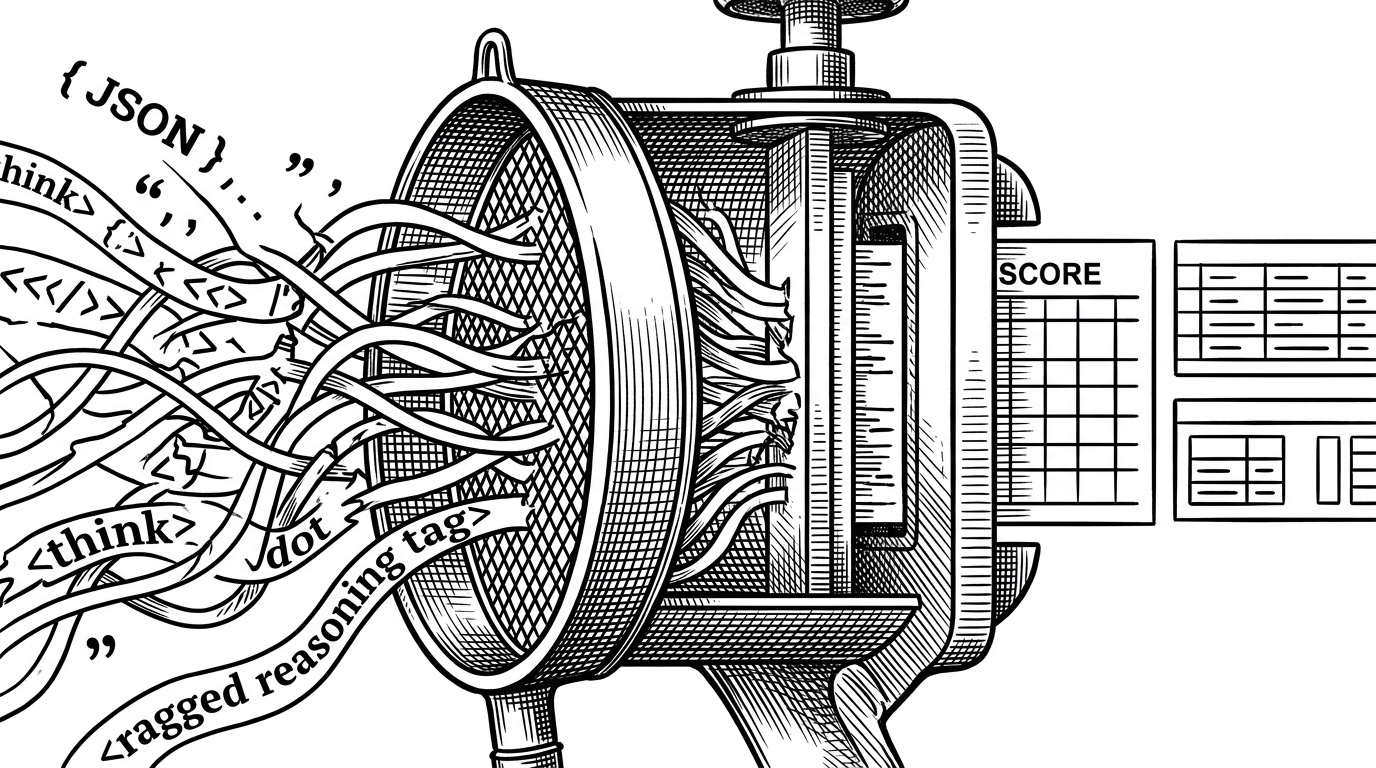
The interesting part is not that the loop exists. It is that the loop is designed to survive model messiness. Reasoning traces arrive with extra tags. Judges answer in semi-structured prose. The repo assumes both will happen and builds parser logic around that assumption.
The Parser Layer Is Doing More Than Cleanup
The parser code is where the project stops looking conceptual and starts looking battle-tested. A function like _remove_thinking_tags is not a convenience. It is a guardrail for reasoning models that mix their internal monologue with the output you actually want to score.
That matters because a naive parser treats all text as equally trustworthy. Qwen-AgentWorld does not. It separates thought from state, then survives malformed JSON in the judge path by falling back through multiple extraction strategies. In other words, it assumes the model will be sloppy and designs for that reality.
output_parser.pystrips reasoning noise before evaluation.judge_parser.pyfalls back through multiple JSON extraction strategies.- Five scored dimensions shape the final metric: format, factuality, consistency, realism, and quality.
That is a quiet but important difference. The repo is not trying to prove that models can speak cleanly. It is trying to prove that messy model behavior can still be measured reliably.
Domain Prompts Turn One Model Into Many Environments
The prompts/ directory is the control surface. The same core world model behaves differently depending on whether it is simulating Android, Web, Terminal, SWE, Search, or MCP. The architecture stays the same. The rules of the universe change.
| Domain | What the prompt controls | Why it matters |
|---|---|---|
| Android | Screen transitions, local edits, representation fidelity | Helps the simulator behave like a phone UI instead of a generic text task |
| Web | Navigation, page changes, element state | Makes browser interactions feel like actual page dynamics |
| Terminal | Command execution and output evolution | Tests how shell state changes after each action |
| SWE | Task context and code-adjacent transitions | Keeps software engineering workflows grounded |
| Search | Query-response behavior and result consistency | Lets the model simulate retrieval-like environments |
| MCP | Tool semantics and multi-tool structure | Checks whether the world model can handle tool-mediated workflows |
This is where Qwen-AgentWorld becomes more than one benchmark. It becomes a family of environments defined by prompt contracts. The project is not only predicting what happens. It is defining what kind of world it is allowed to predict.
What Qwen-AgentWorld Is Really Competing With
The obvious comparison set is LangChain, AutoGPT, AutoGen, and BabyAGI. But the more interesting answer is that Qwen-AgentWorld is not really competing with agent orchestration at all. It is competing with static environments, brittle eval scripts, and benchmark setups that only work once.
| Project | What it optimizes | What it leaves to others |
|---|---|---|
| Qwen-AgentWorld | Environment simulation, parsable evaluation, domain-specific world modeling | Agent policy design |
| LangChain | Application wiring and tool integration | World dynamics |
| AutoGPT | Autonomous task execution | Reliable environment simulation |
| AutoGen | Multi-agent collaboration | Synthetic environment fidelity |
| BabyAGI | Simple task decomposition | Benchmark realism |
That framing explains the project's real niche. It is an infrastructure bet on the idea that better agents will require better worlds to train and test against. If that is true, then the next leap is not just smarter tool use. It is better world models.
The Bigger Bet
Qwen-AgentWorld implies a future where benchmarks are generative instead of static. Instead of freezing a test set and hoping it stays relevant, you model the environment and let new trajectories emerge inside controlled constraints. That makes agent evaluation repeatable without making it boring.
The strategic point is simple. If you can model the world well enough, you reduce dependence on real systems, gain more training signal, and make failures cheaper. That is a big claim, but this repo is one of the clearest open-source attempts to operationalize it.