Finsight: Turning Financial Statements Into a Conversation
A focused open-source app that uses long-context Gemini to read dense PDFs, extract structure, and surface the kind of narrative insights finance teams actually want.


Finsight aims to bridge the gap between complex financial data and accessible, digestible insights. By leveraging the power of Gemini 1.5 Pro, we can automate the arduous task of financial statement analysis, empowering users to make informed decisions without needing advanced financial expertise.
- Finsight matters because it treats a full financial statement package as one analytical object instead of a pile of isolated prompts.
- Its real advantage is not generic chat, but long-context synthesis that keeps tables, notes, and narrative sections in view at once.
- The project is narrow on purpose, which makes its workflow easier to understand and more faithful to how an analyst reads a report.
- As a prototype, it points to a broader pattern in finance tools: fewer retrieval hops, more document-wide reasoning.
The Real Problem: Finance PDFs Are Too Long to Query Naively
Financial statements are built to resist casual reading. Balance sheets, cash flow statements, notes, and management commentary all point at one another, and the useful answer often lives three pages away from the question. Finsight exists to collapse that maze into a single conversational pass.
That framing is important. Finsight is not trying to replace the analyst. It is trying to remove the friction of reading an entire report package well enough to ask better questions.
Why Long Context Changes the Game
The key shift is not model size for its own sake. It is the ability to hold the entire document stack in memory long enough to synthesize it as a whole, instead of bouncing between retrieval chunks and partial answers.
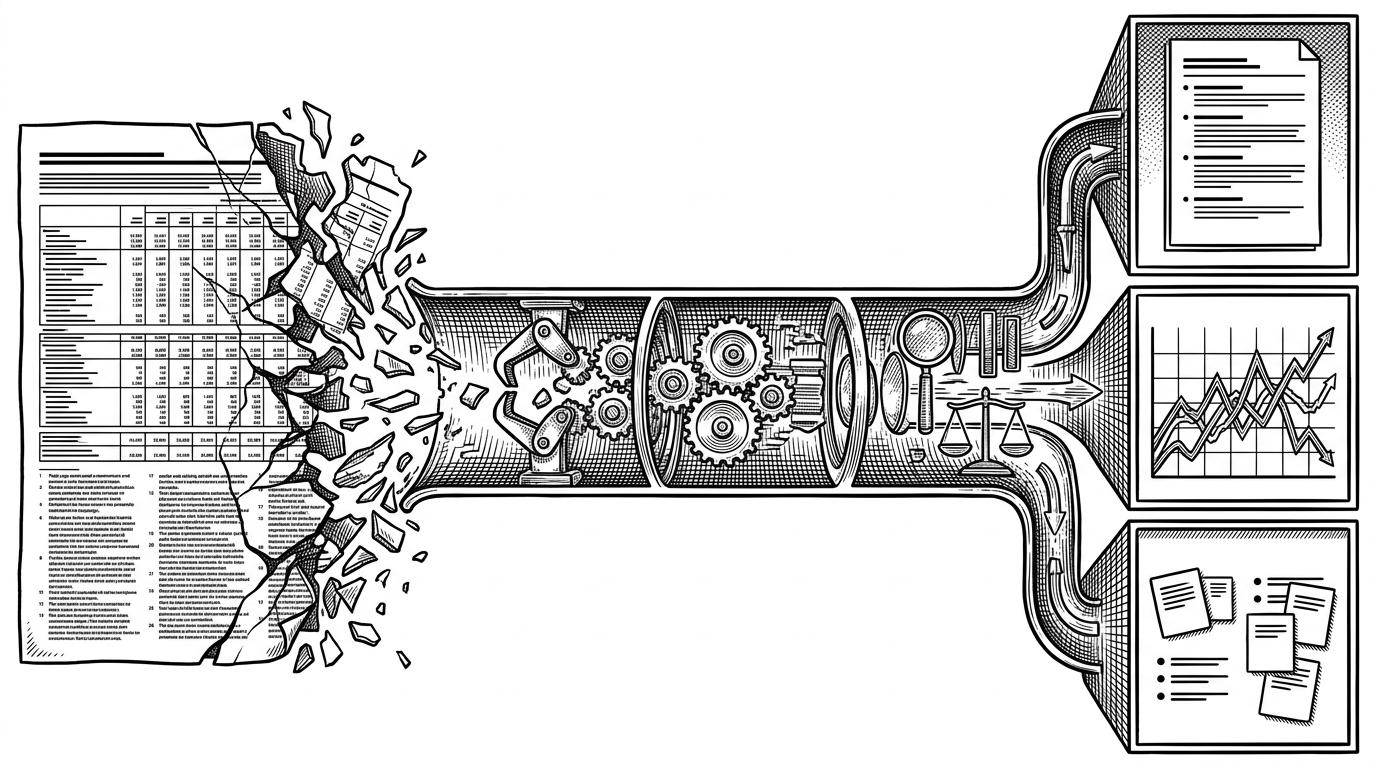
That changes the unit of work. In a retrieval-first workflow, the system hunts for snippets. In Finsight, the system ingests the packet, assembles context, and then reasons across the package like a human analyst would.
How Finsight Works Under the Hood
The workflow is straightforward, which is part of the appeal. A user uploads a financial statement PDF, the app extracts the relevant text and structure, then Gemini 1.5 Pro receives enough surrounding context to produce a synthesis rather than a fragment.
That matters because the model is not only answering a question. It is being asked to build a narrative from the document itself, including the cross-references and footnotes that normally make this work slow.
Upload PDF -> extract text and structure -> assemble full context -> send to Gemini 1.5 Pro -> generate summary, trends, anomalies, and follow-up questionsThe product shape suggests a deliberate constraint. Instead of building a sprawling finance platform, Finsight keeps the surface area narrow so the analysis loop stays legible.
The 1-million-token context window of Gemini 1.5 Pro is a game-changer for this application. It allows us to process entire financial reports in a single go, ensuring that the AI has all the context it needs to provide accurate and holistic insights.
That line gets to the point. Finsight is built around the claim that context is the product. If the model can hold the whole report, the app can ask better questions and return better answers.
Built as a Hackathon Project, Not a Framework
The maker context matters here. Shiv Shah built Finsight as a practical demonstration, not as a platform company or an infrastructure layer. You can feel that in the design: a direct workflow, a clear user, and a specific job to be done.
That also explains why the project feels focused rather than overbuilt. It shows one strong idea clearly, which is often a better signal than a larger feature list.
What It Does Better Than Adjacent Tools
The closest comparisons are not just finance apps. They are general assistants, LLM frameworks, model projects, and research terminals. Each solves a nearby problem, but Finsight is unusually narrow about the one it wants to solve.
| Tool | Primary job | Model strategy | Setup burden | Finance depth |
|---|---|---|---|---|
| Finsight | Turn uploaded financial statements into narrative analysis | Long-context Gemini over the full document packet | Low | Focused on statement synthesis |
| ChatGPT or Claude with uploads | General document Q&A | Interactive prompting over uploaded files | Low | Depends on the prompt and the user |
| LangChain or LlamaIndex | Build custom LLM apps | Framework-agnostic orchestration | High | Whatever the developer assembles |
| FinGPT | Financial LLM research and fine-tuning | Domain-trained open models | High | Deep on model training, not product flow |
| OpenBB Terminal | Investment research and market analysis | Data-first platform with AI features | Medium to high | Broad market coverage, less document-centric |
Finsight is not trying to beat those tools at their own game. It is doing less, on purpose, and the restraint is what makes it legible. The app is a single-purpose synthesis machine, not a general assistant and not a framework demo.
Why This Pattern Matters Beyond One Repo
The larger lesson is simple. Long-context models become much more interesting when they are attached to a narrow workflow with a hard document boundary. Finance statements are a clean example because the task is already expert-shaped and heavily cross-referential.
Finsight shows a pattern that will keep showing up elsewhere. The future is not only about asking models more questions. It is about handing them the whole object and letting them do the synthesis work humans used to do piecemeal.