ConvoBench-AI: The Benchmark That Breaks Evaluation Into Tiny, Verifiable Judgments
A deep dive into the batch-and-score system that evaluates conversation turns across hundreds of facets, from linguistic quality to highly specific domain and persona signals.

- ConvoBench-AI is interesting because it turns evaluation into many small, schema-bound judgments instead of one overloaded prompt.
- Its real invention is the chunked inference loop, which keeps the evaluator inside a manageable attention budget while preserving structure.
- The facet taxonomy matters because it pushes benchmarking toward persona fidelity and domain nuance, not just coarse quality scores.
- Confidence is not an extra field here. It is part of the measurement model, which makes weak judgments easier to detect and filter.
Most benchmarks ask whether a model is good. ConvoBench-AI asks whether we can measure that goodness without crushing the evaluator under its own ambition. That distinction matters, because conversation quality is not a single answer. It is a stack of small behaviors that only make sense when you score them one facet at a time.
The real bottleneck is not model quality, it is measurement
The project is built around a simple complaint: broad benchmarks flatten conversational behavior into coarse numbers. That works when the task is arithmetic or trivia. It breaks down when the object under review is a turn in a dialogue, where tone, safety, specificity, persona fit, and domain knowledge all pull in different directions.
ConvoBench-AI responds by treating evaluation as a precision instrument. Instead of asking one model pass to judge everything, it spreads the work across small batches of facets. The result is less dramatic than a giant leaderboard, but much more useful if your real goal is diagnosis.
The engine that scores twelve facets at a time
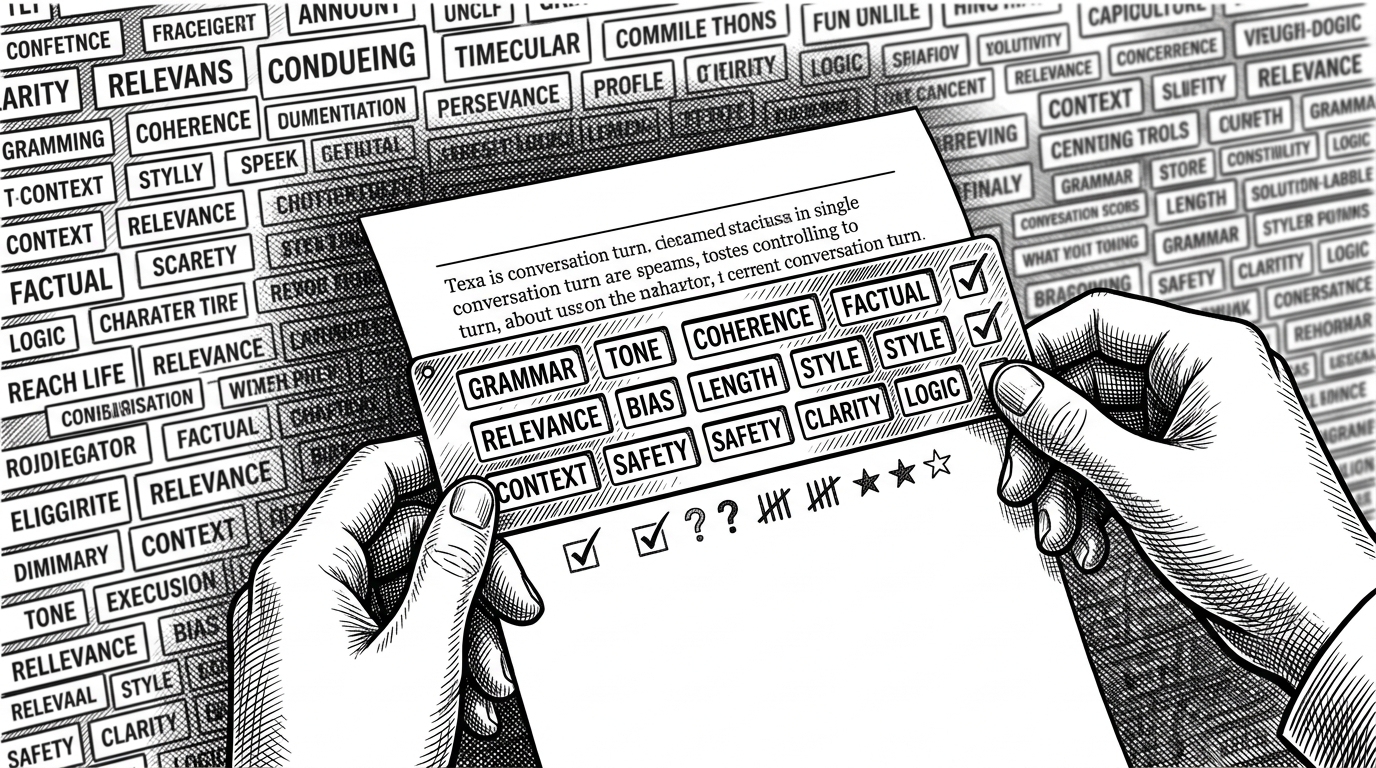
The heart of the repository is an EvaluationEngine inside evaluation_benchmark.ipynb. Its key move is the chunked inference pattern: a conversation turn is paired with a small facet batch, usually 12 items at a time, then sent through a strict JSON prompt. Every facet returns three fields: score, reasoning, and confidence.
{
  "facet": "clarity",
  "score": 4,
  "reasoning": "The response is direct and internally consistent.",
  "confidence": 5
}
That schema matters more than it first appears. It turns the benchmark into a machine that can be aggregated later, rather than a single opaque verdict. It also makes the evaluator's failure modes visible. If a batch produces weak reasoning or low confidence, you do not just get a bad score. You get evidence that the measurement itself is shaky.
Why the facet list matters more than it first appears
The CSV is not just a long list. It is the project's point of view. With 300-plus facets, the benchmark reaches into linguistic quality, safety, psychological texture, and domain-specific signals that most evaluation suites never touch. That makes it feel less like a generic QA tool and more like a microscope for persona and behavior fidelity.
| Approach | Scope | Failure mode | Best use |
|---|---|---|---|
| Coarse benchmark scoring | One score for many behaviors | Hides which dimension failed | Fast model comparison |
| Single-pass rubric grading | Many criteria in one prompt | Attention dilution and inconsistent judgments | Lightweight evaluation drafts |
| ConvoBench-AI | Small batches with structured outputs | More steps, but clearer evidence | Facet-level diagnosis and persona testing |
The taxonomy also changes the kind of question you can ask. Instead of asking whether a model is globally intelligent, you can ask whether it maintains a role, respects a domain boundary, or signals uncertainty in the right places. That is a more realistic test for conversational systems, which fail in narrow but consequential ways.
Confidence is the hidden score
The most underrated field in the whole system is confidence. A score without confidence is a verdict with no uncertainty attached. A score with confidence tells you whether the evaluator is leaning on solid reasoning or making a brittle guess.
That changes how teams can use the benchmark. Low-confidence judgments can be down-weighted or inspected manually. High-confidence clusters can reveal stable strengths. More importantly, confidence gives you a second layer of telemetry about the evaluator itself, which is essential if the benchmark is supposed to be trusted rather than merely reported.
| Signal | What it gives you | What it prevents |
|---|---|---|
| Score only | A ranking | Blind trust in one number |
| Score plus reasoning | A rationale | Opaque judgments |
| Score plus reasoning plus confidence | A measurement with uncertainty | False precision |
This is a subtle but important move. The project does not pretend that evaluation is perfectly objective. It admits that some judgments are softer than others, then exposes that softness as data. For a benchmark, that is unusually honest.
Synthetic scenarios make the benchmark usable before you have real data
ConvoBench-AI also ships with a seed-to-scenario approach through sample_base.json. That matters because teams rarely start with pristine real-world data. They start with a use case, a few hypotheses, and a need to see whether the evaluation pipeline works at all.
- Seed scenarios define the kind of conversation you want to test.
- Synthetic turns expand those seeds into a larger evaluation set.
- The benchmark can be exercised before any proprietary dataset exists.
That makes the project iterative rather than archival. It is not just a retrospective scoreboard. It is a way to pressure-test the evaluation method itself before the system is sitting in front of real users.
Built for small models, which is the point
The stack leans on litellm and Groq-backed inference for models like Llama 3.1-8B. That choice is strategic. If the orchestration is strong, you do not need brute force to get useful evaluation behavior. You need a clean prompt contract, controlled batch size, and enough throughput to make the workflow practical.
| Strategy | What it optimizes for | Trade-off |
|---|---|---|
| Big-model grading | Raw model capacity | Higher cost and less control |
| Small-model evaluation with strong orchestration | Repeatability and speed | More engineering discipline required |
That is one of the repo's sharpest signals. It assumes the hard problem is not finding a giant model that can read everything. It assumes the hard problem is making the evaluation process reliable enough that a smaller model can judge consistently.
Prototype energy, production ambition
The project feels serious, but not finished. The notebook-centered architecture is practical for experimentation, and the use of Dockerfile, requirements.txt, and litellm shows real deployment intent. At the same time, the shape still reads like an early-stage system moving from a working notebook toward a hardened service.
That tension is useful. It keeps the article from overclaiming. ConvoBench-AI is compelling not because it has already solved evaluation at scale, but because it identifies the right bottleneck and proposes a disciplined way around it.