BMAD-CORE: Compiling the Human-in-the-Loop
How a YAML-to-XML pipeline is turning 'vibe coding' into a disciplined agentic factory.
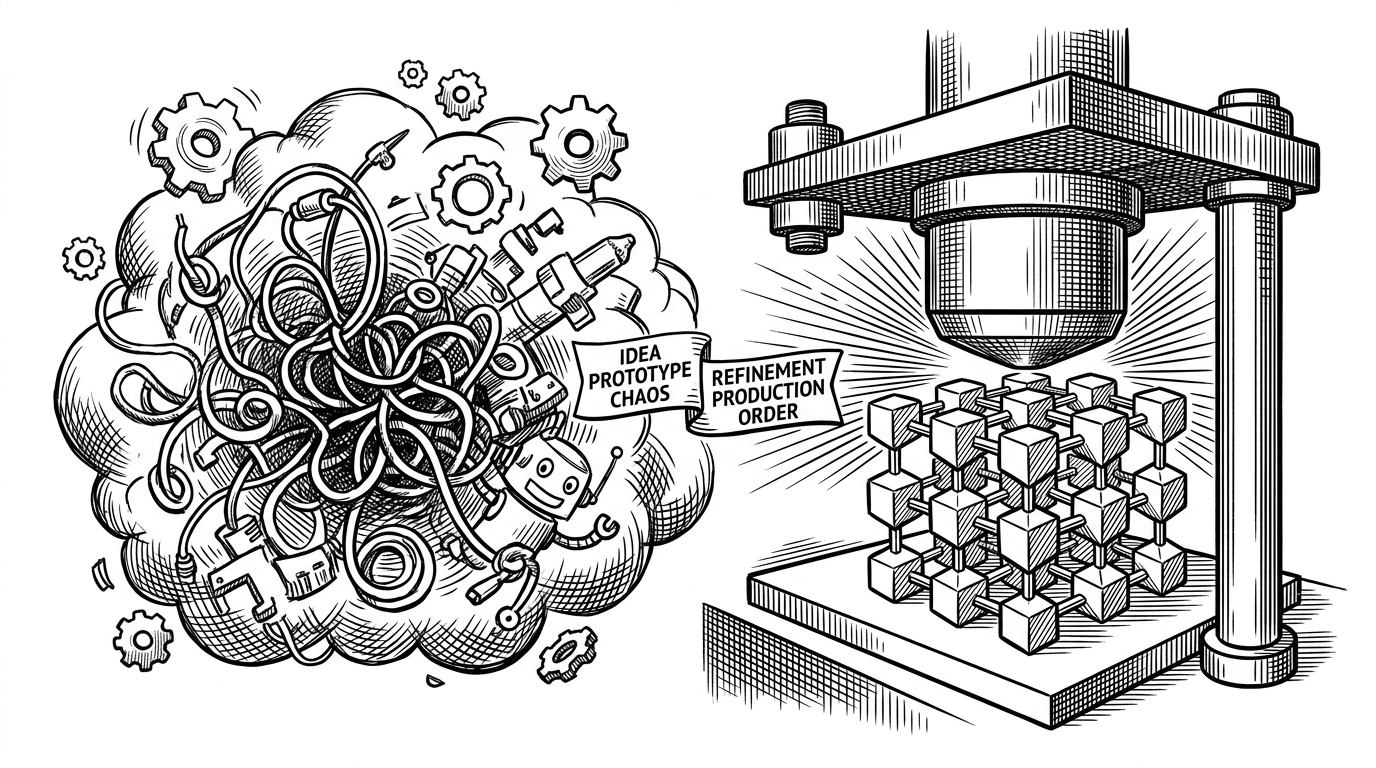
- BMAD-CORE replaces unstructured prompt engineering with a compilation pipeline that converts YAML declarations into rigid XML activation blocks.
- The framework treats architectural documentation as the primary source of truth rather than the generated source code.
- A multi-agent "Party Mode" forces specialized personas to debate and validate technical solutions before implementation begins.
- The system functions as a human-in-the-loop sidecar that requires explicit approval of blueprints at every stage of the development lifecycle.
Beyond the Magic Wand
The era of throwing raw prompts at a chat box and hoping for a working diff is showing its limits. Developers call this 'vibe coding.' It feels incredibly fast initially, but it quickly accrues hallucination debt. When context windows fill up with unstructured, meandering conversations, the AI loses the plot and begins overwriting its own logic.
BMAD-CORE treats this as an engineering failure rather than a model limitation. Instead of relying on endless prompt engineering, it introduces a concept called Context Engineering. It treats agent instructions not as casual chat messages, but as a rigid build target that must be explicitly compiled before execution.
Vibe coding is the antithesis of engineering. It leads to fragile architectures, context drift, and “hallucination debt.” To move from toy demos to enterprise-grade systems, we need a shift from unstructured chat to Agentic Engineering.
The Agent Compilation Pipeline
At the heart of the framework is a compilation step that transforms declarative YAML files into structured XML activation blocks. This pipeline ensures that when an LLM is invoked inside an IDE like Cursor or Claude Code, it operates within strict, deterministic boundaries.
By shunting the agent's persona, rules, and current task into XML tags, BMAD-CORE prevents the model from steering off course. The LLM is forced to read its instructions like a machine parsing a configuration file, rather than a human reading a letter.
The Four-Phase Factory
The framework enforces a strict Software Development Life Cycle (SDLC) divided into Analysis, Solutioning, Implementation, and Cleanup. During this flow, artifacts are passed sequentially between specialized agents.
The output of the Architect agent becomes the immutable source of truth for the Developer agent. If the code does not match the architecture document, the code is considered wrong. This reverses the typical AI coding dynamic where the generated code dictates the project's reality.
In the BMAD framework, source code is no longer the sole source of truth—documentation (PRDs, architecture designs, user stories) is. Code becomes merely a downstream derivative of these specifications. This “docs-as-code” philosophy ensures logical consistency and traceability even at scales of millions of lines of code
"Party Mode": The IDE as a Courtroom
Before a single line of code is written, BMAD-CORE initiates a Multi-Agent System where different personas debate the solution. A Product Manager agent, an Architect agent, and a Developer agent evaluate the requirements together in the same chat session.
This 'Party Mode' acts as a governance layer. The Architect might propose a complex microservice, while the Developer agent pushes back on implementation reality, all while the human developer observes and arbitrates.

Blueprints vs. Black Boxes
Unlike autonomous coding agents that operate in a black box and attempt to solve entire repositories in one go, BMAD-CORE acts as a sidecar. It demands that the human developer approve architectural blueprints at every step.
| Feature | BMAD-CORE | Plandex | Vanilla Chat (Cursor/Claude) |
|---|---|---|---|
| Execution Style | Spec-Driven / Sidecar | Autonomous / Sandbox | Reactive / Vibe Coding |
| Agent Definition | Compiled YAML to XML | Go Binaries | Hidden System Prompts |
| Source of Truth | Architecture Documents | The Codebase | The Chat History |