Paperclip: the company OS for AI agents
An open-source control plane that turns prompts into org charts, budgets, governance, and auditable workstreams.
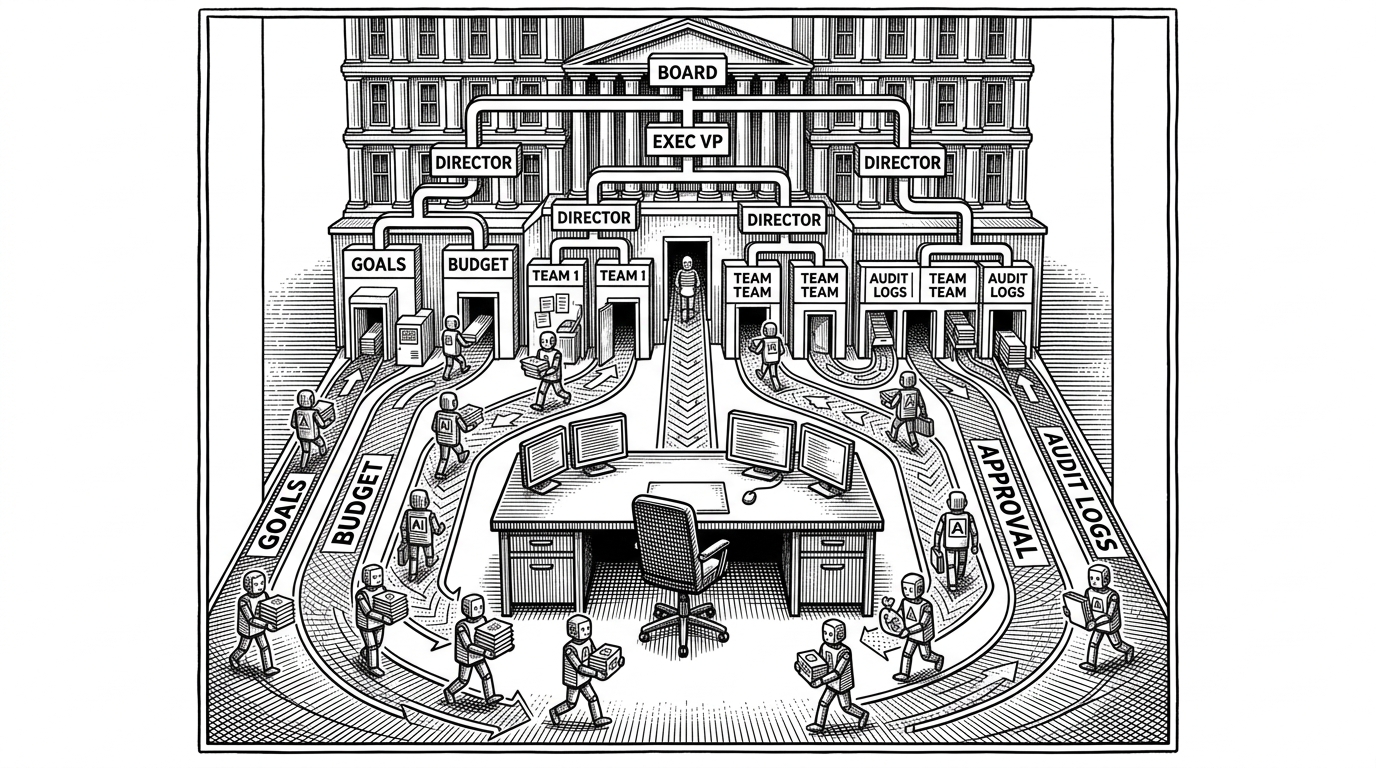
- Paperclip’s central move is to treat AI autonomy as an organizational design problem, not a prompting trick.
- The repo wraps agents in management primitives like governance, budgets, heartbeats, and audits so work can be supervised instead of merely launched.
- Its adapter layer makes runtimes interchangeable, which turns the system into a control plane instead of a fragile one-off runner.
- By pairing local infrastructure with schema-first config and doctor checks, Paperclip tries to make autonomous work observable, recoverable, and portable.
Most agent tools start with execution. Paperclip starts with management. That is the interesting inversion here: before an AI worker can do useful work, it needs a role, a budget, a place in an org chart, and a record of what happened. Paperclip builds that layer first.
The strange idea at the center of Paperclip
Paperclip treats a swarm of AI agents like a company, not a queue of prompts. That means it cares about ownership, delegation, approvals, and audit trails as first-class concepts. In practice, the repo is less interested in making one model smarter and more interested in making many workers governable.
Our mission is to help developers build better user interfaces faster.
Why autonomy gets messy fast
The hard part of multi-agent systems is not generation. It is operations. Once you have more than one worker, you need cost tracking, approvals, persistence, and a way to tell whether the system is healthy or drifting. Paperclip makes those constraints explicit instead of hiding them behind a script.
| Problem | Generic agent runner | Paperclip |
|---|---|---|
| Agent sprawl | Launches tasks, but leaves coordination to the user | Treats agents as roles inside an org structure |
| Cost control | Usually an afterthought | Budget visibility is part of the control plane |
| Approval flow | Manual or bolted on | Governance is a first-class step |
| Auditability | Logs may be scattered | Events become a unified transcript and audit trail |
| Deployment model | Often one-off or environment-specific | Local control with production-like infrastructure |
The control plane underneath the company
The codebase is a TypeScript monorepo with a sharp division of responsibilities. The CLI is the front door, the server coordinates state and requests, and shared schemas keep the contract stable across both sides. That structure matters because it mirrors the product idea: one layer for human operators, one layer for machine workers, one layer for the shared rules.
paperclipai/
  cli/              # onboarding, doctor, run, heartbeat
  server/           # backend coordination and state
  packages/shared/   # schemas and shared types
  .agents/skills/    # reusable agent capabilities
  doc/               # specs and deployment docs
The repo’s schema-first approach is a quiet but important choice. Configuration is validated centrally, and legacy migrations are handled explicitly, which means the system is built for evolution instead of a clean-room demo. That is what a real control plane needs.
Heartbeats, doctor checks, and first-run bootstrap
Paperclip does not assume a healthy environment. It checks whether the database is ready, whether secrets exist, whether the runtime is reachable, and whether the local machine can actually support the workflow. If those checks fail, the system can repair or stop before it drifts into silent failure.
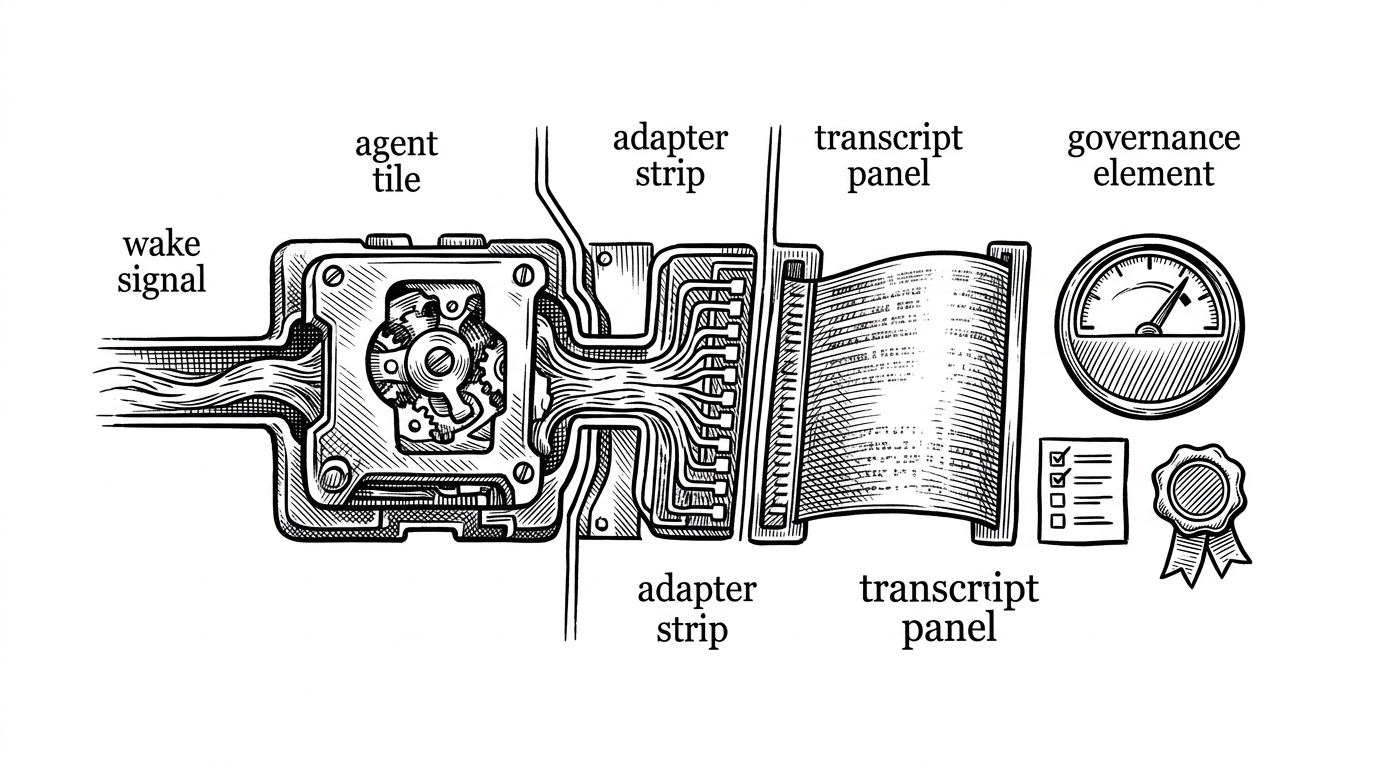
The heartbeat model is the more interesting choice. Instead of a constant always-on loop, Paperclip wakes a specific agent, gathers events, and normalizes the output through an adapter. That makes the system feel less like a daemon and more like an accountable dispatch center.
The adapter layer is the real moat
Paperclip’s adapter registry is what keeps the platform from collapsing into a single runtime opinion. A Claude local process, a gateway-based agent, or a Bash-like tool can all be treated as interchangeable modules. The point is not to standardize the agent. The point is to standardize the management surface around the agent.
| Runtime strategy | What changes | What stays stable |
|---|---|---|
| Local agent | Execution happens on the machine | Events, governance, and transcript shape stay the same |
| Gateway agent | Execution happens through a remote layer | The control plane still sees a normalized event stream |
| Bash-like adapter | The worker is basically a process wrapper | Paperclip still gets logs, status, and audit data |
That adapter philosophy is what makes Paperclip extensible. Once the platform controls the contract, it can swap the worker without rewiring the company around it.
Postgres on the desktop, not SQLite by default
The infrastructure choice is unusual for a local-first tool. Paperclip leans into embedded Postgres rather than defaulting to something lighter, which suggests the team cares about relational depth, portability, and production parity. If the system is meant to model organizations, that choice makes sense.
Local parity matters because organizational workflows are stateful. Org charts, approvals, budgets, and audit logs are not toy data. They need a database that can behave like the real thing even when the app is running on a developer laptop.
What Paperclip is competing against
Paperclip does overlap with agent runners, low-code builders, and prompt-to-code tools, but it is not trying to win the same game. Generic runners optimize for dispatch. Low-code platforms optimize for speed. Design-to-code tools optimize for translation. Paperclip optimizes for governance around autonomous labor.
| Category | Primary strength | Paperclip’s difference |
|---|---|---|
| Generic agent runner | Quick task execution | Company-level control and visibility |
| Closed orchestration platform | Polished managed experience | Open source and local control |
| Design-to-code tool | UI generation from prompts or files | Management primitives for workers |
| Low-code builder | Fast internal apps | Agent governance, budgets, and auditability |
That framing changes the product category. Paperclip is not just another way to launch a model. It is an attempt to define the operating system for synthetic organizations.
The bigger bet
The real wager is that future AI labor will need templates the way software teams need repos and services. If that proves true, then the valuable abstraction is not the prompt. It is the company structure around the prompt.
Paperclip is interesting because it takes that idea seriously in code. It turns management concepts into software primitives, then wires those primitives into a runnable local stack. That is a stronger claim than agent automation, and a more durable one.