bmad-bundles: The Bootloader for AI Teams
How BMAD-Bundles uses XML cartridges to turn raw LLMs into structured agile squads.

- BMAD-Bundles uses XML-based cartridges to inject specific personas and virtual filesystems directly into raw LLMs.
- A mandatory seven-step boot sequence prevents hallucination by forcing agents to halt and wait for user commands.
- The framework eliminates context rot by establishing a single markdown file as the absolute authority for project state.
- Orchestrator agents use transformation nodes to swap their entire command menus and roles within a single session.
The shift from AI as a chatbot to AI as an operating system requires infrastructure. Most developers still copy and paste code into an LLM window, hoping the model remembers the architecture rules established twenty messages ago. The BMAD (Breakthrough Method for Agile AI-Driven Development) framework takes a different approach. Rather than relying on conversational memory, it uses a repository called bmad-bundles to deliver rigid, XML-based personas directly to the model. A single 50KB file transforms a generic model into a specialized Game Architect with its own virtual filesystem and command menu.
The 7-Step Boot Sequence
Every agent in the BMAD ecosystem starts life through a mandatory activation sequence. This bootloader process forces the LLM to initialize its persona, load its skills, and mount its virtual files before interacting with the user. The most critical part of this sequence is Step 5, labeled as a CRITICAL HALT. This instruction explicitly prevents the LLM from hallucinating a proactive conversation, forcing it to wait for the user's first command.
Solving Context Rot with The Bible
Long-running interactions with LLMs inevitably suffer from context rot. The model forgets constraints, hallucinates file structures, and loses track of the overarching goal. BMAD solves this by codifying a single source of truth: the project-context.md file. Across all agent bundles, the instructions mandate that this file must be treated as the absolute authority. It acts as shared RAM between different agent sessions.
Skip BMAD and you get agents that produce code that doesn't match requirements.
XML as a Virtual Filesystem
To ensure agents remain portable across different IDEs and command-line tools, BMAD heavily utilizes the <bundled-files> XML tag. This tag operates as a virtual filesystem packed directly into the prompt. The framework explicitly forbids the LLM from using its own external tools to fetch these dependencies, forcing it to read the CDATA sections provided within the bundle. This guarantees the agent always has the exact, version-controlled instructions it needs to execute a workflow.
<agent-bundle>
  <persona role="architect">
    <instructions>You are the Lead System Architect.</instructions>
  </persona>
  <bundled-files>
    <file path="workflow.xml">
      <![CDATA[
        <!-- Core workflow execution logic -->
      ]]>
    </file>
  </bundled-files>
</agent-bundle>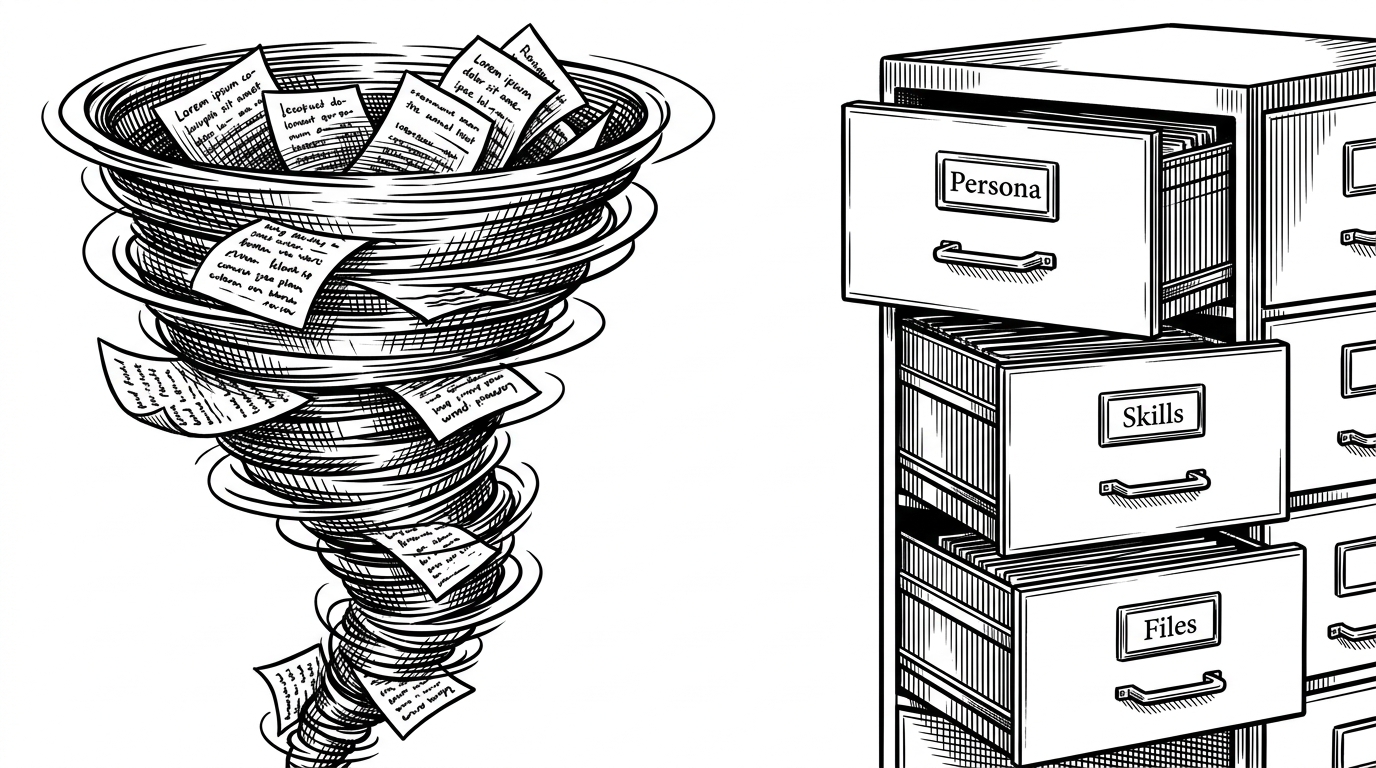
The Orchestrator's Metamorphosis
While specialized bundles like the Game Architect handle specific domains, the team-fullstack.xml bundle introduces an Orchestrator. This master agent does not write code. Instead, its primary function is transformation. Using the <agent-transformation> node, the Orchestrator can completely swap its persona, replacing its own command menu with that of a Product Manager or a QA Engineer. This creates a hierarchical command structure entirely contained within the LLM's context window.
BMAD gives you a spec-first workflow that eliminates AI-agent context loss.
Building the Agentic OS
The competitive landscape for repository packing is growing, with tools like Repomix leading the charge for flattening codebases into readable text. However, BMAD-Bundles occupies a distinct niche. It is not just packing code; it is packing behavior. By serving these XML files over raw GitHub URLs, BMAD enables true Agent-as-a-Service, allowing any compatible CLI to hydrate an entire agile team with a single network request.
| Feature | BMAD-Bundles | Repomix | BundleRepo |
|---|---|---|---|
| Primary Use Case | Role-based AI Teams | General Repository Packing | High-performance XML output |
| Output Format | XML / Markdown | Markdown / Text | XML |
| Core Differentiator | Agent Transformations | Secret Scanning & Security | Rust-based execution speed |