Skylight Turns Your Ceiling Into a Live Sky Map
A projection-first ADS-B system that blends aircraft, stars, satellites, and local radio data into one room-scale illusion.
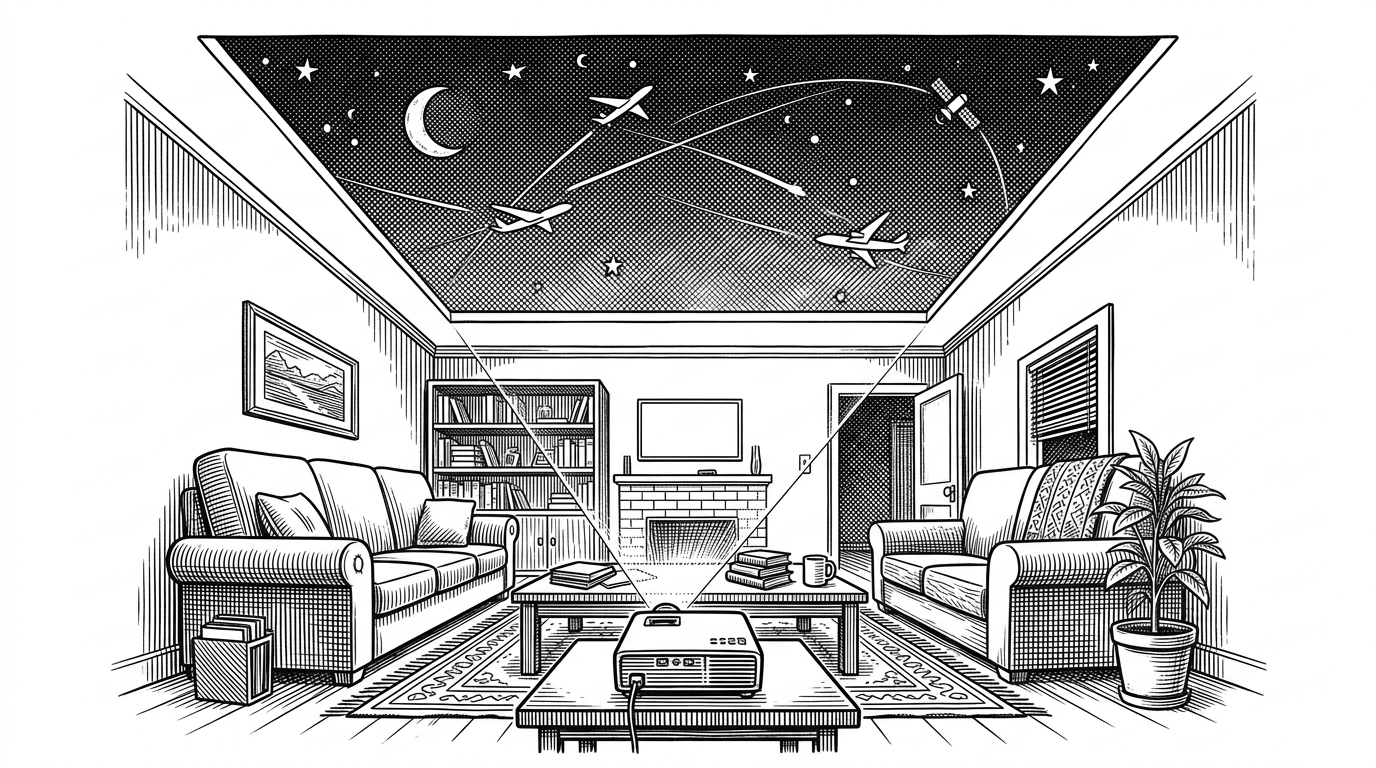

Skylight is a real-time projection of the sky above you, showing aircraft passing overhead.
- Skylight’s breakthrough is not that it tracks aircraft, but that it relocates the sky into the room with projection mapping.
- The repo turns several different data streams into one geometry, so planes, stars, satellites, and camera targets can all live in the same visual system.
- Its smoothness comes from prediction and dead reckoning, which makes sparse ADS-B updates feel like continuous motion.
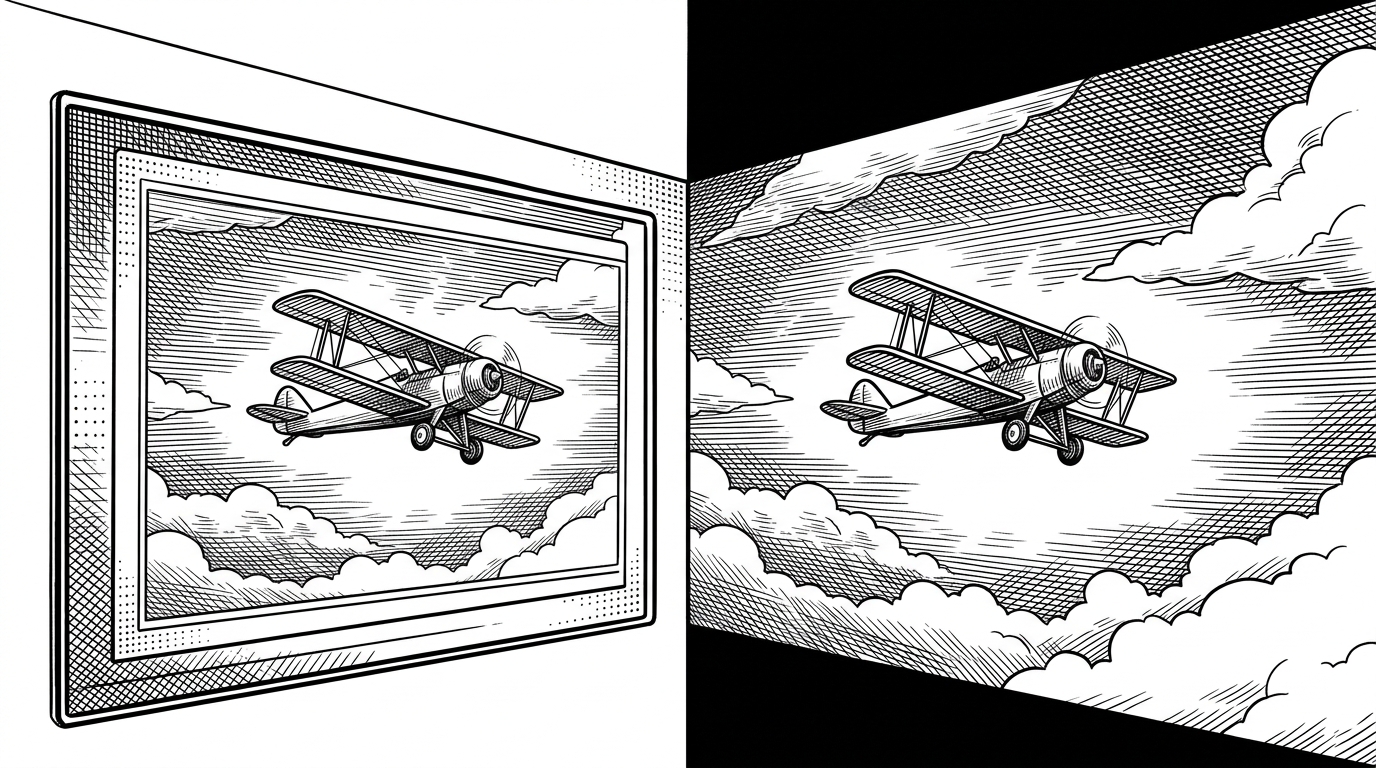
- The black UI is an optical trick, not a minimalist style choice, because it helps the projector vanish into the ceiling.
Most flight trackers are maps. Skylight is a spatial effect. It takes live ADS-B radio data, celestial math, and projection mapping, then makes them feel like one instrument: a ceiling that behaves like a transparent slice of sky.
Why Skylight feels like a window, not a dashboard
Chris Paczek’s stated goal was practical, not theatrical: he wanted to see the planes overhead and know where they were going without reaching for a small screen. That one preference changes the whole category. The project is not asking you to inspect data. It is asking you to look up.
That is why the interface is so stripped down. Skylight is tuned for projection, so the ceiling is not a surface it draws on. It is the surface it disappears into.
The effect is strongest because the content mix is broader than a flight tracker. Aircraft, the sun, the moon, stars, and the ISS all occupy the same visual language. Once everything shares the same sky, the room stops feeling like a dashboard and starts feeling like a local observatory.
How the system turns radio signals into a sky
The repo is organized around translation. A local receiver, fallback APIs, and celestial data all enter separately, but they do not stay separate for long. The server and shared TypeScript code normalize them into a single object model, then the renderer projects that model into room coordinates.
That unification matters. A plane, the ISS, and a star are not rendered as three unrelated UI widgets. They are all points or paths in the same sky system. Skylight is less a visualization app than a geometry engine with a projector attached.
// Shared idea, simplified
const local = llToMeters(aircraft.lat, aircraft.lon, observer.lat, observer.lon)
const smooth = deadReckon(local, aircraft.track, aircraft.speed, now)
const screen = projectToCeiling(smooth, roomCalibration)
render(screen)
The trick is coordinate math
Skylight only feels magical because it does a lot of boring math correctly. ADS-B updates usually arrive about once a second, which is far too slow for motion that should feel continuous. The repo solves that with dead reckoning, so the plane keeps moving between updates instead of hopping from one fix to the next.
The same unification happens in astronomy. Right ascension and declination get converted into azimuth and altitude, which makes stars and satellites legible in the same local frame as aircraft. Once everything is expressed relative to the observer, the sky becomes a single coordinate system instead of three different data products.
That is also why the ceiling mapping works. The display is not trying to simulate the entire Earth. It only needs to be right for the small patch of space above one room, which makes a flat approximation good enough and keeps the projection stable.
Why the ceiling stays smooth
The display would feel mechanical if it only showed raw updates. Instead, Skylight predicts motion, smooths the path, and uses the local geometry to keep the aircraft where your eye expects it to be. That is the difference between a feed and an illusion.
This is where the project’s design and engineering meet. The black background removes the projector’s rectangle. The motion math removes the data jitter. Together they make the ceiling feel like a continuous field, not a pile of overlays.
The result is subtle but important. You are not watching a tracking app redraw itself. You are watching motion occupy space.
Tracker mode pushes the idea into hardware and vision
Skylight’s optional PTZ camera tracker goes beyond display and into physical pursuit. The system compensates for latency, predicts where a plane will be by the time the camera finishes moving, and closes the loop with computer vision and calibration logic.
That part is ambitious, but it still serves the same thesis. The repo keeps asking the same question in different forms: how do you make a distant object feel local? In the ceiling view, the answer is projection. In tracker mode, the answer is motion control and feedback.
// Simplified idea
const target = predictFuturePosition(plane, cameraLatencyMs)
const aim = calibrateToSky(target, mountOffset)
ptz.moveTo(aim.azimuth, aim.altitude)
What Skylight is not
| Project | Primary job | Data source | Interface | What it lacks compared to Skylight |
|---|---|---|---|---|
| dump1090 | Decode ADS-B radio | Local SDR feed | Browser map or raw data | Projection-first sky rendering and celestial layers |
| Stellarium | Planetarium software | Astronomy catalogs and ephemeris | Screen-based sky simulation | Live local aircraft tracking from your own airspace |
| FlightRadar24 | Commercial flight tracking | Crowdsourced and commercial feeds | Web and mobile map | Local, room-scale projection and open source control |
| Virtual Radar Server | Local aircraft monitor | ADS-B and network feeds | Desktop/web dashboard | Ceiling projection as the primary interface |
That comparison is the key. Skylight is not trying to out-feature the big trackers, and it is not trying to out-astronomy Stellarium. It sits between categories and changes the unit of interaction from screen space to room space.
That is why the project lands so hard. It uses familiar parts, but it recombines them into something physically different. A map tells you where a plane is. Skylight makes the plane feel like it is above you.