V3SP3R turns the Flipper Zero into a conversational control plane
The Android app maps plain language to hardware actions, then wraps the whole thing in risk checks, protocol translation, and live recovery.
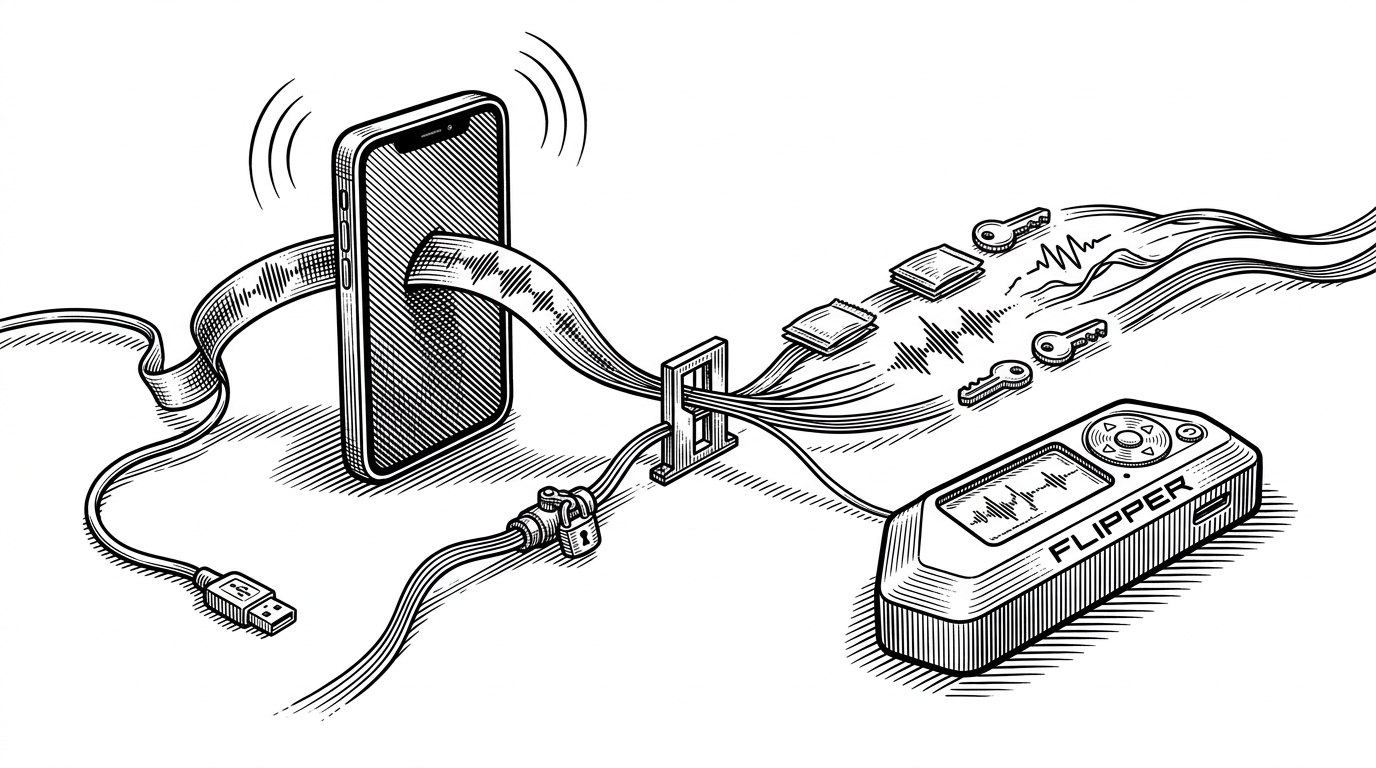
- V3SP3R is less a remote control app than a translation layer that turns language into Flipper-compatible action.
- Its most important feature is the safety gate, which classifies risk before the AI can write files or transmit signals.
- The app combines Compose UI, OpenRouter, protobuf BLE transport, and recovery tools into one Android orchestration stack.
- Compared with the official Flipper app or custom firmware, it replaces protocol fluency with conversation, but only on Android.
Most Flipper tooling still assumes the user can think like the hardware. V3SP3R flips that assumption. It lets you ask for an action in plain English, then tries to turn that intent into the right protocol, the right payload, and the right transport.
it’s called VESPER and it turns your Flipper Zero into a voice-controlled AI hacking companion. simply talk in plain language and it starts executing in real-time. no menus. no manuals. no memorizing signal formats. just speak or type.
The real trick is translation
V3SP3R comes from elder-plinius, also known as Pliny the Liberator. The project reads like a clean-architecture Android app with a very specific job: take human intent, turn it into tool calls, and move those calls across Bluetooth or USB without losing control of the blast radius.
That is why the stack matters. The UI is built in Jetpack Compose, the domain layer owns the rules, and the data side handles the messy parts, from OpenRouter calls to protobuf transport and encrypted persistence. The AGPL-3.0 license matters too, because it keeps the project open even if someone tries to turn the workflow into a service.
any Watch Dogs fans in the building? you know that feeling of hacking every device in the city from your phone? yeah. it’s real now.
What the app actually does
- It takes voice or text and turns it into a model call instead of a menu walk.
- It maps the model output to Flipper-specific commands, file actions, and payload generation.
- It checks the risk of each action before anything can transmit or write.
- It watches for failures, then uses Ops Center style recovery to test the link and retry the path.
The diagram above is the whole point of the repository. V3SP3R does not just send commands, it mediates them. The important pieces are the ones that reduce surprise: RiskAssessor for safety, OpenRouterClient for model traffic, FlipperProtocolCommandMapping for translation, and the Ops Center flow for reconnecting when the hardware or radio path stumbles.
Why the safety layer matters
This is where V3SP3R stops being a demo and becomes a serious systems problem. A read-only request is not the same thing as a file write, and a file write is not the same thing as a radio transmission. The project’s low, medium, and high risk categories acknowledge that the AI is useful only if the software refuses to treat every action as equally safe.
That is a strong design choice for hardware tooling. A bad prompt can do more than return nonsense. It can trigger the wrong frequency, overwrite a payload, or leave the user with a broken chain of assumptions. V3SP3R tries to keep those failures inside the app, where they can be checked, diffed, or retried before they hit the device.
A new project released on GitHub by notorious jailbreaker and Time 100 AI honoree Pliny the Liberator claims to give the popular, portable hacking tool an “AI brain” that lets users enter plain-language prompts to complete tasks instead of requiring them to navigate Flipper Zero’s clunky menus.
Compared with the alternatives, the interface is the product
| Dimension | Official Flipper app | Custom firmware | V3SP3R |
|---|---|---|---|
| Primary interface | Bluetooth remote control and file management | Menu-driven device interface | Natural language chat, voice, and tool calls |
| Core intelligence | Basic companion functions | Expanded device features | OpenRouter models plus command mapping |
| Safety posture | Conservative by design | Depends on firmware and user discipline | RiskAssessor gates low, medium, and high actions |
| Best for | Updates, sync, and light remote use | Power users who already know the menus | Users who want intent to become an action |
| Main tradeoff | No AI automation | Still requires protocol fluency | Android only, more moving parts, more trust required |
That tradeoff explains the lukewarm reaction around the project. V3SP3R is ambitious, but it asks for trust in the model, the transport, and the user’s own judgment. It is strongest when you want to compress expertise into a conversation, and weakest when you want a tool that behaves like a fixed, boring appliance.
The more interesting signal is not whether every Flipper owner should use it. It is that hardware tools are starting to inherit the same pattern as modern software: language in front, policy in the middle, machine at the end. V3SP3R is a clean, opinionated version of that shift.