The $9 Through-Wall Radar: Inside RuView
How a Rust-powered edge mesh turns raw WiFi signals into real-time human pose maps without a single lens.
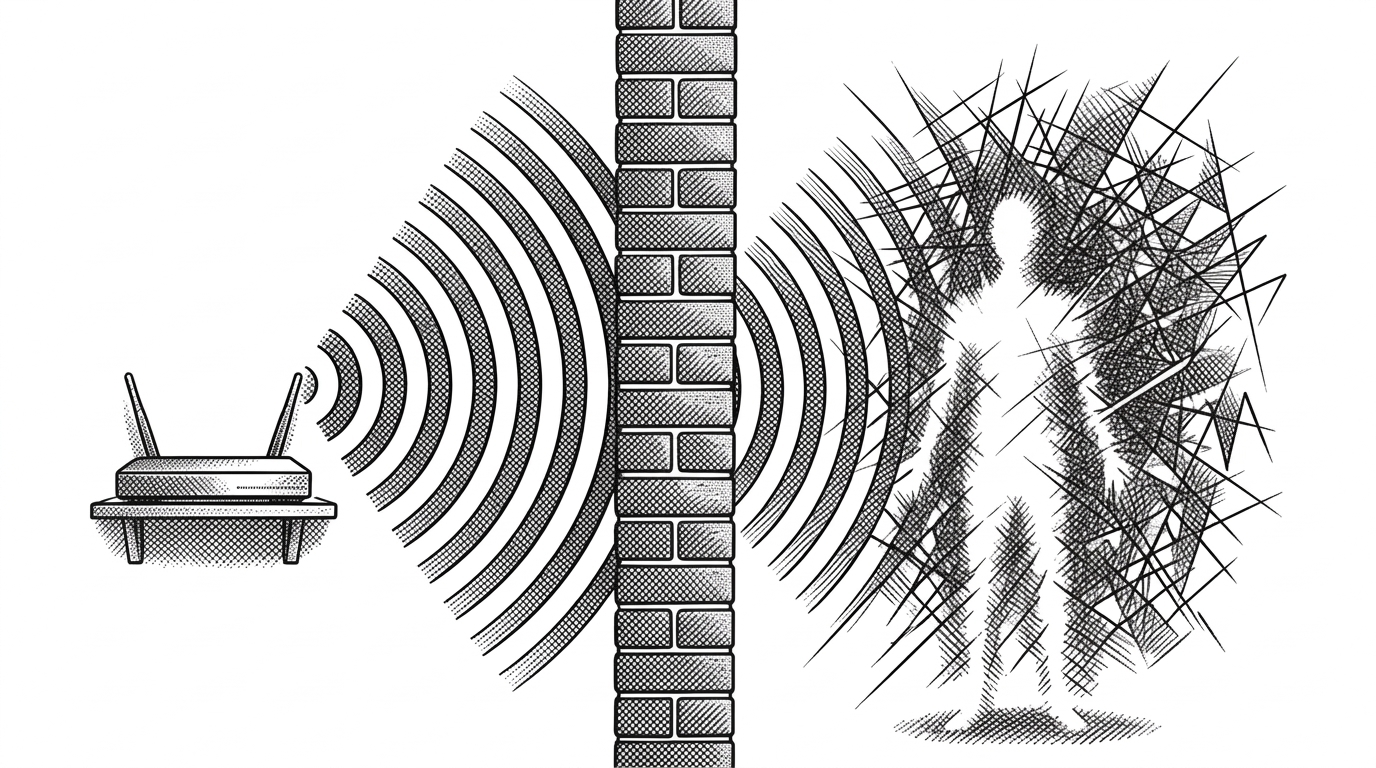
- RuView extracts Channel State Information from standard WiFi packets to map 17-keypoint human poses through solid walls.
- The system achieves 54,000 frames per second by running a specialized Rust signal processing pipeline on a $9 ESP32-S3 microcontroller.
- A swarm of specialized AI agents manages the complex mathematical refinements and high-dimensional RF data optimization within the repository.
- The project moves WiFi sensing from academic theory to local edge deployment without requiring external GPUs or cloud connectivity.
The End of the Camera
Indoor tracking has always presented a brutal compromise. You can either deploy cameras and sacrifice privacy, or you can use standard motion sensors and sacrifice fidelity. There is rarely a middle ground.
RuView eliminates this compromise entirely. It is an open-source system that achieves military-grade, through-wall radar capabilities using commodity microcontrollers. By capturing and processing the ambient radio frequency disturbances in a room, it creates a real-time map of human movement.
This is not simple proximity detection. RuView translates invisible radio waves into 17-keypoint human body poses. It can monitor breathing rates and detect falls through solid walls. It delivers the perceptual fidelity of a camera with the mathematical anonymity of a radar.
What Lucius Fox called “beautiful, unethical, dangerous” is now a peer-reviewed paper on arXiv. ... Then someone built the deployable version. Open-source. MIT-licensed. Runs on a $9 microcontroller. No cameras. No cloud. No internet connection required. That project is called RuView
Reading the Radio Ripples
Most wireless systems measure signal strength using RSSI (Received Signal Strength Indicator). RSSI is a blunt instrument. It tells you how loud a signal is, but nothing about the room it traveled through.
RuView operates on a much deeper level. It extracts Channel State Information (CSI). When a WiFi packet is transmitted, it is spread across dozens of subcarriers. As a human body moves through the physical space, it acts as a bag of water that absorbs and reflects these subcarriers differently.
CSI provides a fine-grained matrix of these phase and amplitude shifts. By analyzing this matrix, RuView can map the exact physical contours of the environment. The room itself becomes the sensor.
A 54,000 FPS Rust Pipeline
Processing CSI data requires massive computational bandwidth. The raw data flows in at high frequencies, demanding a system that can handle continuous, heavy mathematical transformations without dropping frames.
RuView solves this by pushing the intelligence to the absolute edge. It targets the ESP32-S3 microcontroller. The architecture separates concerns across the chip's dual cores. Core 0 handles the high-interrupt WiFi callbacks, capturing the raw radio data. Core 1 is strictly dedicated to the digital signal processing pipeline.
The backbone of this pipeline is written in Rust. It utilizes specialized graph partitioning algorithms to separate human motion from background noise. This Rust implementation achieves an astonishing 54,000 frames per second, allowing the $9 chip to perform real-time sublinear optimization on the fly.

Architected by the Swarm
Perhaps the most unusual aspect of RuView is how it is built. The repository contains an extensive `.claude/agents` directory. This is not just a collection of helper scripts. It is a defined organizational structure of specialized AI personas.
These agents are tasked with maintaining the complex physics algorithms. A `matrix-optimizer` agent, for example, is specifically tuned to handle the high-dimensional RF data math. The project uses these autonomous entities to aggressively refactor code, manage technical debt, and ensure the Rust pipelines remain fiercely optimized.
It is a self-architecting system. Human developers guide the domain-driven design, while a swarm of specialized agents executes the sub-millimeter mathematical refinements required to make WiFi sensing work in the real world.
The Cost of Coherence
WiFi sensing is not a new concept. Academic institutions have published papers on it for years. What makes RuView significant is its deployment model. It bridges the gap between high-end academic theory and accessible, deployable hardware.
| Feature | RuView | Academic Precursors | Standard CSI Tools |
|---|---|---|---|
| Approach | Self-learning edge embeddings | Supervised learning (Camera-to-WiFi) | Raw data collection only |
| Hardware | Commodity ESP32-S3 (~$9) | High-end NICs + GPUs | ESP32 / ESP8266 |
| Processing | Real-time (Edge) | Often post-processed | Requires external PC |
| Privacy | Local-only (No Cloud) | Research-focused | Local-only |
By relying on standard 802.11 packets rather than specialized FMCW radar, RuView democratizes spatial computing. It proves that the physical world can be mapped, monitored, and understood using the ambient signals already bouncing around our homes.
Sources: RuView GitHub Repository, DensePose From WiFi (CMU), Medium coverage by Sage Khan.