ArduPilot: The Open-Source Autopilot That Learned to Fly, Drive, and Dive
A look inside the portable control stack that lets one C++ core power copters, planes, rovers, and submarines with hard real-time discipline and a surprisingly flexible mode system.
- ArduPilot turns autonomy into a portability problem, then solves it with a shared control core that spans copters, planes, rovers, and subs.
- AP_HAL, mode objects, and the scheduler form the project's real architecture: hardware stays behind an interface, behavior lives in swappable controllers, and time stays tightly managed.
- Its maturity shows up in the unglamorous parts, including boot order, failsafes, logging, simulation, and replay for postmortems.
- The repo reads less like single-purpose firmware and more like open-source robotics infrastructure built to survive messy hardware and messy reality.
One codebase, four vehicle classes, many hardware targets
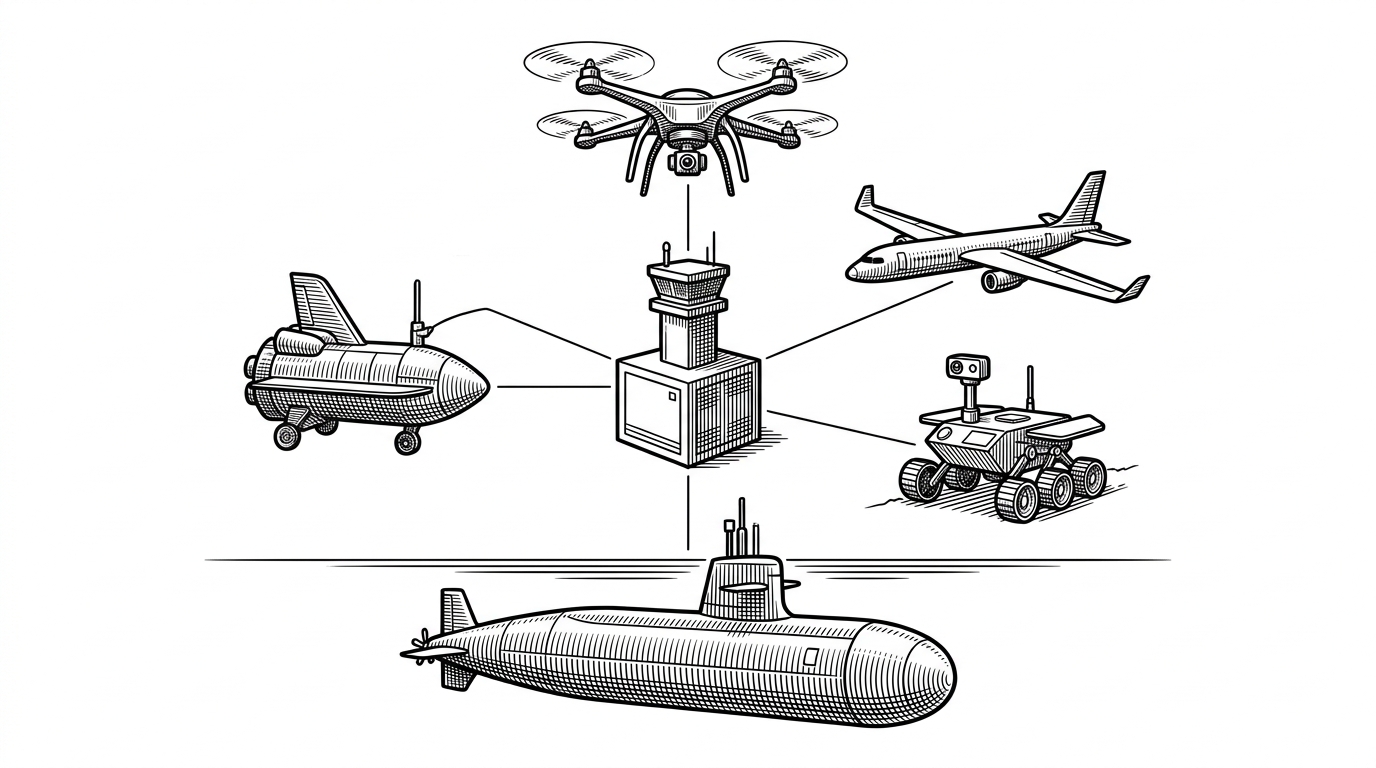
ArduPilot's first surprise is breadth. It is not one drone app with a few presets. It is a family of vehicle stacks for Copter, Plane, Rover, Sub, and Tracker, all orbiting a shared codebase. That makes the project feel less like firmware and more like a universal control layer for robots that move through different worlds.
That scope changes the question. The interesting problem is no longer, "How do you stabilize a quadcopter?" It is, "How do you keep a single architecture useful when lift, friction, drag, buoyancy, and mission logic all change underneath you?"
| Dimension | ArduPilot | Single-vehicle autopilot | Proprietary stack |
|---|---|---|---|
| Vehicle breadth | Air, land, and underwater vehicles | Usually one vehicle family | Often one product line or ecosystem |
| Hardware portability | High through AP_HAL | Moderate to low | Tied to vendor hardware |
| Behavior model | Mode-based controllers | Often fixed mission logic | Varies, usually closed |
| Timing discipline | Scheduler-driven real-time work | Depends on implementation | Often hidden from users |
| Simulation and replay | SITL and log replay | Sometimes partial | Usually limited access |
| Extensibility | Lua scripting and modules | Patch-and-rebuild | Controlled by vendor policy |
The portability layer that makes the whole project possible
The key abstraction is AP_HAL, ArduPilot's hardware layer. It keeps the flight logic from caring whether the target is a microcontroller, a Linux board, or another supported runtime. That separation is the reason the same project can move across boards without every hardware port becoming a private fork.
class Mode {
public:
    virtual bool allows_arming() const = 0;
    virtual bool requires_position() const = 0;
    virtual void run() = 0;
};

Mode *mode_from_mode_num(uint8_t mode_num) {
    switch (mode_num) {
    case MODE_STABILIZE: return &mode_stabilize;
    case MODE_AUTO:      return &mode_auto;
    case MODE_LOITER:    return &mode_loiter;
    case MODE_RTL:       return &mode_rtl;
    default:             return &mode_stabilize;
    }
}
That object model matters because a flight mode is not just a menu selection. It is a controller with its own rules about arming, position requirements, and acceptable behavior. The system can switch from manual stabilization to autonomous mission logic by swapping the active mode object, not by rewriting the whole vehicle.
| Property | What it means in ArduPilot | Why it matters |
|---|---|---|
| Mode is an object | Each flight behavior has methods and gates | Behavior stays modular |
| Mode is not a flag | The system can enforce rules per mode | Safety is built into transitions |
| Mode switch is runtime | Controllers can change without rebooting | One stack supports many missions |
The scheduler is the heartbeat
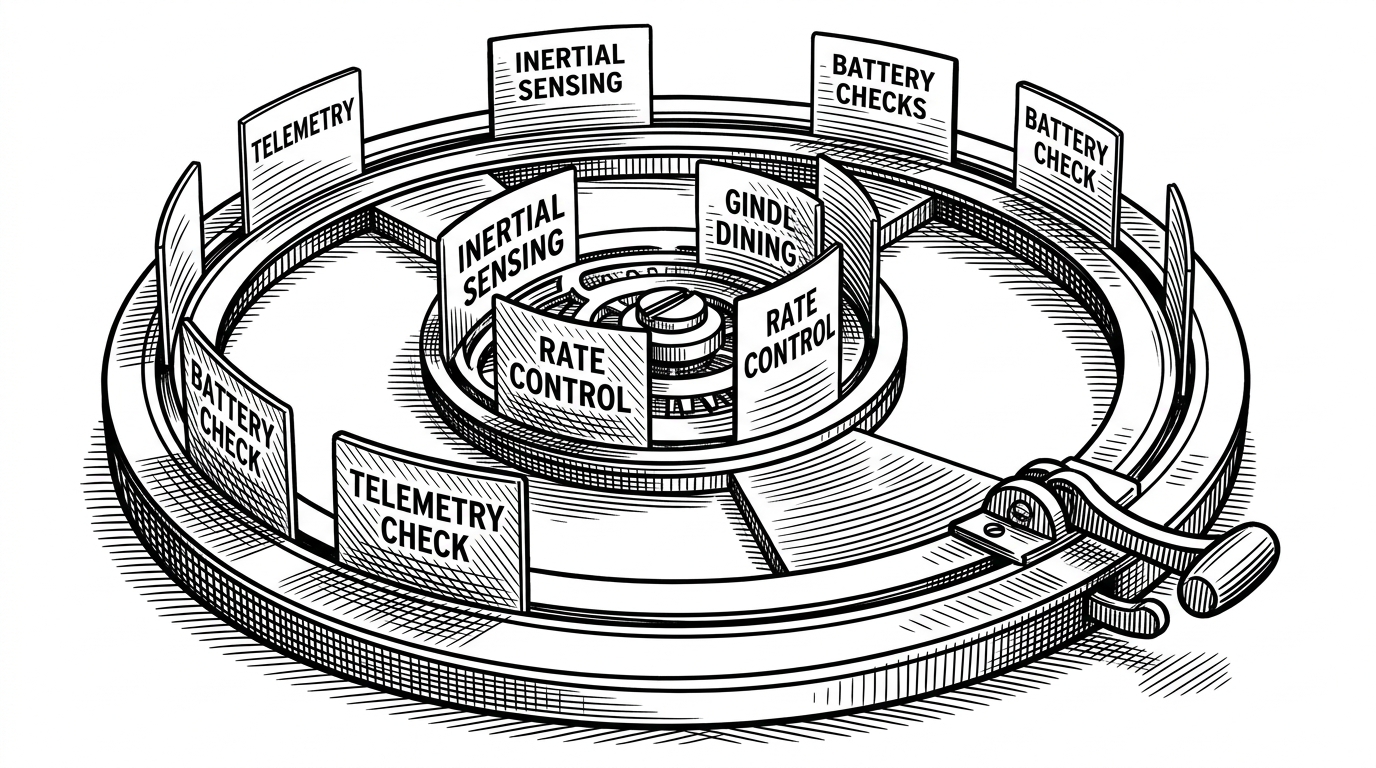
ArduPilot's scheduler is where the project stops looking like ordinary application code. Fast control work, like inertial updates and rate control, has to happen on deadline. Slower work, like telemetry and battery checks, can wait. That timing hierarchy is the difference between a stable vehicle and a crash.
The important idea is not just that tasks run often. It is that frequency is part of the architecture. If the scheduler misses the wrong window, the vehicle does not merely lag. It loses the ability to stay upright, track attitude, or respond cleanly to sensor input.
static const AP_Scheduler::Task scheduler_tasks[] = {
    { "ins.update",            400,  2000 },
    { "rate_controller",       400,  1000 },
    { "attitude_control",      200,  1500 },
    { "telemetry",              50,  3000 },
    { "battery_check",          10,  5000 },
};
Seen this way, ArduPilot is not "real-time" as a slogan. It is real-time as an accounting system, where every task has a budget and some budgets are non-negotiable.
Startup order and failsafes are not afterthoughts
The boot path is carefully staged. Sensors, power, serial links, RC input, GPS, and compass do not just appear all at once. ArduPilot brings them up in a deliberate sequence so that the vehicle becomes trustworthy in steps, not in a single optimistic jump.
Failsafes extend that logic into bad conditions. A timer-based watchdog can intervene if the main loop hangs, which turns a software stall into a recoverable event instead of a silent failure. In a control system, that is not defensive coding. It is the difference between inconvenience and damage.
void init_ardupilot() {
    notify_init();
    battery_init();
    barometer_init();
    serial_init();
    rc_input_init();
    gps_init();
    compass_init();

    hal.scheduler->register_timer_failsafe(failsafe_check_static, 1000);
}
Why ArduPilot looks more like infrastructure than firmware
ArduPilot's scale comes from the boring things done well. It has simulation in SITL, logging, replay, a dense test matrix, and enough compile-time gating to fit a huge feature set into constrained hardware. That combination makes it closer to robotics infrastructure than to a single-purpose embedded binary.
The comparison with narrower stacks is telling. A single-vehicle autopilot can optimize for one frame and one use case. A proprietary stack can optimize for product control. ArduPilot has to optimize for portability, transparency, and long-term maintainability across a scattered ecosystem. That is a harder problem, and it is why the project feels unusually durable.
The only place I could fly and test the early versions of Ardupilot was on Corona Heights in SF – June 2009. Luckily no crashes in populated areas... https://t.co/Lvn73tMwQr
The open-source autopilot test that matters most: replay
Replay is the most revealing part of the project's operational culture. A real-world flight log can be fed back into a simulator, which turns a crash or anomaly into something reproducible. That means debugging is not limited to guesswork after the fact. It becomes an engineering loop.
This is where ArduPilot's black-box quality shows up. It does not just fly vehicles. It records enough of what happened to let the team ask, with precision, what the system believed when it made a bad decision.
| Postmortem approach | What you get | What you lose |
|---|---|---|
| Read the log by hand | Broad context | Reproducibility |
| Replay the log in SITL | Deterministic rerun | Less ambiguity |
| Infer from hardware only | Real sensors | Harder debugging |