Stockfish: The 64-Bit Sovereign
How a distributed army of CPUs and a "tiny" neural network won the war for chess supremacy.
- Stockfish uses NNUE to run neural network evaluations directly on CPUs by only updating the specific parts of the network affected by a move.
- The Fishtest framework requires every code change to prove a statistically significant Elo gain through tens of thousands of automated games.
- Bitboard data structures allow the engine to calculate complex piece movements and attacks using single-instruction bitwise operations.
- Aggressive Alpha-Beta pruning allows the engine to ignore the vast majority of possible moves by prioritizing the strongest candidates first.
The Neural Network That Lives in a CPU
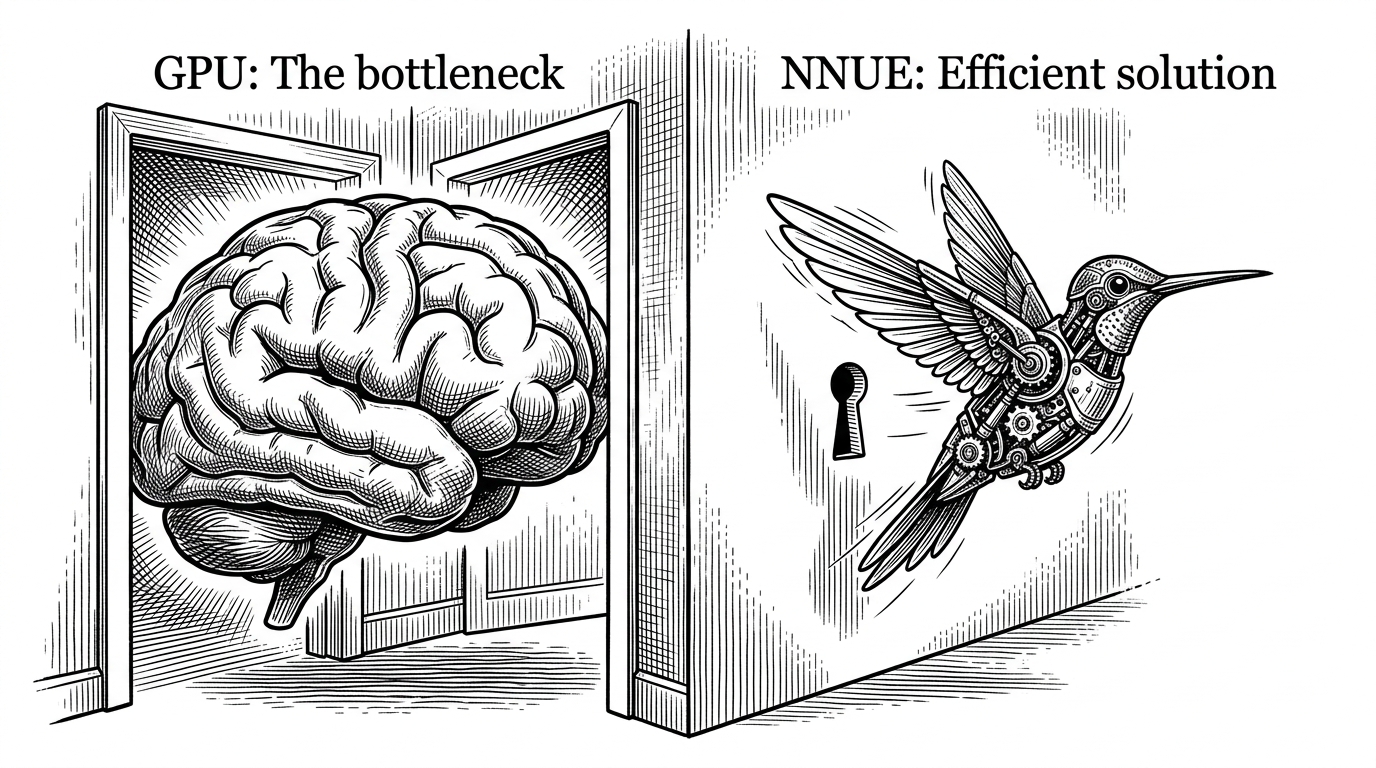
The most significant technical shift in Stockfish's history isn't a new search algorithm; it's the adoption of NNUE (Efficiently Updatable Neural Networks). While the rest of the AI world moved toward massive, power-hungry neural networks running on GPUs (like AlphaZero and Leela Chess Zero), Stockfish took a different path.
NNUE is designed to run efficiently on a standard CPU. It uses a shallow neural network that is "efficiently updatable." When a piece moves on the board, the engine doesn't recalculate the entire network from scratch. Instead, it only updates the parts of the input layer affected by that specific move's "delta."
NNUE lets the engine combine fast neural-network positional evaluation with Stockfish’s search, giving a large Elo leap without sacrificing speed.
This hybrid approach allows Stockfish to evaluate tens of millions of nodes per second while benefiting from the "intuition" of deep learning. It's an AI inference engine running faster than most applications can do simple arithmetic.
Proof by Ten Billion Games
Stockfish isn't just a codebase; it's a distributed supercomputer. Every proposed code change must survive Fishtest, an enormous distributed testing framework where volunteers donate their idle CPU cycles.
Fishtest uses a Sequential Probability Ratio Test (SPRT). A developer can't just claim their code is better; they must prove it yields a statistically significant Elo gain (often as small as 2 Elo points) over tens of thousands of automated games. If the math doesn't check out, the pull request is rejected, regardless of how elegant the code is.
Bitboard Sorcery
Underneath the neural network and the distributed testing lies the raw, uncompromising speed of C++. Stockfish represents the 8x8 chessboard not as a 2D array, but as a series of 64-bit integers called Bitboards.
Every piece type and color gets its own 64-bit integer. A '1' bit means a piece is there; a '0' means it isn't. This allows the engine to perform complex geometric calculations—like "is the king in check?"—using single CPU instructions like bitwise AND, OR, and XOR.
The crowning achievement of this system is "Magic Bitboards." By using precomputed hash tables and bitwise multiplication, Stockfish can calculate the sliding attacks of Rooks and Bishops in O(1) time, instantly accounting for blocking pieces.
The Art of Ignoring Everything
Chess has more possible games than there are atoms in the observable universe. You can't calculate everything. Stockfish wins by aggressively pruning the search tree—ignoring 99% of possible moves using Alpha-Beta search.
The secret to Alpha-Beta pruning is move ordering. If you look at the best move first, you can immediately discard the rest of the branches. Stockfish's MovePicker class is a ruthless triage unit.
The `MovePicker` class generates and orders moves one at a time, rather than generating all moves upfront. This lazy evaluation allows the search to benefit from early cutoffs without the overhead of scoring moves that will never be examined.

The Hardware Schism: CPU vs. GPU
The chess engine landscape is currently divided by hardware. While Stockfish optimizes for the CPU, engines like Leela Chess Zero (Lc0) require powerful GPUs to run deep convolutional neural networks.
| Feature | Stockfish | Leela Chess Zero (Lc0) |
|---|---|---|
| Search Algorithm | Alpha-Beta Pruning | Monte Carlo Tree Search (MCTS) |
| Evaluation | NNUE (Efficiently Updatable Neural Net) | Deep Convolutional Neural Network |
| Hardware Focus | CPU (Highly optimized C++) | GPU (CUDA/OpenCL) |
| Nodes Per Second | Tens of millions | Tens of thousands |
Stockfish's approach ensures superhuman analysis is available to anyone with a standard laptop, democratizing top-tier chess preparation.
From Glaurung to Greatness
Stockfish's lineage is surprisingly humble. It began as an open-source fork.
In 2008 Italian programmer Marco Costalba forked Glaurung, and the new project was named Stockfish — “produced in Norway and cooked in Italy,” as the joking origin line goes.

Today, Stockfish continues to push the boundaries of what is possible on a CPU. Recent versions have refined the neural network even further.
The standout feature is SFNNv10, featuring “threat inputs” that explicitly flag piece attacks and defenses, bypassing indirect inferences.
Stockfish isn't just a chess engine; it's a testament to the power of open-source collaboration, extreme performance engineering, and the refusal to believe that a CPU can't compete in an AI world.