courseware-embedded-machine-learning: The Filename Is the Database: How Edge Impulse Teaches TinyML
A courseware repo mostly made of PowerPoints and notebooks. One Python script turns their filenames into a navigable course index.
- Edge Impulse's embedded ML courseware is a folder of slides, readings, and notebooks whose entire navigation layer is generated from filenames.
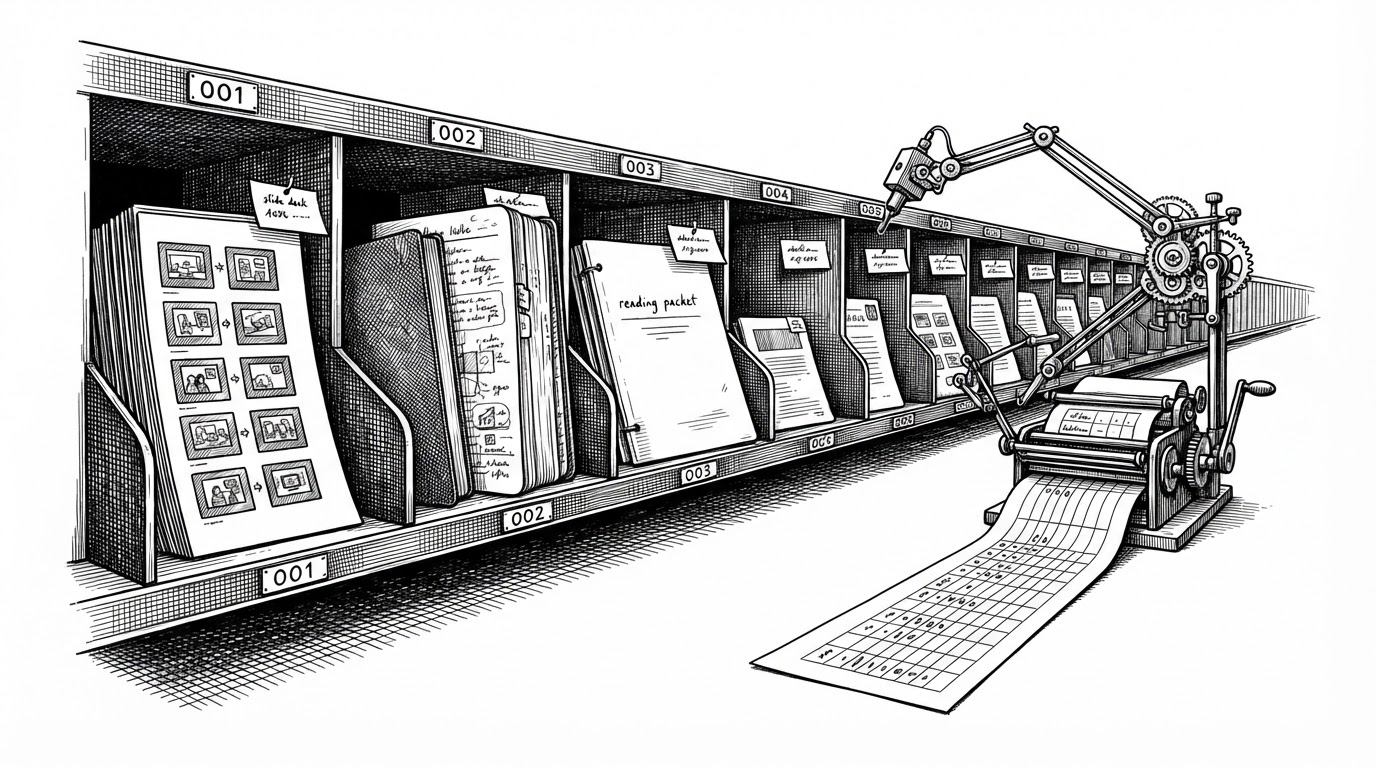
- A single roughly 100-line Python script parses each filename as a structured record, so dropping a file into a module folder adds a row to that module's index.
- The naming convention encodes pedagogical order, display text, license provenance, and link behavior in one token, which is why the folder reads like a schema.
- It is built for instructors to remix rather than students to consume, which is why three CI pipelines police link rot, spelling, and markdown formatting.
The Filename Is the Database
Open a module folder in edgeimpulse/courseware-embedded-machine-learning and you see a flat pile of files. Look closer and you see a record format. Every file is named to the same pattern, spelled out in the header of the one Python script in the repo: [module].[section].[resource].resource-name.[attribution].[extension].
Take 1.1.3.what-is-tiny-machine-learning.3.pptx. The first three fields are integer sort keys. The fourth is the display text. The fifth points at a license footnote. The sixth tells the index generator what kind of link to write. There is no frontmatter, no config file, no CMS. The filename is the row.
# utils/autogen-tables.py (representative of the described logic)
files = [f for f in os.listdir(directory) if not os.path.isdir(f)]
parsed = [f.split('.') for f in files]
parsed.sort(key=lambda x: (int(x[0]), int(x[1]), int(x[2])))

for p in parsed:
    desc = p[3].replace('-', ' ').capitalize()
    ext = p[-1]
    if ext in ('docx', 'pptx'):
        url = f"{base}/{'.'.join(p)}?raw=true".replace(' ', '%20')
    elif ext == 'ipynb':
        url = colab_url(p)
    else:
        exit()
    attr = attr_urls[p[4]]
That is the whole engine. os.listdir() returns a folder listing. split('.') turns each name into fields. The tuple sort key reorders them numerically, so 1.10 lands after 1.9 instead of before it. The extension drives link dispatch: .pptx and .docx become ?raw=true downloads, .ipynb becomes a Colab URL, and anything unrecognized calls exit() and stops the build.
The fragility is part of the design. A stray dot anywhere in a resource name corrupts the parse, because split('.') has no way to know which dot is structural. An unknown extension halts the script outright rather than writing a broken link. And desc.capitalize() lowercases everything after the first character, so an acronym like TinyML would render as Tinyml. The authors avoid acronyms in filenames, which is why nobody has tripped over it.
This repository houses a collection of slides, reading material, project prompts, and sample questions to get you started creating your own embedded machine learning course.
What This Repo Actually Is
Eight modules, roughly one per week: an intro to ML, deep learning basics, the ML workflow, model deployment, anomaly detection, image classification with CNNs, object detection, and keyword spotting. The large majority of files are .pptx and .docx (slides, readings, quizzes, project prompts), with about twenty Jupyter notebooks layered in for the hands-on parts.
Three CI workflows run against all of it. One checks every link recursively, one lints the markdown, one runs a spellcheck against a custom wordlist. For a folder of PowerPoints, that is more quality control than most codebases bother with.
The framing matters. This is an instructor-facing archive, not a learner-facing course. The README is explicit that it is not a complete semester, and it invites educators to pull modules, rearrange them, and make modifications. The polished, sequenced version of this material lives on Coursera. The repository is the substrate underneath it.
Please note that the content in this repository is not intended to be a full semester-long course.
Why an ML Company Built a University
Edge Impulse sells a platform for building and deploying ML on edge devices. Teaching is a distribution strategy that also happens to be genuinely useful: if instructors teach with your tooling, their students arrive already fluent. The company's University program is that bet, and this repository is its reusable half.
The Coursera announcement names the people and partners: instructor Shawn Hymel, plus Coursera, Arm, Arduino, and the tinyML Foundation. The exercise board is the Arduino Nano 33 BLE Sense, and the course assumes no prior machine learning background.
Generating illustration...
The course will give you a broad overview of how machine learning works in embedded systems, how to train neural networks, and how to deploy those networks to microcontrollers.
The Three Licenses
If you want to remix this material, the first thing to check is also the least obvious. Three different licenses govern three different layers, and they are not stated in the same place.
| Layer | License | Where it is stated |
|---|---|---|
| Repository as a whole | BSD-3-Clause-Clear | GitHub repository metadata |
| autogen-tables.py | Apache 2.0 | Header comment inside the script |
| Slides, questions, prompts | CC BY-NC-SA 4.0 | README, unless otherwise noted |
| Linked YouTube videos | YouTube standard license | README |
The non-commercial clause on the content is the one that trips people up. An instructor can adapt the slides for a class. A company cannot fold them into a paid product. That distinction is exactly the kind of thing a courseware repo has to get right, and it is buried one level below where most people stop reading.
Inside the Notebooks: Gradient Descent by Hand
The notebooks are where the pedagogy gets specific. 2.1.9.minimizing-loss.3.ipynb teaches the training loop without any high-level shortcut. No model.fit(). Instead, a manual gradient step makes the chain rule and the weight update visible line by line.
def train(model, inputs, outputs, learning_rate):
  with tf.GradientTape() as t:
    current_loss = loss(model(inputs), outputs)
    dw, db = t.gradient(current_loss, [model.w, model.b])
    model.w.assign_sub(learning_rate * dw)
    model.b.assign_sub(learning_rate * db)
    return current_loss
The model is a plain Python class wrapping two tf.Variable objects. The data is six points on the line y = 2x - 1, and the notebook starts from a deliberately wrong guess of w = 10, b = 10, then plots how the parameters walk toward the true values over 50 epochs. Students watch the loss fall instead of trusting a function call.
It is not flawless. The Colab badge at the top of that notebook links to its sibling 2.1.8.exploring-loss.3.ipynb, not to itself, an apparent copy-paste. The lesson still lands, but it is a reminder that this is teaching material maintained by hand, not a product with a release process.
The Comparison
The honest way to place this repository is by category, not by popularity. It is not competing with a runtime or a guided course. It is a different kind of object, and the table makes that clear.
| Format | Who it's for | What it teaches through | |
|---|---|---|---|
| Edge Impulse courseware (this repo) | Modular .pptx / .docx / .ipynb archive | Instructors remixing a course | Filename-indexed modules plus Edge Impulse platform workflow |
| Harvard TinyML education | Course material and notebooks | Learners and instructors | TensorFlow Lite, quantization, theory |
| TensorFlow Lite for Microcontrollers | C++ runtime | Embedded developers | Inference on microcontrollers |
| Edge Impulse Coursera course | Guided video course | Individual learners | Structured progression on the Arduino Nano 33 BLE Sense |
| Edge Impulse Edge AI on Linux | Adjacent course | Learners on Linux edge platforms | Non-microcontroller edge deployment |
Star counts are meaningless across these rows. A runtime, a guided course, and a module archive have nothing in common to count. The comparison that matters is what each one hands you: a binary, a sequence, or a pile of parts you can reassemble.