expo/skills: The Repository That Trains AI Agents to Code the Expo Way
Official Expo skills turn docs into executable guidance, so AI assistants stop freelancing and start following the same workflows the core team trusts.

- Expo Skills is not just documentation because it acts like a control layer that steers agent behavior toward official workflows.
- The repo combines opinionated instructions, reference material, and validation scripts so AI can be corrected instead of merely informed.
- Its biggest strategic move is to narrow choices early, especially by steering agents toward Expo Go unless a custom build is truly needed.
- Compared with generic AI help, Expo Skills is less about clever answers and more about enforcing a supported operating model.
Expo/skills is not a docs repo in the normal sense. It is a behavioral layer for AI assistants, built to make them follow Expo’s preferred paths instead of improvising from stale training data. That makes the project feel closer to policy software than content.
The Real Product Is Not the Docs
The headline idea is straightforward: Expo is turning documentation into active infrastructure. The repo packages official instructions for specific workflows, then gives agents enough structure to stay inside the lane.
That matters because mobile frameworks punish vague advice. A generic model can describe Expo, but it cannot reliably keep up with API deprecations, route conventions, build constraints, or the difference between a supported path and a clever dead end.
Expo Skills are structured instruction files that teach AI agents how to build, deploy, and debug Expo and React Native apps accurately and efficiently.
How Expo Turns Rules Into Agent Behavior
The repo’s core pattern is simple and effective. Each skill contains a SKILL.md file that behaves like an extension of the system prompt, plus deeper reference files that explain the details when the agent needs them.
The language is deliberately forceful. Words like NEVER and CRITICAL do real work here: they set hard boundaries around deprecated APIs, preferred libraries, and the order of operations for common tasks. Expo is not asking the model to be creative first. It is asking it to be correct first.
# Typical workflow in the skills repo
bunx skills add expo/skills

# Then the agent can follow Expo-specific guidance
# and run validation scripts against local config.
The Validation Layer Makes It More Than Prompting
This is where the repo becomes more than carefully written instructions. The skills include executable scripts that fetch schemas, validate local files, and check developer config against official rules.
That shift is the point. A prompt can suggest the right answer. A validator can tell you whether the answer actually survives contact with the real project.
In the CI and workflow skills, the scripts do the unglamorous but important work: fetch the latest schema, compare it with local definitions, and surface mismatches before they become build failures. For an AI assistant, that means fewer confident mistakes and more bounded correction.
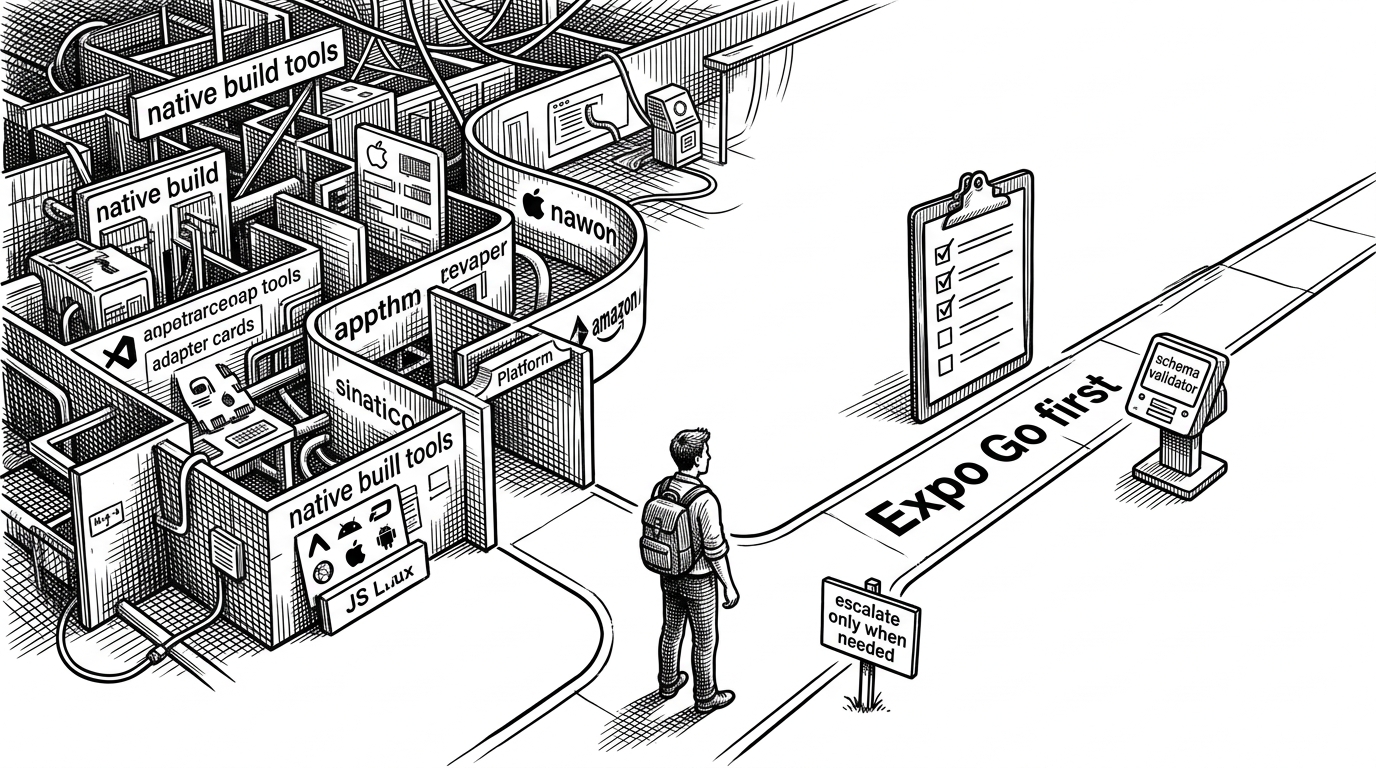
Why Expo Go First Is Such a Strong Constraint
This repo is opinionated in a way that matters operationally. It pushes agents toward Expo Go unless a custom build is genuinely required, which keeps recommendations inside the supported path for longer.
| Question | Generic AI advice | Expo Skills |
|---|---|---|
| What should I start with? | It may jump to the most powerful option. | Use Expo Go first unless there is a clear native requirement. |
| How does it choose APIs? | It may mix old and new guidance. | It prefers current Expo conventions and avoids deprecated choices. |
| How do I know it is right? | You mostly trust the answer. | You can validate against official schemas and scripts. |
| What is the failure mode? | Confident but stale recommendations. | Narrower, more conservative, and easier to correct. |
That constraint is strategic. Every time the repo narrows the solution space, it also reduces support burden, avoids premature complexity, and makes the AI assistant feel more like a guided operator than a brainstorming partner.
What This Changes for Mobile Teams
For teams shipping on Expo, the practical win is consistency. You no longer have to hope a model remembers the latest conventions or correctly infers the preferred route from general web knowledge.
Instead, the team can point the agent at an official playbook. That playbook tells the model what to favor, what to avoid, how to validate, and when to stop escalating complexity.
The broader implication is bigger than Expo itself. If this pattern works, more frameworks will ship their own skills, and the repository will stop being the place where documentation lives. It will become the place where machine behavior is governed.
Expo Skills vs. Generic AI Help vs. MCP
The cleanest way to understand this repo is as one layer in a stack. Skills teach the agent how to reason. MCP gives it tools to act. Validation scripts close the loop by checking whether the action matches the official shape.
| Layer | What it does | Best at |
|---|---|---|
| Generic AI help | Predicts useful text from context | Quick answers and broad explanation |
| Expo Skills | Encodes official Expo workflows and preferences | Guiding the model toward supported choices |
| MCP | Connects the agent to live tools and services | Running commands, fetching logs, taking action |
| Validation scripts | Check output against schema and local reality | Catching drift before it becomes failure |
Skills teach AI how to think and correctly, MCP gives AI tools to act automatically
That distinction is the heart of the project. Expo is not betting on more chat. It is betting on a tighter contract between guidance, tooling, and verification.