NeonClipping Picks the Clip Before It Downloads the Video
A local-first clipper from a Jaipur filmmaker scores loudness, raised voices, and motion, then pays bandwidth for only the seconds it keeps.
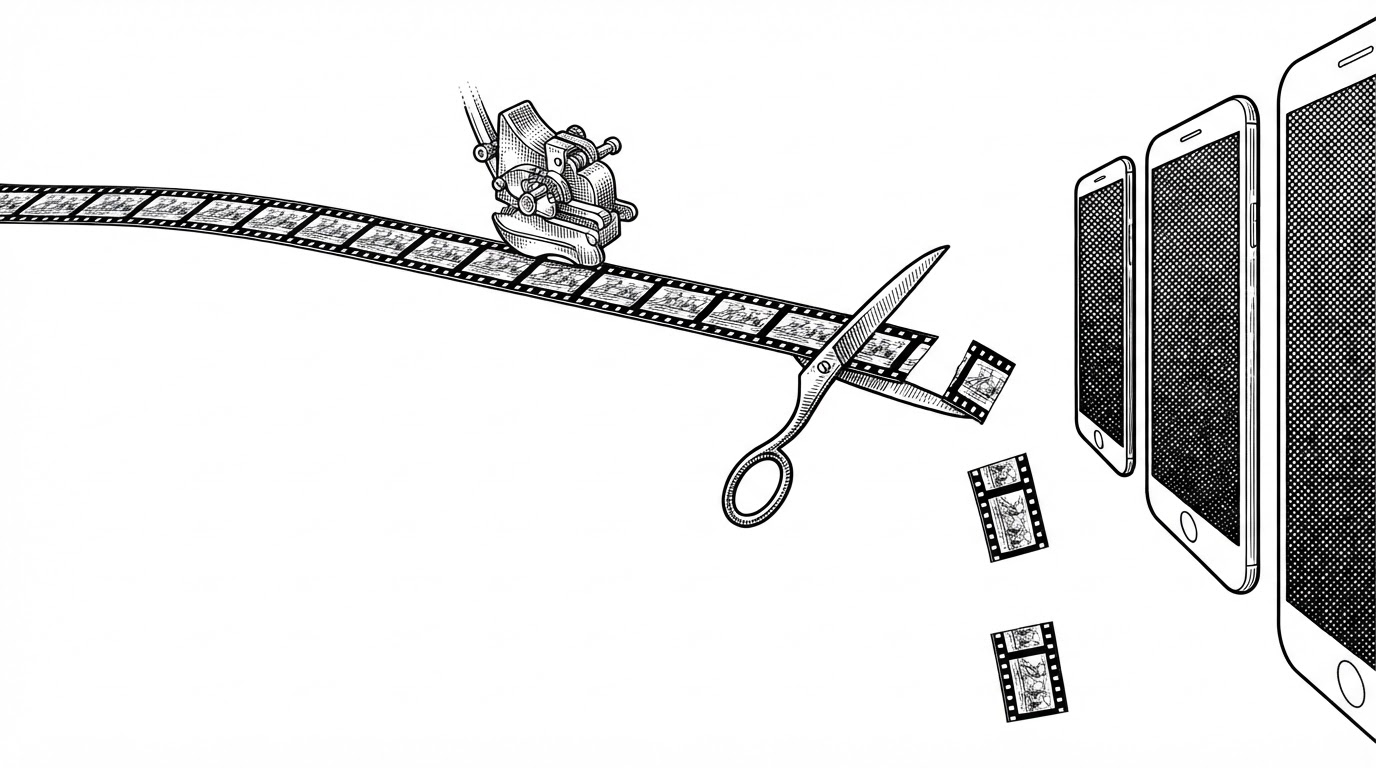
- NeonClipping decides which moments to keep from the audio track alone, then downloads only the seconds it needs.
- Its moment finder uses rolling z-scores and an FFT band ratio, not an ML model.
- Every quote and number the LLM produces is checked verbatim against the transcript before it reaches a clip.
- The project is local-first and creator-first, with Hindi and Hinglish caption support built in rather than bolted on.
The Clip Comes Before the Download
Most clippers work the same way. You hand over the entire video, the service pulls it down or you push it up, and only then does it decide which parts were good. NeonClipping inverts the order. It reads the audio track and YouTube's own captions, ranks candidate moments, and only then fetches the narrow ranges it plans to keep.
Everything else follows from that single decision. Because the decision is cheap, the pipeline is fast. Because the video never leaves your machine, there is no account and no upload. Because the deciding happens locally, there is no per-clip cost.
- 85 minutes in, 97 seconds out (self-reported on an RTX 2060)
- 0 bytes uploaded
- 11 vertical layouts
- MIT licensed
The 97-second figure is the author's own measurement on one machine, not an independent benchmark. The README is explicit that results depend on network and CPU. Read the number as a demonstration of the mechanism, not a promise.
Paste a link. Get captioned 9:16 clips in about two minutes. Free, local, open-source.
How It Decides Without Watching
The fast mode never looks at the picture. It listens. Four signals come out of the audio track: loudness, raised voice, and in deep mode motion and scene cuts. Each is scored per second, normalized, and combined.
The weights are fixed: motion 0.35, loudness 0.30, raised voice 0.20, cuts 0.15. Motion and loudness dominate. Scene cuts barely move the result.
The interesting part is the normalization. A raw loudness number means nothing on its own, because a quiet podcast and a loud gameplay stream have different baselines. So the code computes a rolling z-score: for each second, how far does this second sit from the local average, measured in local standard deviations?
# rolling z-score, clipped to [0, 1], with z = 3.5 mapped to 1
mu = np.convolve(y, k, 'same')
sd = np.sqrt(np.convolve(y * y, k, 'same') - mu * mu)
return np.clip((y - mu) / sd / 3.5, 0, 1)
The result is clipped to [0,1], with z equal to 3.5 mapped to 1. A moment is loud relative to its neighbors, not loud in absolute terms. That is what lets the same weights work on a whisper-quiet interview and a screaming stream.
One small honesty note: the README says loudness is compared with the last two minutes. The code actually uses a centered 120-second window, which looks both backward and forward in time. The centered version is arguably better for finding peaks, but the documentation and the code do not quite match.
Candidates are chosen greedily, highest-scoring second first, and any window that overlaps a previous pick is skipped. No global optimization, no ML model. Just a rolling z-score, an FFT band ratio for the 2 to 4 kHz range that raised human voices occupy, and Farneback optical flow run on 160x90 grayscale frames.
The Judge Doesn't Get the Last Word
Once candidates exist, a local LLM (Ollama by default, or any OpenAI-compatible endpoint) scores them and writes a title and a hook. This is where most projects would stop and trust the model. NeonClipping does not.
Every piece of output is checked. The evidence the model cites must appear verbatim in the clip transcript, after casefolding and whitespace normalization. Any digit in the hook must also appear in the transcript, which blocks invented statistics. If the hook fails a grounding check, it is thrown away and replaced by extract_hook(), a real line pulled straight from the transcript.
The prompt itself carries a defense against injection: transcript text is quoted content, never instructions. A clip where someone says to ignore previous instructions is treated as content, not as a command.
There is also a filler penalty. If the model tries to score a clip of empty chatter as a highlight, the score is capped at 2. The model proposes. The code disposes.

Highlight picking is a heuristic plus a small local LLM. It finds loud, energetic, quotable moments, not guaranteed "viral" ones. Review before posting.
A Colorist in Jaipur
Ajay K Meena is a director, cinematographer, and DaVinci Resolve educator based in Jaipur. He edits for a living. That shows in what the tool treats as a first-class concern.
Hindi and Hinglish caption support is not a checkbox bolted on at the end. It is a core market. The project was built by someone whose audience speaks those languages, for creators who need them.
The whole design is creator-first and local-first. No account, no subscription, no upload. The README frames the promise plainly.

Clip an 85-minute stream in 97 seconds, 100% locally, with zero API cost.
Where It Sits
The honest way to read this table is as a map of approaches, not a scoreboard. Only NeonClipping has a verifiable snapshot in the available sources. The other columns describe documented ways of working, not measured benchmarks.
| NeonClipping | Cloud clippers (OpusClip, Klap) | Docker self-hosted (SupoClip, OpenShorts) | Precursors (PeakCut, ClipCutter) | |
|---|---|---|---|---|
| Where it runs | Your machine, no account | Vendor cloud | Your server, Docker | Your machine |
| Cost | Free, MIT | Subscription or credits | Free, self-hosted | Free |
| Input | YouTube, Twitch, Kick, local MP4 | Upload | Mostly upload | Varies |
| Transcript source | YouTube captions, Whisper fallback | Vendor ASR | Varies | Captions or ASR |
| Finds moments by | Audio signals plus LLM judge | Vendor model | Varies | Audio-first ideas |
| Downloads | Only selected ranges in fast mode | Entire video | Entire video | Section downloads |
| Output | Local MP4 and SRT, no auto-post | Cloud export | Local export | Local export |
The README credits PeakCut specifically for inspiring audio-first downloading and section downloads. That lineage is worth stating rather than hiding. NeonClipping did not invent the idea of deciding before downloading. It built a sharper version of it.
What It Won't Do
Local processing still has to fetch the remote footage. The decision is local, but the bytes still come from somewhere, and reuse rights are a separate question from where the editing happens.
- CPU transcription is slow. A GPU makes Whisper fallback much faster.
- Highlight selection is heuristic. It is not a virality guarantee.
- There is no auto-posting. The tool exports MP4 and SRT and stops.
- Deep mode downloads the full video and is slower by design.
- The Mac and Linux installer is new and untested on a real Mac.
Stating the limits is what makes the rest of the claims believable. A tool that tells you where it stops is easier to trust where it works.