KrishiLink_AI: KrishiLink AI: The Farm Logistics Repo That Still Works When the Database Doesn’t
A full-stack agricultural marketplace with return-trip matching, cargo consolidation, and an unusual in-memory fallback that keeps the system usable in imperfect conditions.
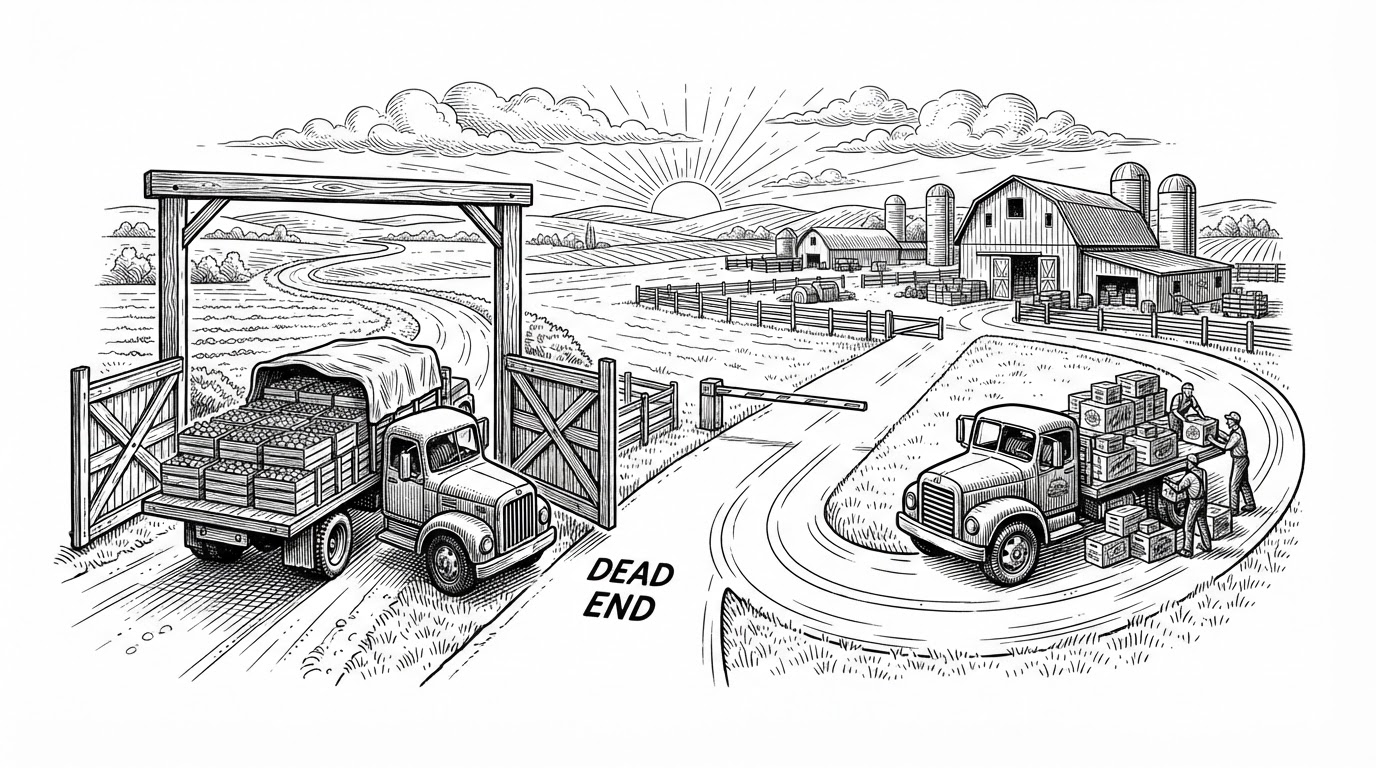
- KrishiLink AI treats reliability as part of access, not just infrastructure, by keeping the workflow usable even when the database is unavailable.
- Its real product idea is return-trip utilization, where empty truck capacity becomes a transport asset instead of wasted motion.
- The backend is pragmatic rather than flashy, combining Express, JWT, Swagger, and a fallback data layer that favors demoability and resilience.
- Compared with advisory agri-tech tools, KrishiLink tries to close the loop between logistics, transaction flow, and trust.
KrishiLink AI is easy to mistake for another farm marketplace. The more interesting read is harsher and more useful: this repo assumes the environment around it may be unreliable, then builds around that assumption.
That starts with the most unusual part of the stack. If PostgreSQL is unavailable, the platform can fall back to in-memory mode and keep moving. For agricultural software, that is not a toy feature. It is a statement about where the product expects to be used.
KrishiLink is a Futuristic Smart Agriculture Ecosystem developed to modernize and digitize Indian farming through the integration of IoT, Artificial Intelligence, and Blockchain technologies.
The App That Refuses to Break
The fallback architecture changes the meaning of the repo. A lot of demo apps fail the moment setup gets awkward. KrishiLink AI does the opposite. It keeps the core workflow alive, even when the persistence layer is missing, which makes the project feel portable and field-aware.
That is not just good developer experience. It is a resilience choice. In rural and low-connectivity settings, software that stops at the first infrastructure problem is not very useful.

Why Empty Backhauls Are the Real Target
The logistics problem here is not abstract. Trucks often return with unused capacity, and that wasted leg costs money, fuel, and time. KrishiLink AI tries to match that return trip with cargo that can be consolidated, so the vehicle earns on the way back instead of leaving empty.
That matters because the platform is not trying to win with generic marketplace mechanics. It is built around a specific inefficiency in agricultural transport: fragmented loads, uneven demand, and return routes that can be turned into productive trips.
How KrishiLink Matches Cargo to Capacity
The cleanest way to understand the repo is as a three-step loop. A farmer posts cargo, a truck exposes return capacity, and the matcher tries to consolidate the load onto that available route. The result is not just transport. It is better utilization.
Farmer load -> matcher -> return-trip truck
Truck capacity remaining -> consolidation check -> assignment
Database up -> persist normally
Database down -> keep matching in memory
The important detail is that the system appears to treat storage as a layer under the business logic, not the business logic itself. That separation is what makes the fallback possible without turning the app into a dead end.
The Backend’s Split Personality
The backend reads like a practical Express service rather than a research project. It uses JWT for authentication, validation libraries for input safety, and Swagger for documentation. That combination suggests the repo wants to be legible to contributors as much as it wants to be functional.
The split personality is the point. Under normal conditions, the backend behaves like a conventional API. Under failure conditions, it degrades into an in-memory system that still serves the same product logic. That makes the architecture more portable than a typical stack that assumes perfect infrastructure.
In this video, we present our prototype and working solution developed for the Smart India Hackathon. Our aim is to address the given problem statement through an innovative, practical, and technology-driven approach.
That quote fits the codebase well. The repo is not trying to impress with novelty alone. It is trying to be demonstrable, adaptable, and hard to knock over.
The Frontend Is Built for Fast Trust
On the frontend, React and TanStack Query suggest an app that cares about fast, predictable updates. That matters in logistics, where a delayed state change can look like a failed pickup, a missed route, or a broken trust signal.
The UI needs to do one job especially well: make the system feel current. Farmers and drivers do not need decorative dashboards. They need to know whether a request was accepted, whether capacity is available, and whether the assignment has been persisted.
What It’s Competing With
KrishiLink AI sits in a strange middle ground. It is more operational than advisory tools, but less infrastructure-heavy than a full transport-management platform. That makes the comparison useful, because it shows what kind of software this really is.
| Project | Core job | Offline capability | Hardware integration | Marketplace / logistics | Trust layer | Primary audience |
|---|---|---|---|---|---|---|
| KrishiLink AI | Match farm cargo to truck capacity and support return-trip logistics | Yes, through in-memory fallback | Indirect in the current repo | Yes | JWT auth, validation, fallback persistence | Farmers, drivers, local operators |
| PlantVillage Nuru | Diagnose crop issues from mobile vision | Yes, on device in supported contexts | Camera-centric | No | Model confidence and agronomy guidance | Farmers and field advisors |
| Kissan AI | Provide multilingual farmer support and advisory chat | Usually cloud-first | No | No | Conversation and advice | Farmers seeking guidance |
| Generic marketplace app | Connect supply and demand | Depends on implementation | Usually no | Sometimes | Payments and accounts | Broad commerce users |
The deeper distinction is that KrishiLink is trying to close a loop. It is not only helping users detect a problem or ask a question. It is trying to move goods, assign capacity, and keep the transaction alive when the storage layer is less than ideal.
Why This Repo Feels Early, But Not Naive
The repo still reads like a prototype, but it is not a naive one. The monorepo split is clear, the docs are present, the auth and validation layers are real, and the fallback mode shows someone has thought about failure instead of pretending it will not happen.
That is the lasting impression. KrishiLink AI is a farm logistics app, yes. More than that, it is an argument that agri-tech should be designed for messy conditions first, then optimized later.