Altr and the Art of Casing-Aware Refactoring
Why a specialized Rust CLI is safer than your IDE's "Global Replace" for evolving complex codebases.
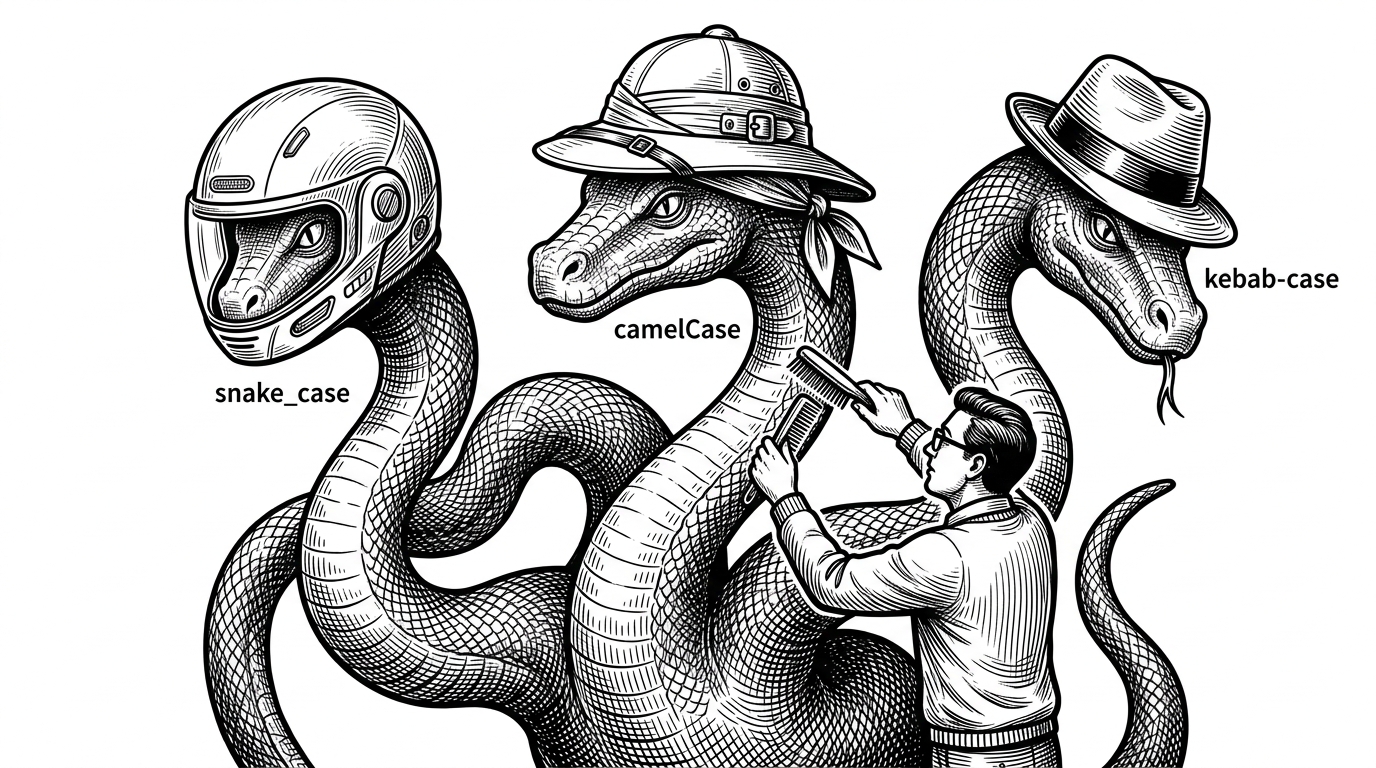
- Altr automates multi-format refactoring by dehydrating tokens into a neutral state before rehydrating them into target casing styles.
- A dedicated offset engine prevents file corruption by dynamically recalculating character coordinates as replacements shift the text buffer.
- The tool uses intelligent heuristics to provide the safety of a language server with the lightweight portability of a Rust CLI.
The Multi-Casing Nightmare
Standard search-and-replace is a blunt instrument. Modern full-stack development scatters a single concept across multiple casing formats. A database expects user_id, a JavaScript payload demands userId, and a CSS class requires user-id.
Changing that concept globally usually requires running three separate regex commands or manually toggling case-matching rules in an IDE. Skip one step, and the build breaks. Altr solves this by treating refactoring as a semantic translation problem rather than a raw string-matching exercise.
Dehydrating the Word
The core of Altr lives in its internal tokenization engine. Instead of looking for exact string matches, it dehydrates a word into a neutral state. When it scans your codebase, it identifies the casing of a found token using a strict order of operations, checking for underscores and hyphens before evaluating capitalization.
Once identified, the string user_id is converted into an internal representation separated by a neutral delimiter. This neutral token is then rehydrated into the target case on the fly. If you tell Altr to replace user with customer, it translates user_id to customer_id and userId to customerId in a single pass.
Moving the Goalposts
Safe in-place file modification is notoriously difficult. When you replace a short word like id with a longer word like identification, every subsequent character in the file shifts to the right. The original coordinates of all downstream matches become instantly invalid.
Altr handles this through a dedicated offset engine. It builds a map of all matches before making any changes. As it processes replacements sequentially, it calculates the cumulative character offset and adjusts the target coordinates for the remaining operations. This prevents file corruption without requiring complex abstract syntax tree transformations.

Precision over Power
Unix tools like sed offer immense power but require deep regex expertise to execute safe multi-case replacements. IDE built-ins are easier to use but often lack pipeline integration for automated refactoring scripts.
Altr occupies the middle ground. It is a lightweight Rust binary that prioritizes surgical precision. By focusing entirely on casing inference, it does one thing exceptionally well and integrates easily into standard continuous integration pipelines or shell scripts.
| Feature | Altr | sed | IDE Replace |
|---|---|---|---|
| Multi-Case Inference | Automatic | Manual Regex | Manual Toggles |
| CLI Pipeline Support | Yes | Yes | No |
| Buffer Offset Safety | Built-in | N/A (Stream) | Built-in |
| Learning Curve | Low | Steep | Low |
The Minimalist Philosophy
Software development naturally gravitates toward heavy, all-encompassing tools. Abstract syntax tree parsers and language servers provide perfect syntax awareness but carry massive overhead.
Altr proves that intelligent heuristics can often match the utility of heavy parsers for everyday tasks. By combining Rust's performance with a laser focus on the developer experience, it transforms the most dangerous tool in a developer's arsenal into a precise, predictable utility.