`obsidian-skills`: The Markdown Middleware That Teaches AI How to Speak Obsidian
A surprisingly formal bridge between LLMs and a deeply opinionated knowledge base, where prompt files, schemas, and reference docs become the operating layer.

- `obsidian-skills` turns documentation into middleware by teaching agents the grammar of Obsidian’s note formats, not just how to generate text.
- The repo matters because generic LLMs can write Markdown, but they still break the syntax, structure, and spatial rules that make Obsidian useful.
- `SKILL.md` files work like compact operating manuals, with reference docs and validation rules carrying the format-specific details.
- The real breakthrough is that Obsidian can be treated as a headless knowledge system that agents can edit safely when the rules are explicit.
When the prompt is the product
Most AI tooling tries to bolt intelligence onto an app. `obsidian-skills` does the opposite. It turns the app’s own documentation into the operating layer, so an agent can write valid Obsidian Flavored Markdown, Bases, Canvas files, and CLI actions without guessing the grammar.
That is why this repo is interesting. It is not a chat feature disguised as infrastructure. It is a set of instructions that says: if the model wants to act inside Obsidian, it has to learn Obsidian’s rules first.
Why generic agents keep breaking Obsidian
Plain LLMs are decent at generic Markdown. Obsidian is not generic Markdown. It uses wikilinks, embeds, callouts, properties, `.base` schemas, and `.canvas` geometry, and those details are exactly where models tend to drift.
| Layer | What it does well | Where it fails | Best fit |
|---|---|---|---|
| Generic LLM prompt | Drafts prose quickly | Breaks Obsidian syntax and structured files | One-off text generation |
| Obsidian AI plugin | Keeps work inside the app | Usually stays user-driven and narrow in scope | In-app assistance |
| `obsidian-skills` | Teaches external agents the file grammar and workflows | Requires disciplined instruction design | Autonomous vault editing |
The failure mode is not subtle. A model can produce readable text and still corrupt a callout, flatten a wiki link, or misunderstand a canvas node. Once the vault is treated as a machine-readable environment, those are not cosmetic mistakes. They are data integrity problems.
How the skills files teach the rules
The repo follows the Agent Skills pattern: a compact `SKILL.md` at the top, then reference files that expand only when needed. That progressive disclosure is the whole trick. It keeps the active context small while preserving the detailed rules that Obsidian formats demand.
The pattern is easy to miss, but it is the real architecture. `SKILL.md` is not the whole brain. It is the router. It decides which references matter, when validation should happen, and which output format the agent is allowed to touch.
Removed standard Markdown content (headings, bold, lists, quotes, etc.) that Claude already knows — this was the biggest token savings.
The hardest part is not text. It is structure
This repo gets more ambitious once it leaves ordinary notes behind. `obsidian-bases` asks the model to respect schema logic, date functions, and view definitions. `json-canvas` asks it to handle coordinates, node dimensions, edge connections, and layout spacing. That is not prompt writing. That is formal structure management.
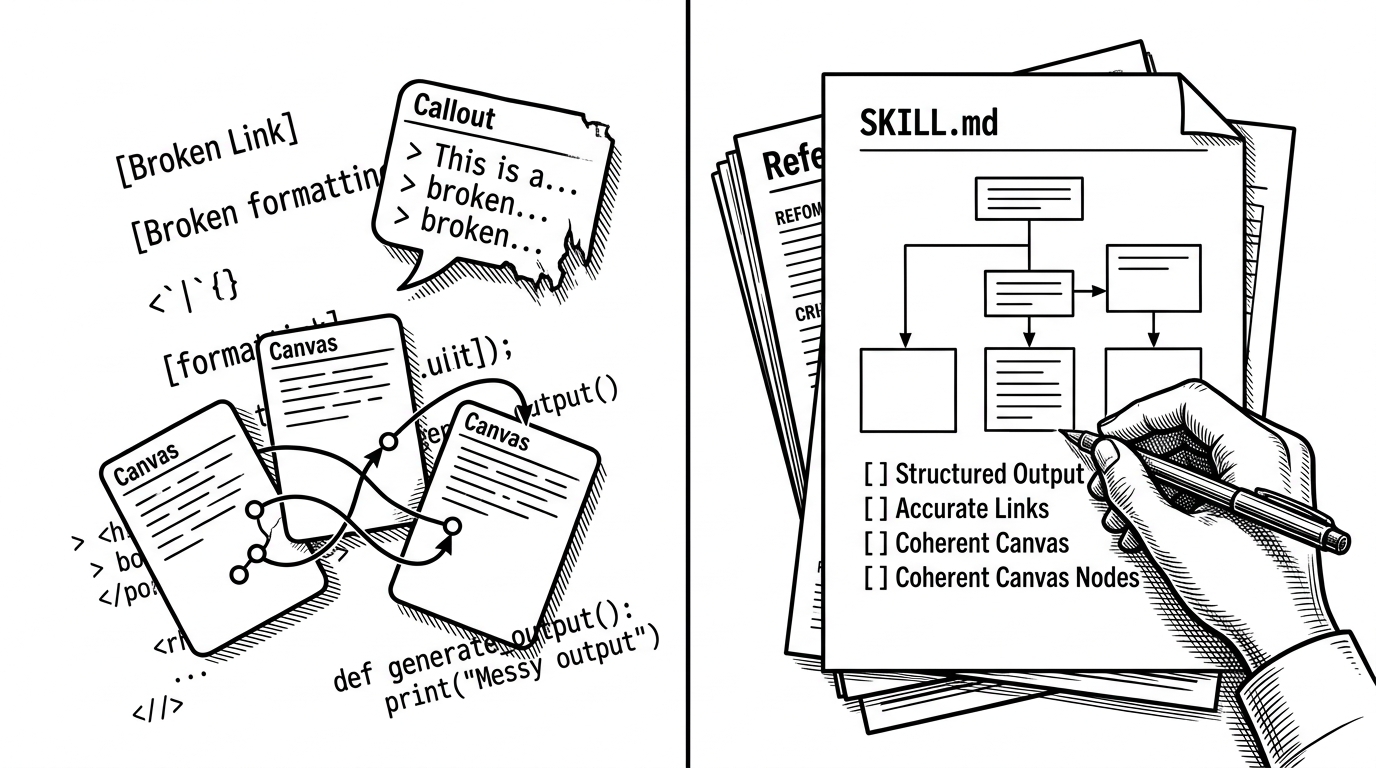
That distinction matters because structure is where generic models tend to improvise. The repo’s reference files, especially for callouts and functions, keep the agent from inventing its own version of Obsidian’s rules.
A small code-level clue
{
  "node": {
    "id": "a1b2c3d4e5f6a7b8",
    "x": 240,
    "y": 160,
    "width": 320,
    "height": 180
  },
  "edge": {
    "from": "user-task",
    "to": "valid-canvas",
    "label": "validate before write"
  }
}
The point is not that the repo is full of code. It is that it encodes the kinds of constraints code usually enforces. The prompt becomes a specification, and the reference docs become the test suite.
What this repo says about the future of software
The bigger implication is simple. Obsidian starts to behave like a headless knowledge store. The human still owns the vault, but an agent can now create, revise, and reorganize it with enough discipline to be useful instead of destructive.
That is a template for other vertical tools too. Any app with its own syntax, schema, or geometry can be wrapped in the same kind of instruction layer. The software is no longer only the UI. It is the documentation that teaches models how to operate the UI safely.
| Question | Old model | `obsidian-skills` model |
|---|---|---|
| What is the interface? | A chat box inside or around the app | A precise instruction layer that governs the agent |
| What is being optimized? | Convenience | Correctness under Obsidian’s rules |
| Who controls the workflow? | The user, step by step | The skill file, with validation and references |
| What is the product? | AI assistance | AI literacy for a specific tool ecosystem |
The official bridge matters
Steph Ango’s role changes the reading of the repo. This is not an unofficial hack sitting at the edge of the ecosystem. It is a first-party-adjacent signal that Obsidian’s future includes agents that can work directly against the vault’s real formats.
That matters for trust and for adoption. When the maintainer of the platform encodes the rules, the repo stops looking like a clever side project and starts looking like product direction.
I ran your skills through a `tessl skill review` and found some ways to improve discoverability and usability. I hope this is welcome, and helpful.
Compared with plugins and generic chatbots
The cleanest way to think about `obsidian-skills` is as a deeper layer than either a chatbot or an in-app plugin. It is not trying to be the place where you ask questions. It is trying to be the layer that makes external agents reliable enough to act.
| Capability | Generic chatbot | Obsidian plugin | `obsidian-skills` |
|---|---|---|---|
| Writes valid Obsidian Markdown | Sometimes | Usually | Yes, by design |
| Handles `.base` and `.canvas` | No | Rarely | Yes |
| Runs outside the UI | Yes | No | Yes |
| Needs human babysitting | High | Medium | Lower |
| Main value | Speed | Convenience | Format-aware autonomy |
That is the real contrast. A chatbot is a conversation surface. A plugin is an in-app convenience layer. This repo is closer to infrastructure for trustworthy agent action.