RAG-Tutorials Shows Why Good Retrieval Is a Systems Problem
A modular tour through ingestion, FAISS, agentic retrieval, and vectorless document navigation that shows how RAG matures beyond naive chunk search.
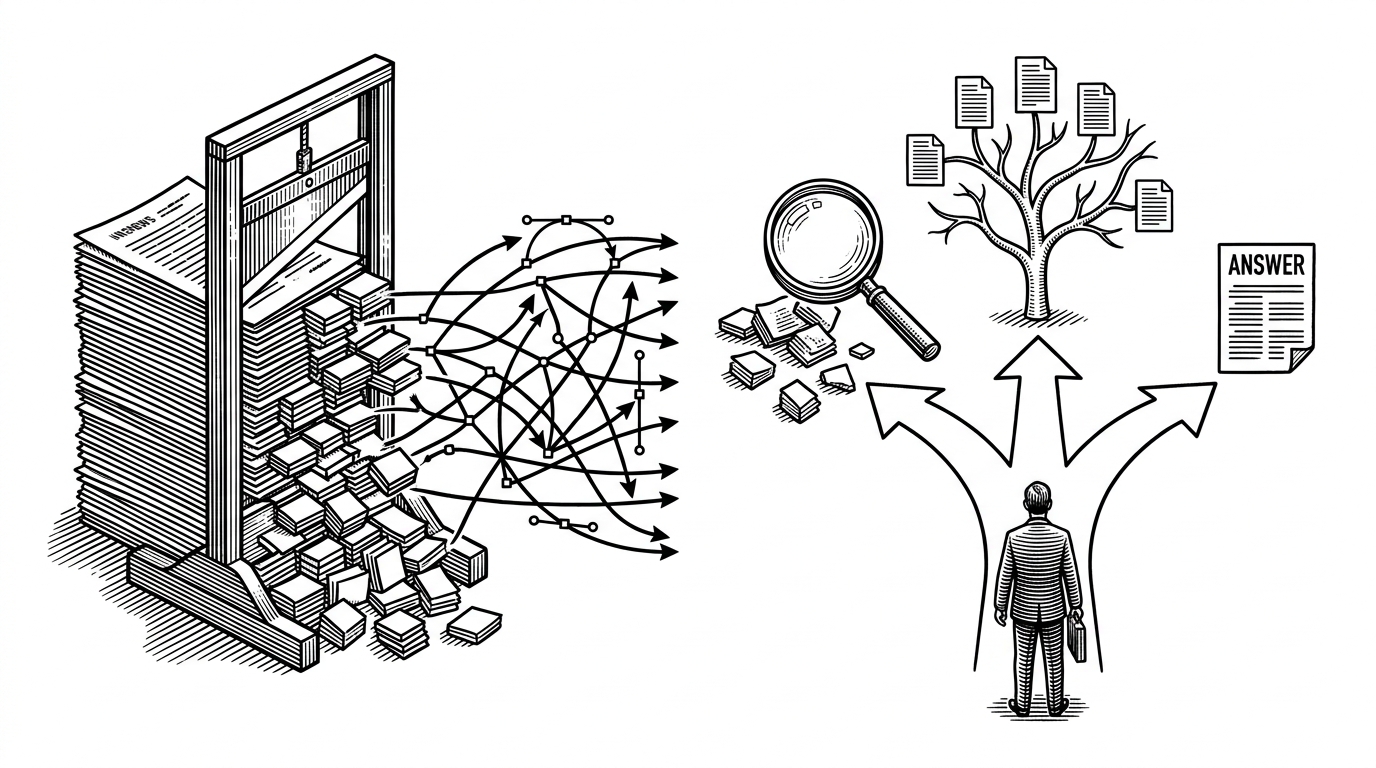
- This repo treats RAG as a sequence of retrieval decisions, not a fixed embed-and-search recipe.
- Its modular core matters because ingestion, embedding, storage, and search are separated cleanly enough to swap strategies without rewriting the whole stack.
- The agentic notebook changes the default question from “how do we retrieve?” to “should we retrieve at all?”
- The vectorless PageIndex material pushes the strongest point in the repo: structure can beat similarity when the document has real hierarchy.
The Chunk Is Not the Whole Story
Most RAG tutorials stop at the obvious loop: split text, embed it, search nearest chunks, generate an answer. RAG-Tutorials keeps going, and that is why it is useful. The repo is really about a harder question: what if retrieval is not one mechanism, but a set of choices?
That framing matters because real documents are not bags of semantically similar fragments. They have sections, headings, footnotes, and context that a closest-vector match can miss. This repo keeps returning to that gap.
What This Repo Teaches That Most RAG Tutorials Skip
| Layer | Standard tutorial | RAG-Tutorials |
|---|---|---|
| Ingestion | One document type, one happy path | A loader that scans PDFs, TXT, CSV, XLSX, DOCX, and JSON |
| Retrieval trigger | Always retrieve | Sometimes retrieve, if the question needs it |
| Storage | Vectors only | Vectors plus metadata you can map back to text |
| Document shape | Flat chunks | Flat chunks, then hierarchical navigation |
| Teaching goal | Show the API | Show the system decisions behind the API |
The repo reads like a staged curriculum, but the lesson is not “here are more notebooks.” The lesson is that mature RAG work expands outward from embeddings into orchestration, evaluation, and document structure.
The Modular Core: Ingest, Embed, Store, Search
The core code path is straightforward in the best way. `data_loader.py` gathers heterogeneous files, `embedding.py` turns text into vectors, `vectorstore.py` persists and retrieves them, and `search.py` closes the loop. That modularity is the repo’s quiet strength.
It also makes the repository feel less like a demo and more like a lab bench. Each notebook can swap in a different retrieval idea without tearing apart the base pipeline.

Why the FAISS Wrapper Is More Interesting Than It Looks
The interesting part is not that the repo uses FAISS. It is that it treats vectors and metadata as a pair. The index gives you a nearest neighbor; the metadata gives you the actual passage you can trust, display, and trace.
That hybrid pattern is the hidden plumbing in most practical vector systems. The repo makes it visible, which is exactly what a tutorial should do.
When the Model Decides Whether to Retrieve
The agentic notebook shifts the question from search quality to retrieval necessity. Instead of forcing every prompt through a database, the system first asks whether external context would help at all.
That is a small change with large consequences. It can cut latency, reduce wasted calls, and avoid pretending that every user question belongs in the vector store.
| Mode | Trigger | Strength | Failure mode |
|---|---|---|---|
| Always-retrieve RAG | Every question | Simple and predictable | Wastes time on questions that need no retrieval |
| Agentic RAG | A retrieval decision first | Selective and cheaper | Depends on the quality of the decision step |
| Direct answer | No retrieval | Fast for general knowledge | Can miss domain-specific context |
This is where the repo stops being a pipeline demo and starts looking like system design. The system is no longer just retrieving. It is deciding when retrieval is worth doing.
Vectorless RAG Changes the Question
The PageIndex material is the most interesting pivot in the repository. It suggests that some questions are better answered by navigating structure than by chasing semantic proximity across chunks.
That changes the mental model. Similarity search is still useful, but it is no longer the only way to find truth inside a document. If the document has a real hierarchy, the hierarchy can become the retrieval surface.
| Question type | Flat vector search | Tree-based navigation |
|---|---|---|
| Find a related paragraph | Strong fit | Overkill |
| Locate a section inside a report | Can miss structure | Strong fit |
| Answer from a broad concept | Strong fit | Depends on document layout |
| Preserve author intent | Weak when chunks are isolated | Better when sections stay intact |
This is the repo’s conceptual payoff. It teaches that retrieval is not always a nearest-neighbor problem. Sometimes it is a navigation problem.
Evaluation Is the Real Product
The LangSmith notebook matters because it closes the loop. If RAG is a system, then answer quality and retrieval quality are not side quests. They are the actual product.
That mindset separates educational code from serious engineering. The repository does not stop at building a path from question to answer. It asks whether the path worked.
- Measure retrieval, not just output text.
- Inspect failures as system failures, not prompt failures.
- Treat evaluation as part of the architecture, not a postscript.