dify-python-sdk: The Python client that makes Dify feel like infrastructure
A close look at the official SDK’s shared client core, typed responses, retries, and twin sync and async paths, and why that matters more than a thin wrapper should.
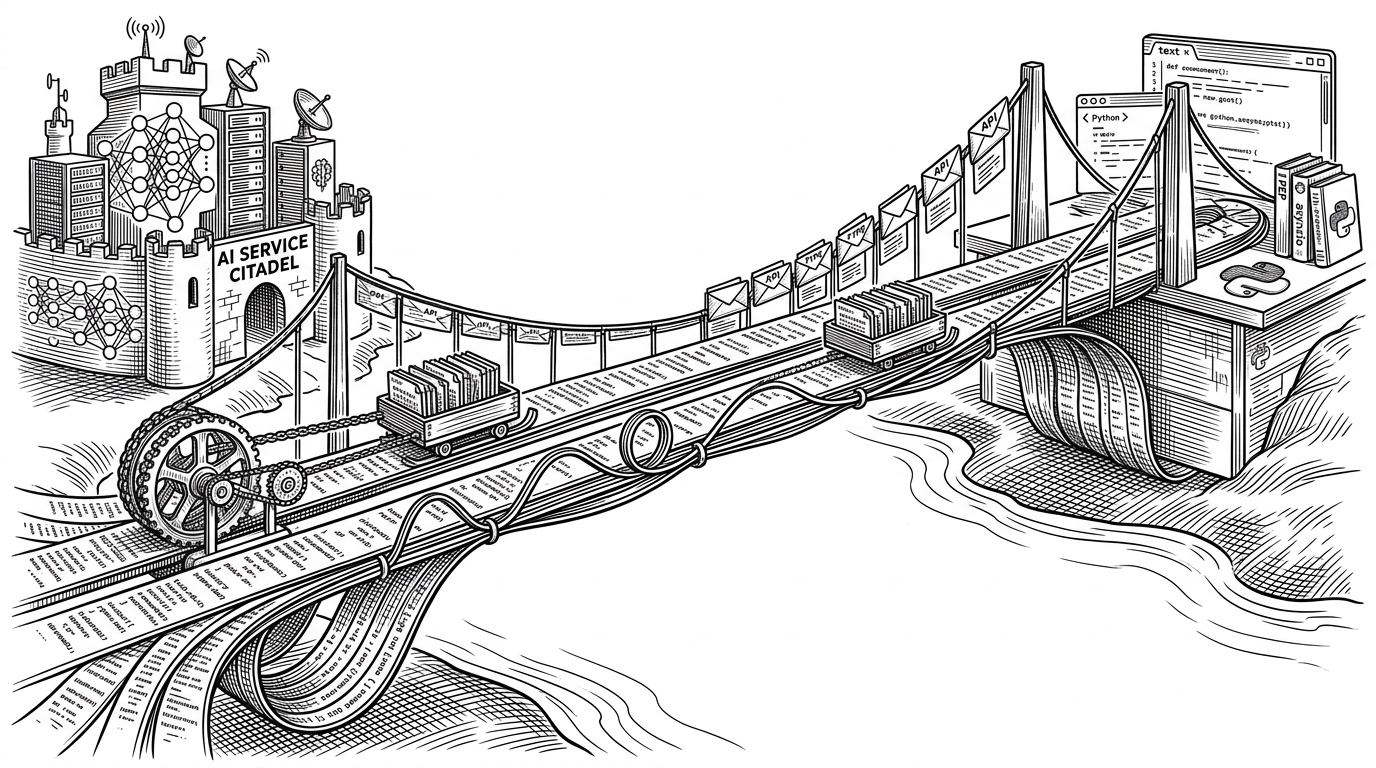
- The SDK’s real value is not that it wraps Dify, but that it turns a hosted platform into ordinary Python objects, retries, and exceptions.
- A single shared client core keeps sync and async behavior aligned, so the same API feels predictable in notebooks, scripts, and web services.
- Typed models and named errors make AI integration failures easier to diagnose and safer to refactor.
- Compared with raw HTTP or broad orchestration frameworks, the SDK wins by narrowing the job to talking to Dify well.
Dify is the platform. dify-python-sdk is what keeps it from feeling like a platform. The interesting part is not the feature list. It is the seam: a shared client core that lets Python code talk to a hosted AI system without dropping into handwritten HTTP for every call.
That seam matters because AI apps are not polite. They stream, they rate limit, they upload files, they return partial failures, and they often need to run both in a notebook and inside a web server. The SDK answers with a narrow trick: one request engine, two native surfaces.
One core, two Python faces
In dify_client/base_client.py, the shared mixin owns headers, URL construction, retries, and error translation. The sync client and async client inherit the same behavior, so the calling style changes, but the contract does not. That is the part that makes the package feel disciplined instead of merely convenient.
That is why the switch to httpx matters. One transport library can drive both httpx.Client and httpx.AsyncClient, which means the SDK can mirror itself instead of maintaining two separate mental models. The sync version fits scripts and notebooks. The async version fits FastAPI and other concurrent services.
This PR migrates the Dify Python SDK from the legacy requests library to the modern httpx library, adding full async/await support while maintaining 100% backward compatibility.
Typed response models do the quiet work here. Dataclasses for messages, workflows, and datasets turn JSON into named fields, which makes completion, refactoring, and tests less brittle. The SDK is not trying to surprise you with magic. It is trying to make the obvious code shorter.
The hardening layer
Retries and exceptions are where the library stops looking like a convenience wrapper and starts looking like production glue. Exponential backoff is built in. Status codes become named Python errors. A 429 is not just a failed request. It is a RateLimitError with enough context to back off intelligently.
The Python SDK in sdks/python-client is missing several Service API endpoints that are available in the platform. External applications would benefit from having access to these additional endpoints including:
The validation story follows the same logic. The move toward Pydantic models standardizes parsing and error reporting, so bad inputs fail early instead of drifting into a workflow run and breaking somewhere harder to debug.
This pull request undertakes a significant refactoring effort within the API layer, transitioning from flask_restx's native request parsing and response serialization mechanisms to Pydantic models. This change aims to standardize data handling, improve validation, and enhance the maintainability and clarity of the API definitions
Where it sits in the stack
The real comparison is not just between SDKs. It is between three levels of effort: raw HTTP, an official client, and a broad orchestration framework. Dify-python-sdk is the middle layer that earns its keep by removing boilerplate without stealing control.
| Approach | What it optimizes | Trade-off |
|---|---|---|
| dify-python-sdk | Typed Dify calls, retries, sync and async parity, and broad Service API coverage | It only solves the Dify boundary |
| Direct httpx or requests calls | Maximum control and zero abstraction | You rebuild auth, models, retries, and errors yourself |
| LangChain or similar framework | Broad orchestration and agent tooling | It solves a different problem and adds more moving parts |
That middle layer is what makes it useful to senior engineers. You can keep Dify as a service boundary, still wire it into your own app architecture, and still decide where the async boundary belongs. The SDK helps you stay architectural without forcing you to become a transport engineer.
Why the origin matters
This looks like a platform team shipping the bridge they need. The repo is small, but the discipline is obvious: tests, packaging, linting, static typing, and a layout that cleanly separates shared client behavior from endpoint-specific methods. It covers chat, completion, workflow runs, file uploads, vision inputs, and dataset operations without turning into a framework of its own.
The packaging stack also reads like modern Python done on purpose: uv, hatchling, ruff, mypy, and bandit. That matters because client libraries die by friction. This one is trying to behave like maintained infrastructure, not a code sample.