TailoredResume.ai: The Resume Builder That Treats Your CV Like a Build Pipeline
An open-source agentic system that reads a job description, rewrites a master profile with governance rules, scores its own output, and exports ATS-safe PDFs without pretending the candidate is someone else.

- TailoredResume.ai stands out because it treats resume tailoring as a closed-loop system with analysis, rewriting, scoring, and retry logic.
- Its real novelty is governance, especially the split between strict honesty and flexible keyword absorption.
- The structured JSON master resume is the source of truth, which makes tailoring reproducible instead of ad hoc.
- The product is engineered for ATS readability first, then presentation, which puts it in a different category from flashy resume builders.
The easiest way to misunderstand TailoredResume.ai is to file it under AI resume builder. That misses the point. This repo is closer to a compiler with a conscience: it reads intent from a job description, transforms a master profile, checks its own work, and tries again if the output is not good enough.
The resume app that refuses to stop at one draft
The project's main loop is simple to describe and unusually disciplined in execution. A job description goes in. The system extracts intent, drafts a tailored resume, scores it against internal criteria, and repeats until the score crosses a high threshold. That is the difference between writing and governing.
Tailor your resume to a job description with a click! Hey Reddit! I'm super excited to share my side project, TailoredResume.
That announcement frames the project as convenience, which is fair. But the code and README reveal a stronger claim: the tool is built to keep tailoring from turning into fabrication. That matters because resumes sit in a gray zone where personalization often drifts into exaggeration.
Why the honesty tiers matter more than the prompt
The project's most interesting decision is to split behavior into strict and flexible modes. Strict mode protects factual integrity. Flexible mode lets the system absorb keywords into the summary and skills sections without inventing experience. That is a practical answer to a real LLM failure mode: plausible nonsense.
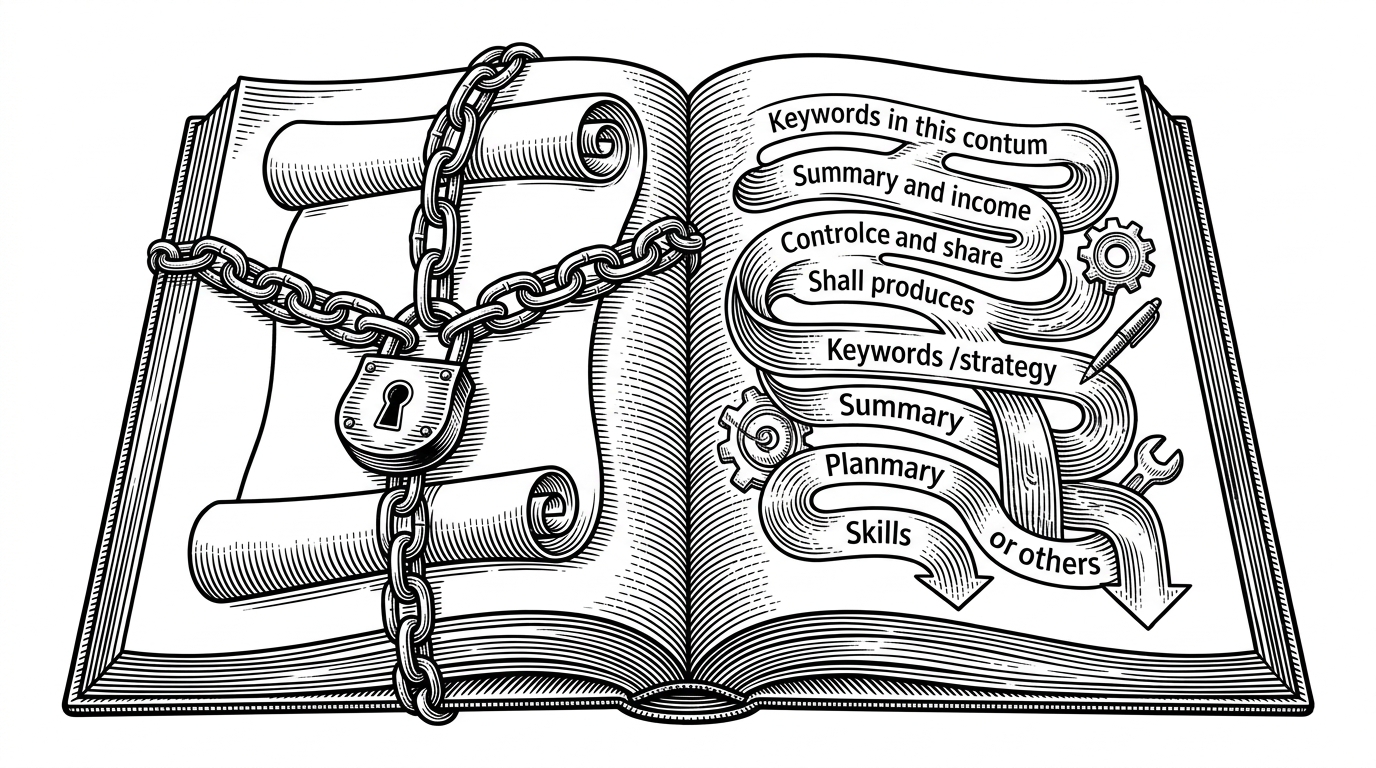
The deeper move is not that the system is careful. It is that it encodes care as workflow. The critic agent evaluates keyword match, impact density, verb diversity, and structural integrity. If the output is weak, the pipeline loops. That turns judgment into a machine-enforced constraint instead of a vague instruction.
{
  "summary": {
    "mode": "flexible",
    "job_target": "platform engineer",
    "keywords": ["Python", "FastAPI", "ATS", "ReportLab"]
  },
  "experience": {
    "strict": true,
    "source_of_truth": "master_resume.json",
    "claims": [
      "quantified impact",
      "core actions",
      "master narratives"
    ]
  },
  "governance": {
    "retry_threshold": 95,
    "no_fabrication": true
  }
}
The structured JSON master resume is what makes that discipline possible. Instead of treating a resume as a finished document, the repo treats it as source data with separate fields for master narratives, quantified impact, and core actions. That means tailoring is not freeform rewriting. It is a controlled transformation of canonical inputs.
A resume is only useful if the machine can read it
This is where the architecture becomes persuasive. A single PDF is fragile. A structured master profile is reusable. Once the source data lives in JSON, the system can generate multiple tailored versions without losing the underlying truth of the candidate's history.
I built this because I was tired of manually tailoring my resume for every single job application. It's a time-consuming process, and I wanted to automate it as much as possible.
That motivation shows up in the implementation. The frontend is just the surface. The real product is the data model and the orchestration around it. If the master record is clean, the rest of the system can tailor, score, and export without drifting into rewrite chaos.
The PDF engine is built for ATS, not aesthetics first
TailoredResume.ai uses programmatic PDF generation rather than browser-driven layout tricks. That is a deliberate choice. ATS systems are notoriously sensitive to layout complexity, so the repo favors predictable spacing, standard font hierarchies, and controlled section styling over decorative flourishes.
| Layer | TailoredResume.ai | Design risk avoided |
|---|---|---|
| Layout engine | ReportLab platypus | Fragile browser rendering and hidden DOM artifacts |
| Typography | Template-based paragraph styles | Inconsistent spacing and unreadable section flow |
| Structure | Programmatic sections from JSON | Manual layout drift across variants |
| Output | ATS-safe PDF and DOCX | Pretty documents that machines misread |
That is the right tradeoff for this product. In a resume tool, visual ambition is cheap. Readability is expensive. The repo spends its complexity budget where it matters: scoring, governance, and structured export.
The design language says serious tool, not resume toy
The frontend reinforces that posture. Ivory tones, amber accents, and a glassmorphic interface make the workspace feel deliberate instead of playful. The look says precision desk, not template marketplace. Even the mobile warning fits the product thesis. This is a desktop-first workbench for a serious document workflow.
The tool is completely free and open-source. You don't even need an OpenAI key to use it. I'm leveraging a few different open-source models to power the suggestions.
That openness is part product strategy, part trust signal. It lowers adoption friction, but it also matches the repo's broader posture: keep the user close to the data, keep the system explicit, and avoid black-box magic where a user expects control.
Where TailoredResume.ai sits in the market
Compared with Resume-Matcher, Reactive-Resume, and JobScan, TailoredResume.ai is smaller and more opinionated. It is not trying to be the broadest resume platform. It is trying to be the clearest answer to a narrow problem: how to tailor accurately, repeatedly, and without fiction.
| Project | Positioning | Governance | Privacy posture | Output focus |
|---|---|---|---|---|
| TailoredResume.ai | Agentic tailoring pipeline | Explicit strict vs flexible modes | Open-source and privacy-conscious | ATS-safe PDF and DOCX |
| Resume-Matcher | Matching and analysis tool | Less explicit in workflow terms | Open-source | Keyword and fit analysis |
| Reactive-Resume | General resume builder | Builder-first, tailoring secondary | Open-source | Multi-resume editing and publishing |
| JobScan | Commercial optimization suite | Proprietary scoring | Closed-source | Resume and recruiter optimization |
The upside is obvious. You get structured source data, privacy-friendly tailoring, and a system that pushes back on weak output. The hard question is whether that rigor is enough to beat broader tools for everyday users. That is the real market test: not whether the pipeline is elegant, but whether it is the one people come back to when the job hunt gets noisy.
The upside and the hard question
Nikhil Pitroda built something more interesting than a resume generator. He built a workflow that treats professional identity as governed data, then uses models to transform it with constraints. That is a sharper idea than it first looks, and it points toward a future where document generation is less about prose and more about accountable pipelines.