The Pristine Skeleton of rushindrasinha/git-practice
A journey into the digital archaeology of a mid-2010s Rails monolith, where the framework is the message.
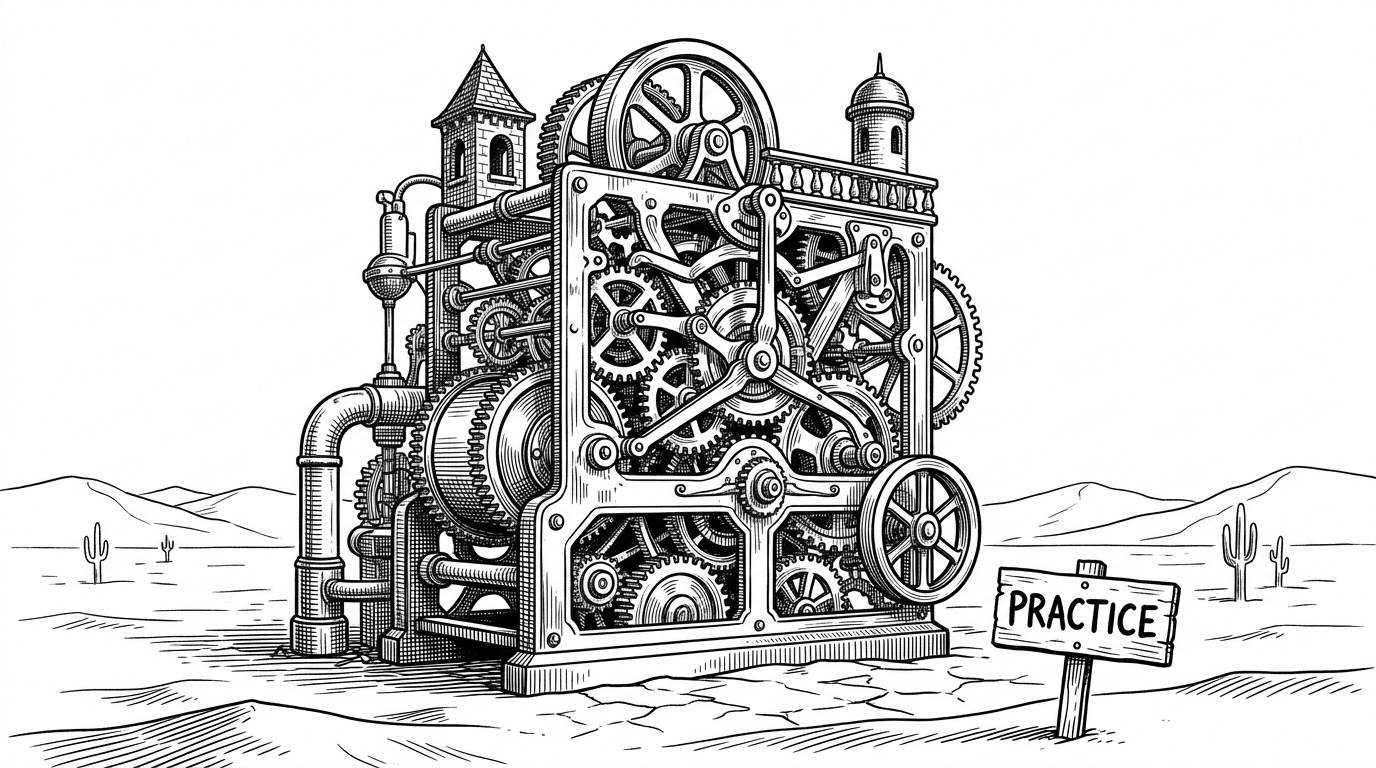
- The repository uses a massive Rails framework skeleton as dummy data for version control practice.
- The codebase preserves specific mid-2010s technologies like Sprockets and Turbolinks before the era of modern bundlers.
- Generating a complex monolith simulates the real-world friction of managing large-scale configuration files and metadata.
The 20,000-Line "Hello World"
A repository named for Git practice usually contains a single text file or a few shell scripts. This repository contains a fully initialized Ruby on Rails 4.2.1 application. It spans over 20,000 bytes of code across dozens of files before a single line of custom logic is written. It is a perfect type specimen of mid-2010s web development.
The architecture follows the classic Model-View-Controller pattern. The repository is not a tutorial. It is the raw output of a framework generator, capturing the exact moment of maximum potential. The developer generated this complex structure simply to have something substantial to practice version control against.
Fossils in the Gemfile
Looking at the dependency list is an exercise in digital archaeology. The files reveal a specific era of Ruby history. The inclusion of Turbolinks and Sprockets points to a time before Webpack dominated the frontend. The configuration file even includes a flag for transactional callbacks, a specific artifact of the Rails 4.2 to 5.0 transition period.
This README would normally document whatever steps are necessary to get the application up and running.
The standard boilerplate text remains untouched. The developer never intended to build an application. The framework itself was the dummy data.
The Asset Pipeline: A Lost Art
Modern frontend development relies on complex bundlers and import maps. In 2015, Rails used the Asset Pipeline. The files in the javascripts folder act as manifests. Developers used specially formatted comments to instruct the engine on how to concatenate files.
| Feature | 2015 Rails (git-practice era) | Modern Rails (2024+) |
|---|---|---|
| Asset Bundling | Sprockets (Manifests) | Propshaft / Importmaps |
| Documentation | RDoc formatting | Markdown |
| JavaScript | CoffeeScript default | ES6 / TypeScript |
| Page Transitions | Turbolinks | Turbo / Hotwire |

Why Practice on a Monolith?
Practicing version control on a single text file is easy but unrealistic. Generating a 100-file framework skeleton forces a developer to confront real-world complexity. You have to deal with ignore files, merge conflicts in configuration settings, and hidden metadata. By using a heavy monolith to practice basic commands, the developer simulated the exact friction of a professional production environment.