generative-ai-learn: The open-source repo that starts at day zero
A blank GitHub repository can still tell a story. This one shows how developers turn a personal learning path into a public artifact before the first notebook, script, or syllabus exists.
- This repository matters because it turns a public GitHub URL into a visible act of intent before it becomes a learning resource.
- Blank learning repos are common in AI because public scaffolding serves accountability, discoverability, and momentum at the same time.
- The real challenge is not starting a generative-AI learning lab, but getting from empty metadata to a structure other people can actually use.
- A stronger version of this repo would need a README, a syllabus, notebooks, examples, and a clear path from prompts to more advanced workflows.
A repository that begins with intention, not implementation
generative-ai-learn is interesting because it arrives as a declaration. The repository name promises a learning journey, but the current state is mostly empty scaffolding. That gap is the point.
Most repo coverage starts with architecture. This one starts with absence. There is no codebase to trace, no dependency graph to decode, and no folder tree to admire. What remains is a public marker that says: this is where the work will happen.
Why blank learning repos keep appearing in AI
This is the learning lab pattern. Developers create a public repo before the curriculum exists because public ownership changes behavior. It makes the project harder to abandon, easier to find later, and more legible to anyone who stumbles across it.
The reason this pattern keeps showing up is simple. Public learning repos do three jobs at once. They hold a promise, they create accountability, and they make a future portfolio artifact before the portfolio artifact exists.
What’s missing tells you what will probably come next
When a generative-AI learning repo matures, it usually grows in a fairly predictable order. The first useful commit is often a README with a mission statement. Then comes structure: notebooks, examples, environment files, and eventually a sequence of topics that can be followed without guesswork.
| Stage | Blank learning repo | Mature learning repo |
|---|---|---|
| Initial state | A name, maybe a README stub | A documented learning path with clear scope |
| Typical content | Almost nothing visible | Notebooks, examples, scripts, and notes |
| Reader value | Signals intent | Teaches something immediately |
| Signal to visitors | "This is being started" | "This is ready to use" |
| Maintenance burden | Low at first, but ambiguous | Higher, but more honest and more useful |
| Likely next milestone | Add a README and structure | Add modules, exercises, and examples |
The open question is not whether this repo will change. It almost certainly will. The real question is what shape the first useful structure will take. In generative AI, that usually means a notebook-first learning path, then a set of examples that move from simple prompting toward retrieval, evaluation, and possibly fine-tuning.
The cold-start problem, but for knowledge sharing
This repo exposes the hardest part of educational open source: getting from private curiosity to public utility. A blank repository can be honest about ambition, but it still has to overcome the same problem every new project faces. No one benefits from it until it contains enough structure to reward a visitor's time.
| Question | Blank repo answer | Useful learning lab answer |
|---|---|---|
| What is this? | A public promise | A navigable curriculum |
| Why should I click? | To see if anything exists | To learn something concrete |
| How easy is it to share? | Easy to publish, hard to recommend | Easy to recommend, easier to reuse |
| What creates momentum? | Visibility alone | Visibility plus substance |
That is why the cold-start matters here. Open source is not just a code distribution system. It is a discovery system. If the first visible artifact is empty, the project has to work harder later to earn trust, attention, and repeat visits.
What a stronger version of this repo would need
A credible next version does not need to be large. It needs to be legible. A strong learning repo would probably start with a README that explains scope, then a syllabus that sets expectations, then a small set of notebooks that build in difficulty.
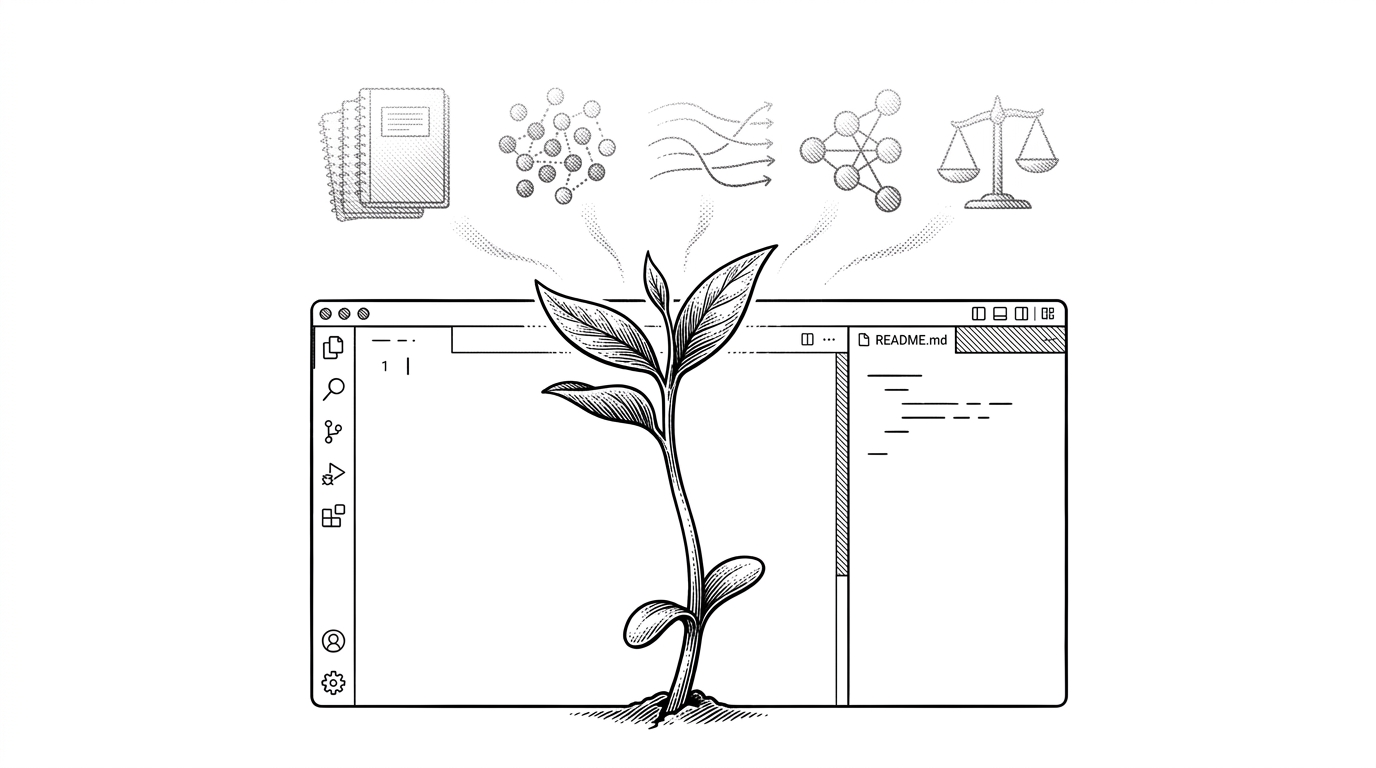
The best learning labs usually move from prompt engineering to retrieval-augmented workflows, then to evaluation and deployment. That sequence matters because it turns a pile of experiments into a reusable path for other people.
| Element | Why it matters | What it unlocks |
|---|---|---|
| README | Explains the mission | Makes the repo navigable |
| Syllabus | Defines the order of learning | Prevents random wandering |
| Notebooks | Show the work | Turns ideas into practice |
| Environment file | Pins the setup | Reduces friction for newcomers |
| Examples and evaluations | Prove the ideas hold up | Makes the repo reusable |
If this repository becomes more than a placeholder, that is the shape it will need. The lesson is not that every learning repo must be elaborate. It is that every learning repo must become specific enough that another person can actually follow it.
Why this empty repo is still worth noticing
A public repo at day zero is a snapshot of ambition at the moment it becomes visible. That is not trivial. It tells you something real about how technical learning now happens in public, and how often the first artifact is metadata rather than code.
generative-ai-learn is not yet a teaching resource. It is the opening gesture of one. That makes it a small but useful example of how open-source learning often begins: with a name, a promise, and a blank screen that still has to be filled.