repo-explainer: The Repo That Turns Code Into a Feature Article
A Cloudflare-native editorial engine that reads source code like evidence, plans the story like a newsroom, and ships illustrated technical deep-dives as a single HTML artifact.
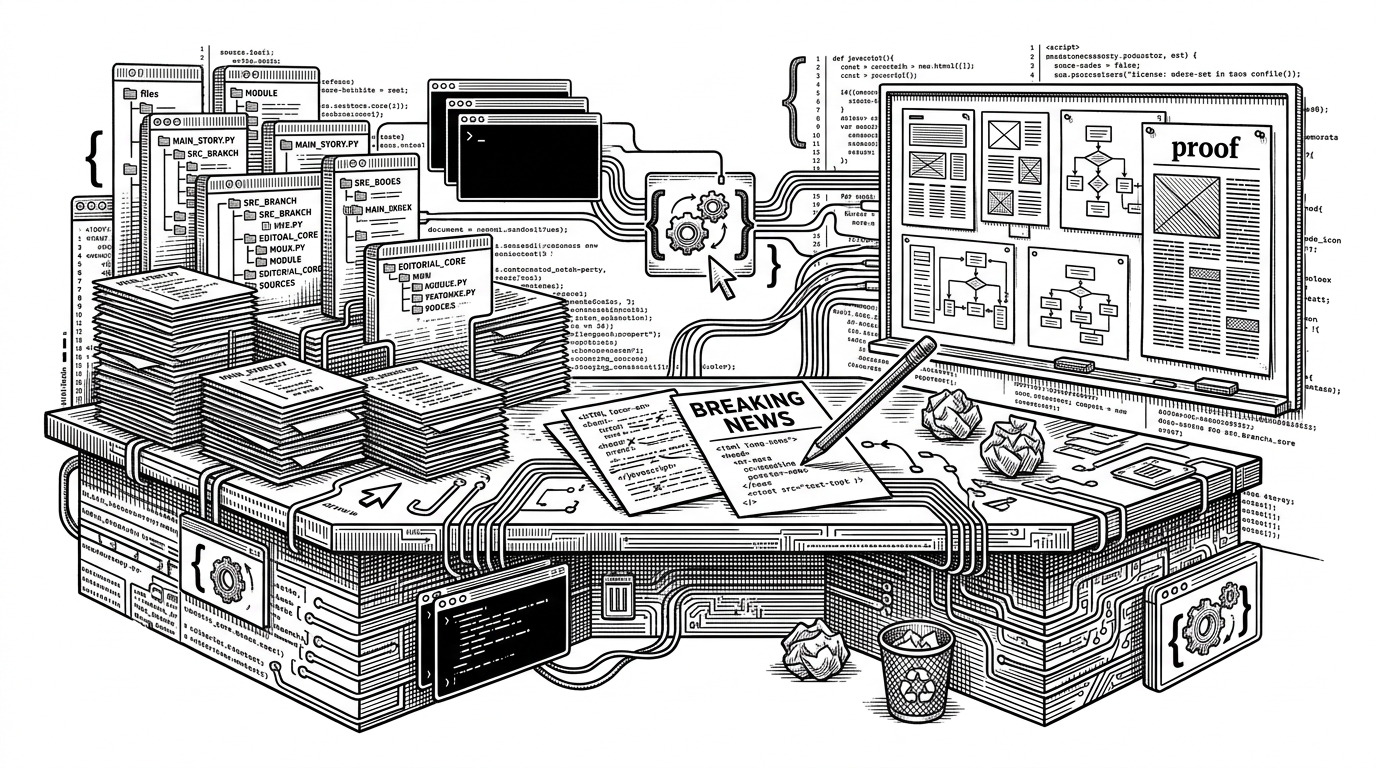
- repo-explainer is less interested in summarizing repositories than in editorializing them into a publishable argument.
- Its key move is to separate angle selection and story structure from prose generation, which makes the output feel planned instead of improvised.
- The Cloudflare stack matters because the job is stateful and long-running, so Workflows, Durable Objects, KV, and R2 function like a newsroom backend.
- The project’s output is not just text, but a packaged article with diagrams, portraits, comments, and deployable HTML.
Most tools ask an LLM to explain a repository in one shot. repo-explainer does something stranger and more disciplined: it treats the repo as primary source material, then runs it through an editorial pipeline that decides the angle, the structure, and the production format before a full article is written.
The system replaces simple prompts with an 11-step industrial pipeline that mimics a human editorial office.
Why the Editorial Plan Comes Before the Writing
That separation is the project’s sharpest idea. The system does not jump from repo URL to prose. It first creates an editorial plan, then makes the writer follow it. The result is closer to a magazine feature than a generic code summary.

How the Pipeline Reads a Repo Without Getting Lost
Under the hood, the repository analysis is built to avoid the common failure mode of code explainers: skimming the surface and pretending they saw the whole thing. This system recursively discovers files, selects a budgeted set of relevant paths, and reads actual source code so the article has evidence instead of vibes.
It also sanitizes the selected file paths before fetching them, which matters more than it sounds. That small guardrail keeps the model from inventing a file tour that never existed, and it helps the final article stay anchored to the repository’s real structure.
// Conceptually, the repo analysis stage does three things:
// 1. discover candidate files
// 2. choose the most relevant ones under a character budget
// 3. fetch and sanitize only valid paths before synthesis

const selected = sanitizeSelectedSourcePaths(
  extractJsonStringArray(llmOutput)
);

const sourceBudget = MAX_TOTAL_SOURCE_CHARS;
const files = await recursivelyCollectRepoFiles(repoUrl, selected, sourceBudget);
const sourceBundle = await readSourceFiles(files);
Cloudflare Is Not the Gimmick Here. It Is the Enabler
This is the other surprise. The project uses Cloudflare Workers, Workflows, Durable Objects, KV, and R2 not as a novelty, but because the job is inherently stateful. A repo article is not one request. It is a sequence of research, synthesis, enrichment, assembly, and deployment steps that need coordination.
Durable Objects bound concurrency. Workflows carry the long-running job. KV tracks metadata and status. R2 stores the assembled output. That division is what lets a serverless system behave like a production pipeline.
| Project type | Primary output | Core mechanism | Strength | Limitation | What repo-explainer does differently |
|---|---|---|---|---|---|
| Single-shot repo explainer | Short summary | One prompt over README or a few files | Fast and cheap | Shallow and brittle | Turns analysis into a planned editorial artifact |
| Repo chat tool | Interactive answers | Q&A over code context | Flexible exploration | No fixed narrative | Writes the story before it answers the questions |
| Graph-RAG code tool | Grounded technical tutorial | Knowledge graph plus vector search | Better retrieval | Still optimized for recall | Treats retrieval as research, not the final product |
| Code review or scoring tool | Health score or review notes | Static analysis plus LLM output | Useful diagnostics | Not publication-ready | Packages the result as a magazine-style feature |
The Part Most Tools Skip: Images, Diagrams, and Production
The system does not stop at prose. It generates diagrams, editorial portraits, and a standalone HTML article, which pushes it from analysis tool into publishing system. That matters because the final object is not a chat transcript. It is a finished piece with a visual grammar.
That production layer is also where the project’s taste shows up. A good technical article does not just explain. It frames, simplifies, and contrasts. Here, the visuals are not garnish. They are part of the argument.
What This Beats, and What It Doesn’t
Compared with repo chat tools and single-shot explainers, repo-explainer is slower, more structured, and more opinionated. That is the point. It is optimizing for a publishable narrative artifact, not a quick answer in a sidebar.
It will not replace a developer who wants to interrogate the code live. It is for the job that comes after that: producing a coherent, illustrated explanation that another human can read, trust, and share.