cn: The Tailwind Merger That Moves the Work Out of React
A deep look at the compiled class-matching engine that replaces runtime parsing with flat tables, typed arrays, and aggressive caching.

- cn is interesting because it relocates Tailwind conflict resolution out of the render path and into precomputed tables.
- Its speed story is not just compilation. It also leans on cache layers that match how React components actually reuse class strings.
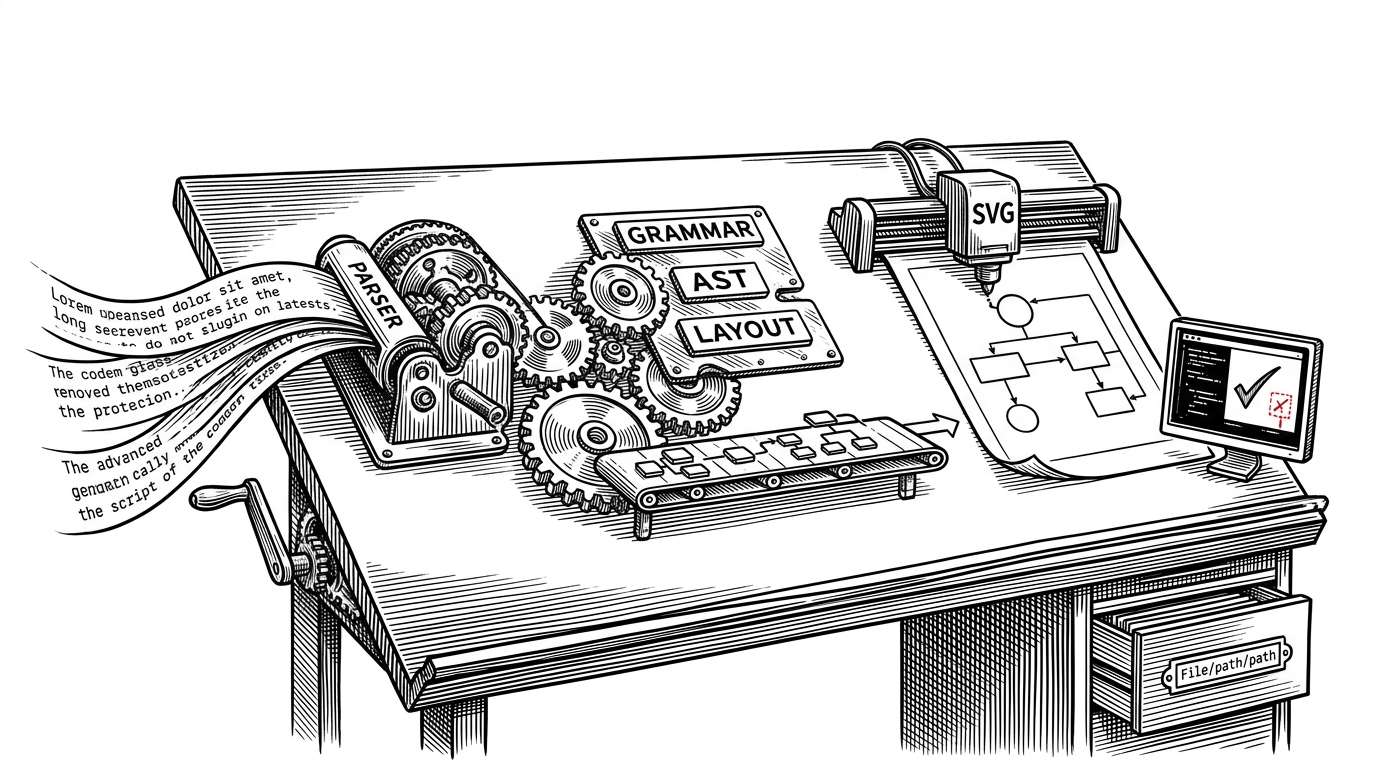
- The implementation reads like a tiny compiler pipeline, with a build step that flattens Tailwind semantics and a runtime that does almost nothing.
- The project competes by collapsing the usual clsx plus tailwind-merge stack into one package without giving up output parity.
The class helper that stopped interpreting and started compiling
Most class helpers are glorified string glue. cn is different. It takes the Tailwind merging problem, compiles the rules into compact tables, and leaves runtime with a narrow job: look up, scan, return.
That is the real surprise in this repo. It does not try to make class merging a little faster in the old shape. It changes the shape.
cn produces the same output as tailwind-merge for every input. We verify this with 356,000 differential tests.
Why Tailwind class merging is secretly expensive
Tailwind makes class strings expressive, but it also creates a conflict system. If a component receives p-2 and later adds px-4, the merge layer has to know which rule wins. Add variants, responsive prefixes, conditional branches, and repeated React renders, and the work stops being trivial.
This is why the old pattern exists in so many codebases: clsx builds the string, then tailwind-merge resolves the conflicts. It works well, but it still interprets Tailwind semantics at runtime.
import { clsx } from "clsx";
import { twMerge } from "tailwind-merge";

export function cn(...inputs: Parameters<typeof clsx>) {
  return twMerge(clsx(inputs));
}| Tool | What it does | Where the Tailwind logic lives | Runtime cost |
|---|---|---|---|
| clsx | Conditionally concatenates classes | Nowhere, it does not know Tailwind semantics | Low |
| tailwind-merge | Resolves Tailwind class conflicts | Runtime parser and merge logic | Higher |
| clsx + twMerge | Common hand-rolled cn pattern | Split between two libraries | Higher |
| cn | Single package with compiled conflict tables | Mostly build time, then fast lookup | Lower |
The key idea is not that Tailwind rules disappear. They are simply paid for earlier.
The compiler: where Tailwind rules become tables
The compiler in compiler.ts is where the project earns its compiler label. It takes nested class-group definitions, validators, and conflict rules, then flattens them into structures the runtime can traverse cheaply. The repository description calls out a radix trie and conflict adjacency lists, which is exactly the kind of transformation that turns human-readable semantics into machine-friendly lookup data.
// Conceptual shape, not exact source
const compiled = buildCompiler({
  classGroups,
  conflictingClassGroups,
  validators,
});

// Runtime uses integer lookups instead of rebuilding rules
const merged = cnRuntime(input, compiled);
This is why the article’s core claim matters. cn is not a faster interpreter. It is a compiler that ships the result.
The runtime: one pass, no allocations, minimal drama
The runtime in engine.ts is built for the common case: strings that repeat, class fragments that do not change much, and UI code that reruns often. Instead of splitting strings into objects and maps, it scans character by character and uses typed arrays like Int32Array and Uint8Array as pointer-like structures.
That matters because allocations are not free. Fewer temporary objects means less garbage collection pressure, and that usually matters more than a flashy benchmark headline. If the engine can return the original string reference, it avoids doing work entirely.

The cache story is what keeps the speed claims from feeling magical. cn assumes UI code behaves like UI code: it repeats itself.
Why the cache layers matter more than the benchmark headline
The best performance ideas usually fit the workload instead of fighting it. cn does that by stacking shortcuts around the patterns React teams already have: the same component trees, the same class combinations, the same prop-driven branches.
| Layer | What it avoids | Why it helps |
|---|---|---|
| Argument cache | Re-checking identical argument lists | Stable references can short-circuit immediately |
| Sequence learning | Walking the same merge path repeatedly | Common render loops become cheaper after the first pass |
| Whole-string cache | Recomputing completed merges | Final outputs can be reused directly |
That is a better story than a raw speed number. The benchmark matters, but the real design insight is that the library treats repetition as the default, not the exception.
How cn compares to clsx, tailwind-merge, and the old pattern
The ecosystem view is straightforward. clsx is good at assembly. tailwind-merge is good at Tailwind conflict knowledge. The old cn pattern glues those together. This project collapses the stack and moves the intelligence out of the hot path.
| Package | Strength | Weakness | Best use case |
|---|---|---|---|
| clsx | Tiny and fast | No Tailwind conflict logic | Conditional class assembly |
| tailwind-merge | Understands Tailwind rules | Does its work at runtime | Conflict resolution only |
| clsx + twMerge | Familiar and flexible | Two libraries, more runtime work | Common app-level helper |
| cn | Compiled tables plus caching | More specialized under the hood | Teams that want parity with less runtime cost |
The practical tradeoff is not simplicity versus power. It is whether you want the runtime to interpret Tailwind on every render, or whether you want that interpretation prepaid.
What this says about the direction of frontend tooling
cn fits a broader pattern in frontend infrastructure. The more predictable a UI problem becomes, the more often its expensive parts can be extracted, precomputed, and stored in compact data structures. That is a compiler instinct applied to app code.
It also suggests something narrower but useful: mature UI tooling is starting to treat repeated renders as a systems problem. Once you do that, optimizations like table flattening, typed arrays, and aggressive caching stop looking exotic and start looking obvious.
Check out cn by shadcn for an even faster cn package. cnfast will no longer be maintained in favor of cn. I recommend you go use that package instead!
That is where cn lands best. It is a utility, but it is also a signal: if the problem is stable enough, move the work out of React and into a compiler.
Source authors and implementation context
The project is co-authored by shadcn and Aiden Bai. The repository structure centers on packages/cn/src/compiler.ts, packages/cn/src/engine.ts, and generated tables, with conformance tests that compare output against tailwind-merge across a large fuzz corpus.
That testing posture is important. A faster class merger is only useful if it keeps the exact same behavior people already depend on.