The Token Miser: How tontinton/maki Built a 60 FPS Coding Agent in Rust
While standard AI tools burn tokens reading entire codebases, this native terminal UI uses AST parsing and local sandboxing to give LLMs exactly what they need.

- Maki rejects the Electron ecosystem, delivering a 60 FPS terminal UI powered by Rust and the lightweight smol async runtime.
- Instead of reading full files, Maki uses tree-sitter to generate structural code skeletons, drastically reducing LLM context window bloat.
- A local Python sandbox allows the LLM to write scripts for heavy data processing outside its context window, returning only the final, filtered results.
- Maki prevents destructive bash commands by parsing them into an Abstract Syntax Tree before execution, neutralizing the classic rm -rf disaster.
The GUI Tax on AI Agents
Modern AI coding agents suffer from a fundamental architectural mismatch. They attempt to run text-based LLM interactions inside heavyweight browser engines and Node.js daemons. This results in bloated, memory-hungry applications that struggle to maintain responsiveness when dealing with massive codebases. The GUI tax is steep, and developers pay it in lost RAM and sluggish performance.
Maki flips this model entirely. Built as a native Rust terminal application, it utilizes the ratatui framework for UI rendering and the lightweight smol async runtime. The result is an agent that operates at a consistent 60 FPS with a near-zero memory footprint. It delivers the power of a modern AI assistant without the overhead of an Electron wrapper.
| Feature | Maki (tontinton/maki) | Standard AI Agent |
|---|---|---|
| Core Engine | Native Rust (Compiled) | Node.js / Electron |
| UI Framework | ratatui (Terminal) | HTML/CSS/DOM |
| Context Strategy | tree-sitter Skeletons | Full File Reading |
| Command Security | AST Pre-parsing | Blind execution with confirmation |
The Token Miser Pipeline
The true cost of an AI agent is measured in context tokens. Traditional agents blindly dump entire 2,000-line files into the LLM's context window just to locate a single function. This approach is computationally expensive and quickly exhausts context limits, leading to "Context Inflation."
Maki acts as a strict token miser through its maki-code-index tool. Instead of reading full files natively, it leverages tree-sitter to map the codebase into a structural skeleton. The LLM receives only function names and line numbers. When the LLM needs specific logic, it uses the read tool to fetch only the required line ranges. This pipeline ensures the context window remains pristine and focused.
Sandboxing the Search
Perhaps the most brilliant technical trick in Maki's repository is the code_execution meta-tool. When an LLM needs to perform heavy data processing, such as searching through hundreds of files, Maki refuses to let it do the work within the context window.
Instead, Maki instructs the LLM to write a Python script. This script is then executed locally via the monty sandbox. The sandbox performs the heavy lifting—running glob and grep commands across the file system—and returns only the filtered results back to the LLM. This offloading strategy drastically reduces network overhead and preserves precious tokens.

Parsing Intent, Not Just Text
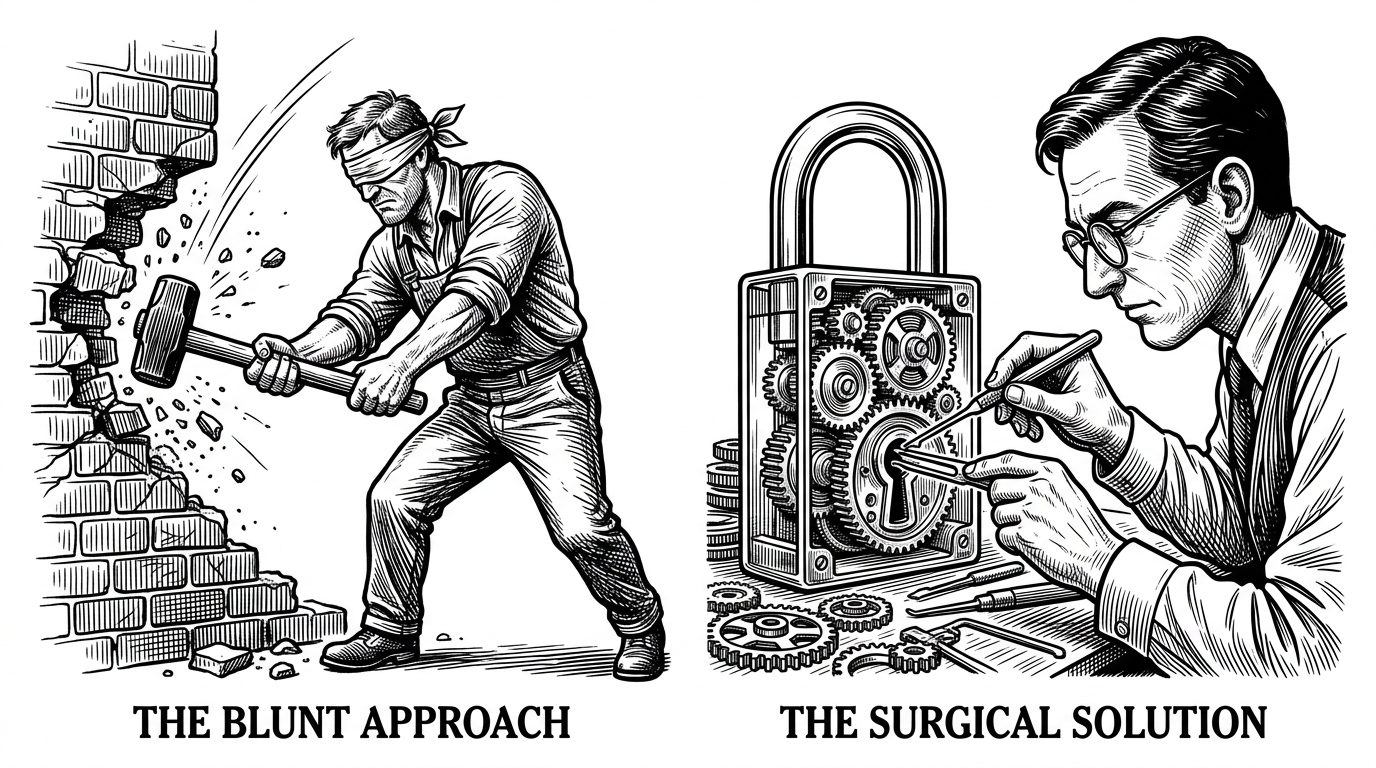
Security in AI agents is often an afterthought, typically handled by simple confirmation prompts before executing bash commands. This leaves developers vulnerable to the classic rm -rf disaster if an LLM hallucinates a destructive command.
Maki disarms the AI through its permissions.rs security model. It utilizes tree-sitter-bash to parse incoming commands into an Abstract Syntax Tree. By analyzing the AST, Maki determines the true intent of the command, neutralizing destructive operations before they ever reach the shell.
Breaking the Doom Loop
Autonomous agents often fall into "Doom Loops," repeatedly calling the same failing tool in a desperate attempt to force an outcome. Maki implements a RecentCalls state tracker to monitor tool usage.
When Maki detects an LLM caught in a loop—such as calling a tool with identical input three times—it forcefully intercepts the execution and returns an error. This breaks the cycle and forces the LLM to adopt a new strategy, ensuring the agent remains truly autonomous.
if self.recent_calls.is_looping(&tool_call) {
    return Err(ToolError::DoomLoopDetected("Forcing strategy change.".to_string()));
}
The Bootstrap Paradox
Maki's extreme optimization is not merely theoretical. The project's scale and highly modular workspace are a testament to its effectiveness. The most compelling proof of Maki's capability is its own creation.
The agent was so successful at managing complex codebases and conserving tokens that it was able to write the vast majority of its own source code, creating a fascinating bootstrap paradox in the world of AI tooling.