grok-build: Grok Build: The Coding Agent That Treats Every Edit Like a Forked Universe
Inside xAI’s Rust-heavy terminal harness, isolated worktrees, actor-managed memory, and structured tools turn coding from a chat into a controlled experiment.
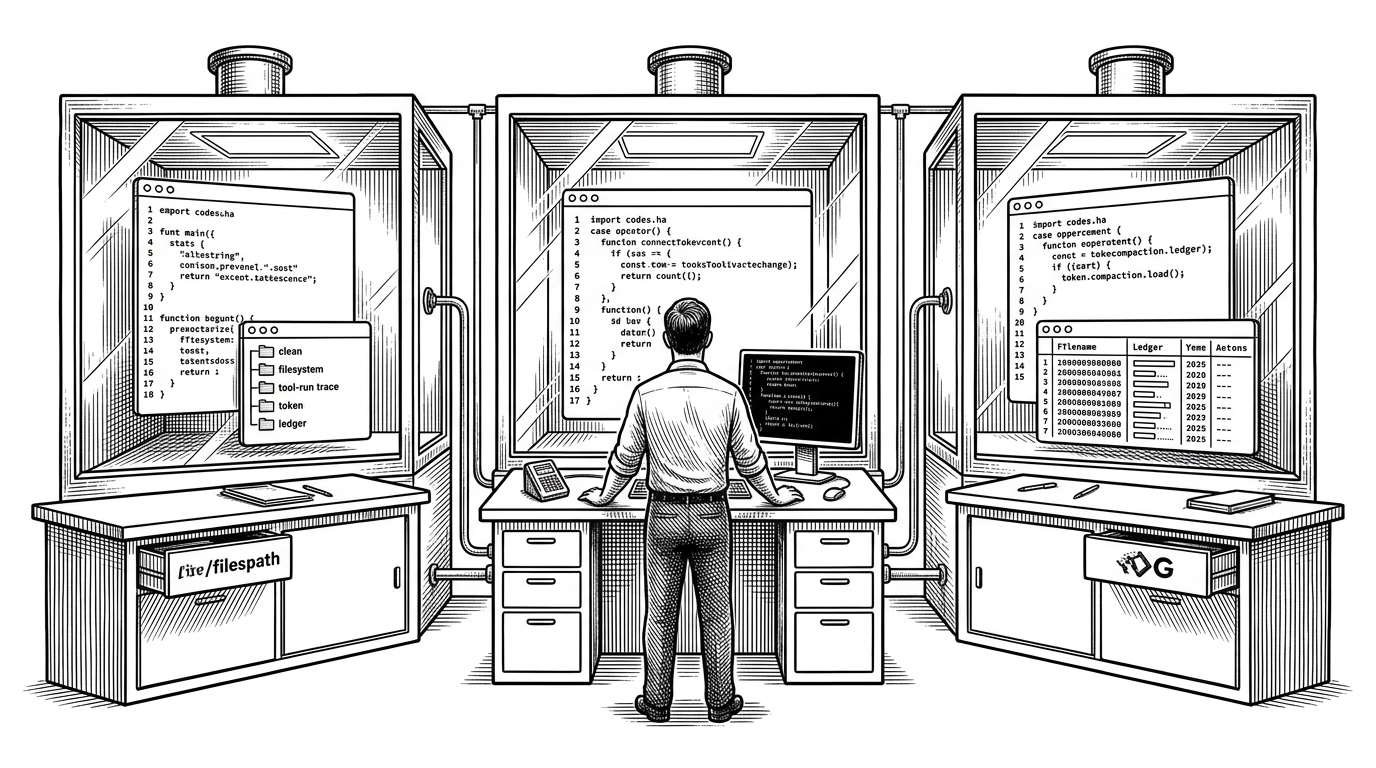
- Grok Build’s biggest idea is isolation, not chat, because it runs code changes through worktrees and controlled tool loops instead of editing the user’s directory in place.
- Its state model is explicit and actor-driven, which makes long sessions and parallel attempts easier to reason about than a shared-mutation design.
- The prompt is compiled like software, not pasted like prose, so safety rules and tool preferences live in maintainable code.
- The repo reads like agent infrastructure, which puts it closer to a sandboxed operating system for coding than a lightweight CLI wrapper.
A Coding Agent Built Around Isolation, Not Hope
Most coding agents sell speed. Grok Build sells containment. The repo is organized around a simple but consequential belief: if an agent is going to make risky edits, it should do so inside a controlled environment, with the failure modes boxed in from the start.
That is why the codebase feels heavier than a typical terminal assistant. It is not just a chat loop with shell access. It is a stack of machinery for spawning experiments, tracking state, and deciding which branch of work deserves to rejoin the main line.
Open-sourcing Grok Build allows anyone to participate in building a reliable and powerful framework.
The Sandbox Is the Product
The center of gravity is xai-fast-worktree. In practice, that means Grok Build is not content to work inside your checkout and hope for the best. It creates isolated copies, lets subagents try different approaches, and keeps the consequences contained until a result is worth merging back.
| Product | Primary environment | Sandbox strategy | State management | Tooling philosophy | Best fit |
|---|---|---|---|---|---|
| Grok Build | Fullscreen terminal TUI | Isolated worktrees and copy-on-write branches | Actor-based chat state | Structured tools first | Multi-step software work |
| Claude Code | Terminal | Managed session sandboxing | Model-centric session state | Tight CLI workflow | Fast interactive edits |
| Aider | Terminal | Lightweight repo editing | Simpler conversation flow | Model-agnostic and direct | Small to medium refactors |
| Cursor | IDE | Workspace-level editing | Editor-integrated context | GUI-first assistance | In-IDE coding and review |
Memory Is Managed, Not Implied
Grok Build’s state layer is one of the least glamorous parts of the repo and one of the most important. Conversation history, token counts, commands, and emitted events are handled explicitly through an actor model, which keeps the agent from becoming a pile of accidental shared state.
// Conceptual shape of the actor flow
let session = SessionActor::spawn();
session.send(Command::UserMessage("refactor the parser"));
session.send(Command::StartSubagent { branch: 1 });
session.send(Command::RecordToolCall { tool: "read_file" });
session.send(Command::MaybeCompactHistory);

// The point is not syntax.
// The point is that state changes travel through a single source of truth.
That design matters because agent sessions are not linear. They branch, revisit old context, and generate enough history to overflow a naive prompt window. A dedicated state actor gives the system a place to compact, summarize, and re-inject reminders without guessing what the rest of the runtime is doing.
Why the Prompt Is a Template, Not a Blob
The prompt is not treated as a hand-edited string. It is rendered with MiniJinja, which means system instructions can vary by role, tool policy, or agent mode without turning the prompt into a maintenance hazard. That is a very different posture from the usual hidden prompt file stuffed at the edge of a repo.
{% if role == "primary" %}
You coordinate subagents and merge results carefully.
{% else %}
You work in a bounded sandbox and report results precisely.
{% endif %}

Prefer structured tools over raw shell commands.
Treat irreversible actions as exceptional.
Keep reminders concise and relevant.
The practical payoff is boring in the best way. Tool preference becomes policy. Safety guidance becomes code. And the prompt can be re-rendered instead of rewritten every time the agent’s role changes.
The Terminal UI Is the Face, Not the Core
The fullscreen TUI is what users notice first, but it is not the deepest part of the system. It is a control room for the machinery underneath: interactive sessions, headless runs, embedded ACP usage, mouse support, and inline rendering for Markdown and Mermaid diagrams.
That puts Grok Build in an unusual place. It is terminal-native, but not minimalist. It is designed to feel operational, almost like a cockpit, because the underlying agent model is already doing the hard work of orchestration.
How Grok Build Compares to Claude Code, Aider, and Cursor
Grok Build enters a crowded field, but the comparison is architectural more than cosmetic. Some tools optimize for convenience. Grok Build optimizes for controlled execution, repeatable tooling, and internal separation of concerns.
| Product | Primary environment | Sandbox strategy | State management | Tooling philosophy | Best fit |
|---|---|---|---|---|---|
| Grok Build | Fullscreen terminal TUI | Parallel isolated worktrees | Actor-based and explicit | Structured tools and policies | Agentic software engineering |
| Claude Code | Terminal | Scoped CLI workspace | Session-driven | Fast conversational coding | Quick terminal workflows |
| Aider | Terminal | Direct repo editing | Lightweight chat flow | Lean and model-agnostic | Simple code changes |
| Cursor | IDE | Editor workspace | IDE-integrated context | GUI-first copilot | In-editor development |
The main difference is that Grok Build behaves like infrastructure. Aider is lighter. Cursor is more visual. Claude Code is a close terminal peer. Grok Build feels built for the kind of software work where the agent needs to run many attempts, isolate the damage, and surface a result only after the experiment proves itself.
What the Repo Reveals About xAI’s Agent Strategy
The repo suggests a strategy that favors deterministic tooling, hermetic execution, and observability over a thin model wrapper. The engineering choices point in the same direction: keep tools structured, keep work isolated, keep state explicit, and keep the UI subordinate to the runtime.
That does not make Grok Build elegant in the minimalist sense. It makes it legible as a production system. The interesting bet is that coding agents become more useful when they stop behaving like improvisational chatbots and start behaving like disciplined laboratories.