`Awesome_Math_Books`: The GitHub Repo That Treats Old Math Books Like Infrastructure
A curated, proof-first library of timeless mathematics texts, Soviet-school pedagogy, and new English translations for people who want fewer shortcuts and more understanding.
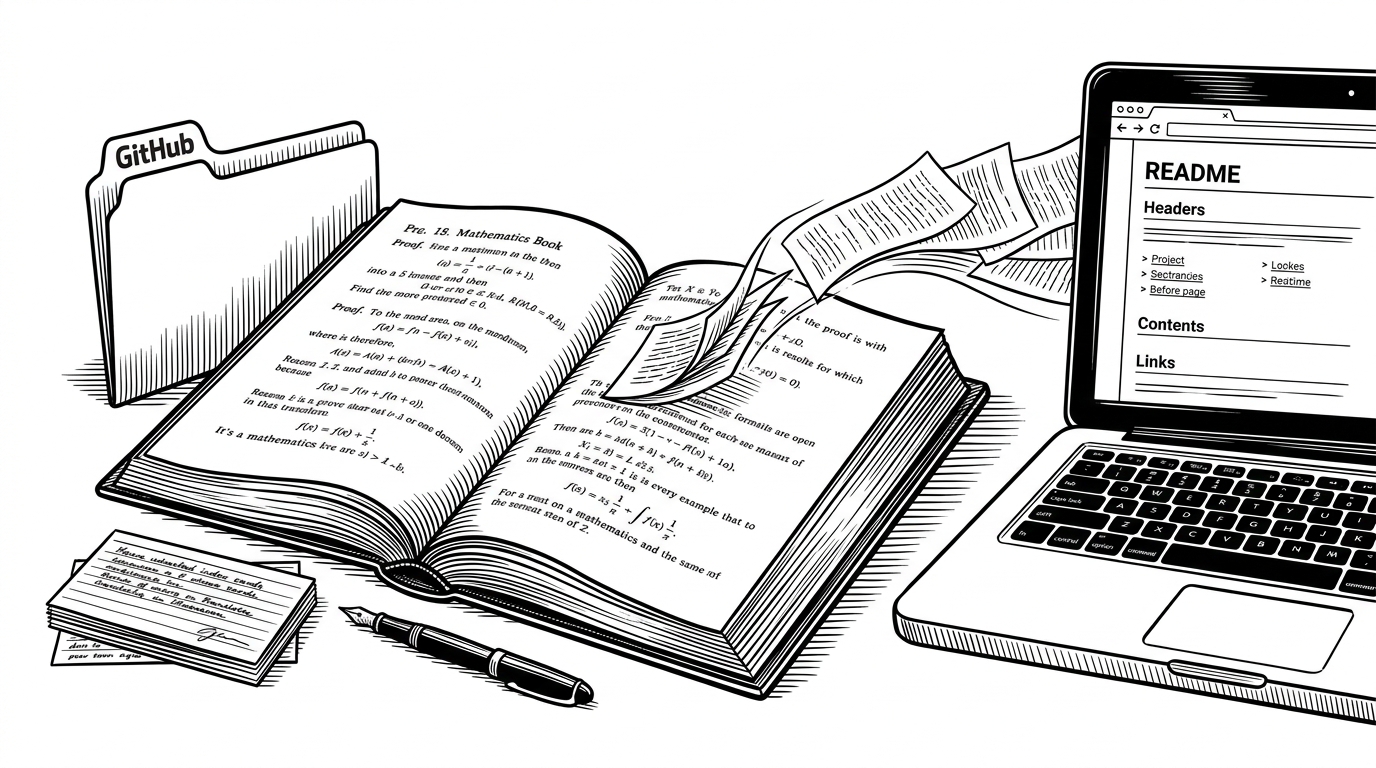
- `Awesome_Math_Books` is not trying to be comprehensive; it is trying to be coherent, and that makes it feel more like a curriculum than a catalog.
- The README does double duty as a syllabus and a storefront, surfacing curated classics while also distributing new English translations of older texts.
- Its core thesis is pedagogical: define, prove, apply, practice beats modern textbook bloat for readers who want structural understanding.
- The repo shows how GitHub can host editorial judgment, not just code, when a single maintainer turns taste into a visible system.
Why this repo exists
Most math reading lists are built like search engines. This one is built like a point of view. `valeman/Awesome_Math_Books` argues that the shortest path to mathematical clarity still runs through older, proof-led books, especially the Soviet tradition of teaching.
That position matters because it is opinionated in a useful way. The repository is not trying to cover every subfield or every modern textbook. It is choosing books that reward slow reading, dense reasoning, and repeated practice.
The goal of this repository is simple: • highlight timeless mathematical books • avoid modern textbook bloat • emphasize logical thinking and problem solving
The README is the product
On the surface, the repo is a Markdown file with links. In practice, it behaves like a database, a storefront, a syllabus, and a publishing manifesto at once. The top of the README spotlights featured translations. The rest of it becomes a curated library organized by subject and use case.
## Featured translations
- Kiselev, Arithmetic and Algebra
- A.A. Markov, The Calculus of Probabilities

## Categories
- Mathematics
- Probability
- Physics
- Optimization
- Machine Learning
From curation to translation
What makes this repo more than an awesome list is that the maintainer is not only collecting links. He is selecting canonical texts, translating them, packaging them, and then using GitHub as the distribution layer. That is a real editorial pipeline.
The result is a rare combination of roles. The repo is curator, translator, and distributor. That is why it feels less like a bibliography and more like a lightweight publishing operation built on open infrastructure.

Why Soviet-school math keeps winning people over
The appeal is not nostalgia. It is structure. These books often move through definition, proof, application, and practice with a discipline that many modern textbooks dilute with extra commentary, visual clutter, or over-simplified intuition.
That format is especially attractive to self-taught learners and technical readers. If you already know how to think in abstractions, you do not need more fluff. You need a path that keeps the logic visible.
| Repo / source | Scope | Curation style | Pedagogical philosophy | Best for | Weakness |
|---|---|---|---|---|---|
| valeman/Awesome_Math_Books | Narrow and selective | Opinionated, proof-first | Define, prove, apply, practice | Readers who want coherence | Not exhaustive |
| Broad awesome math lists | Wide and sprawling | Aggregative | Mixed approaches | People searching by topic | Hard to know where to start |
| Modern textbook lists | Often current and practical | Utility-driven | Concept first, then exercises | Classroom users | Can feel bloated |
What the library contains
The collection spans foundations, probability, geometry, analysis, machine learning, physics, optimization, econometrics, signal processing, and history. That breadth matters, but the key detail is selectivity. This is not a giant index. It is a filtered curriculum.
The categories make the repository useful in a second way. They show how older books can still serve modern technical work, especially for AI, statistics, and applied mathematics. The classics are framed not as museum pieces, but as working tools.
How this beats bigger math lists
Broader awesome lists win on breadth. This repo wins on coherence. That difference is decisive if you are not browsing for entertainment, but trying to build a mental model of mathematics from the ground up.
A giant list gives you options. This one gives you a method. It says, in effect: start here, trust the sequence, and let the books do the teaching.
| Dimension | Broad awesome list | Awesome_Math_Books |
|---|---|---|
| Curatorial goal | Include as much as possible | Build a coherent thesis |
| User experience | Browse and hunt | Follow a reading path |
| Editorial voice | Low | High |
| Role of translations | Usually absent | Central |
| Primary value | Coverage | Judgment |
What GitHub becomes when it publishes knowledge
This repository is a good reminder that GitHub is not only for code. It can also host taste, judgment, and distribution. When a single maintainer uses a README to surface a philosophy and ship translations, the platform starts to look like a niche publishing house.
That is the real story here. `Awesome_Math_Books` is not merely organizing books. It is turning a repo into an argument about how people should learn mathematics, and then making that argument easy to act on.