react-native-diffs: The Native Diff Engine Hiding Inside a React Native Component
A look at how Vercel Labs turns markdown, diffs, and Nitro Modules into a mobile renderer that feels closer to an IDE than a UI widget.
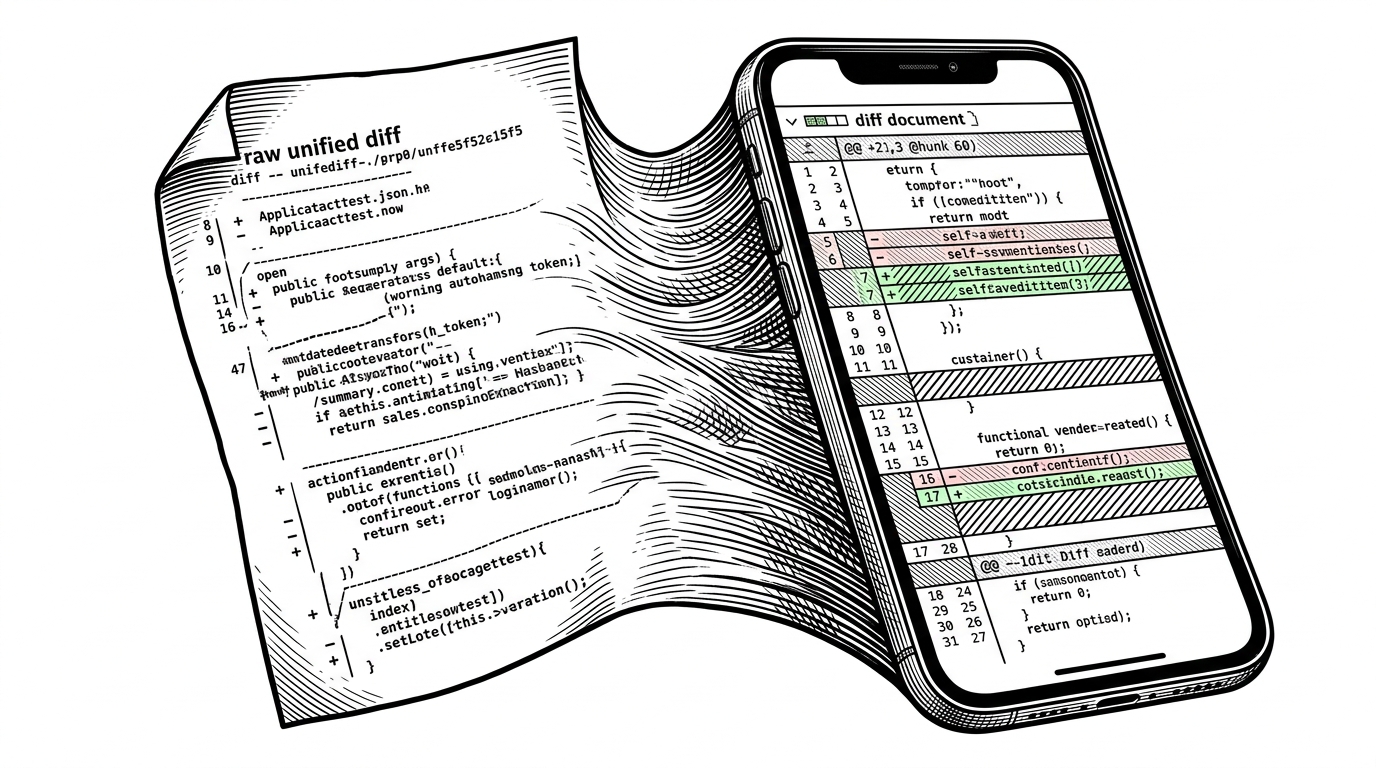

Diff library for React Native, powered by MarkdownView.
- `react-native-diffs` treats diff rendering as a native document pipeline, not a JavaScript widget layered on top of a scroll view.
- The real abstraction is the Nitro contract: React defines a rich theme and content surface, while native code owns rendering, scrolling, and rerender control.
- The iOS implementation is the clearest proof of the thesis, because it maps theme data into a native markdown renderer and skips work when content has not changed.
- The unfinished Android side is not a footnote, it is evidence that this repo is an experimental bet on where React Native performance work is headed.
The best part of this repo is not the diff
The obvious reading is wrong. This is not a clever diff component, it is a native document renderer that happens to accept diff-shaped input. The README says it can render raw unified diffs, fenced diff blocks, and patch blocks, then auto-detect, style, and annotate them with hunk headers, line numbers, and inline highlighting.
That quote is almost too modest for what the repo is doing. The interesting move is that the project starts from MarkdownView, not from a custom diff painter. That choice reframes diffs as structured documents, which is why the component can feel closer to an IDE subsystem than a normal React Native wrapper.
Why React Native needs a different diff stack
Diffs are not just text. They are text plus structure plus layout pressure. You want syntax-aware rendering, inline change emphasis, theming that holds up on large files, and scrolling that does not fall apart when the content gets dense.
| Problem | JS-first approach | Native-first approach |
|---|---|---|
| Rendering model | Reconcile and paint through React Native view updates | Let native own the view hierarchy and scroll behavior |
| Performance posture | Flexible, but bridge-heavy when content is large | Lower overhead once the contract is set |
| Theming depth | Often enough for surface styling | Granular enough for diff-specific colors and behaviors |
| Scrolling | Depends on RN layout and virtualization choices | Uses native scrolling primitives directly |
| Best fit | Simple viewers and broad compatibility | IDE-like document surfaces on mobile |
That is why the repo matters. It is not trying to be the universal diff answer. It is choosing a narrow use case, then pushing the implementation toward the place where React Native is strongest: describing the interface in JS while letting native code do the expensive, latency-sensitive work.
Inside the contract: Nitro, HybridView, and the Theme object
The key file is Diffs.nitro.ts. That is where the public contract lives, and it is unusually rich for a component that could have been a thin wrapper. Instead of a few cosmetic props, the type surface includes detailed theme controls, plus behavior knobs like contextCollapseThreshold.
That matters because the component is not just accepting a color scheme. It is receiving enough structure to let the native side own more of the rendering policy. In other words, React declares intent, native executes.
The iOS path is where the thesis becomes visible
On iOS, the implementation wraps a UIScrollView around a markdown text view, then maps the TypeScript theme into native objects before rendering. There is also a simple but telling guard: if the content has not changed, it does not do the expensive work again. That is the sort of detail that separates a demo from a rendering engine.
The Display P3 color handling is another clue. Nobody adds wide-gamut support because they want a basic proof of concept. They add it because they care about the fidelity of the rendered surface, the same way a desktop editor or design tool would.

The unfinished Android story says something important
The Android side is mostly scaffold, and that is not a weakness in the article. It is part of the evidence. The repo is not pretending to be a mature cross-platform library yet, which makes the architectural ambition easier to trust.
| Platform | State in repo | What it implies |
|---|---|---|
| iOS | Implemented with native rendering and theme mapping | The rendering thesis is already real |
| Android | Mostly scaffolding plus Nitro glue | The architecture is prepared, but the product is still experimental |
| C++ bridge | Present through Nitro initialization | The team expects the native path to matter on both platforms |
That asymmetry tells you where the interesting work is happening. The project is betting that the expensive part of diff display belongs in native code, and it is willing to prove that idea on one platform before it fills in the other.
How it compares to browser diff tools
Browser-first diff tools optimize for reach and simplicity. They are easy to ship, easy to inspect, and often good enough for quick comparisons. But they live in a different world from a React Native app that wants IDE-grade scrolling, theming, and document rendering on mobile.
| Dimension | Browser diff tools | react-native-diffs |
|---|---|---|
| Platform target | Web browser | React Native apps |
| Rendering model | DOM and browser layout | Native document rendering through Nitro |
| Performance bias | Universal access | Mobile-native presentation and scroll behavior |
| Theming | Usually surface-level | Highly granular diff-specific theming |
| Typical use case | Quick comparisons and utilities | Developer tools and mobile review surfaces |
| Trade-off | Less mobile-native | More platform-specific, but more faithful to the device |

What kind of team builds this?
This looks like a Vercel Labs experiment in the best sense. The code is small, the surface is focused, and the scaffolding is serious enough to suggest a project with real intent rather than a throwaway demo. The repo reads like a prototype that was designed by people who care about production constraints even before the product is finished.
That is why the contributor footprint matters. A single visible maintainer and a compact repo make the architecture easier to read. You can see the thesis without having to dig through a large team’s layers of abstraction.
The real takeaway
The best way to understand this repo is to stop thinking about diffs and start thinking about rendering authority. React Native declares the contract, but the native layer owns the expensive work. That is the pattern this project is quietly arguing for.
If you are building a mobile app that needs IDE-grade text surfaces, this is the kind of architecture that should make you pay attention. It is not a universal answer. It is a pointed answer to a class of problems that JS-only rendering tends to handle poorly.