DuelingUCB: Learning the Best Choice Without Ever Seeing a Score
A compact Python repo that turns pairwise wins into an Upper Confidence Bound loop, showing why preference feedback can be more useful than numeric reward.
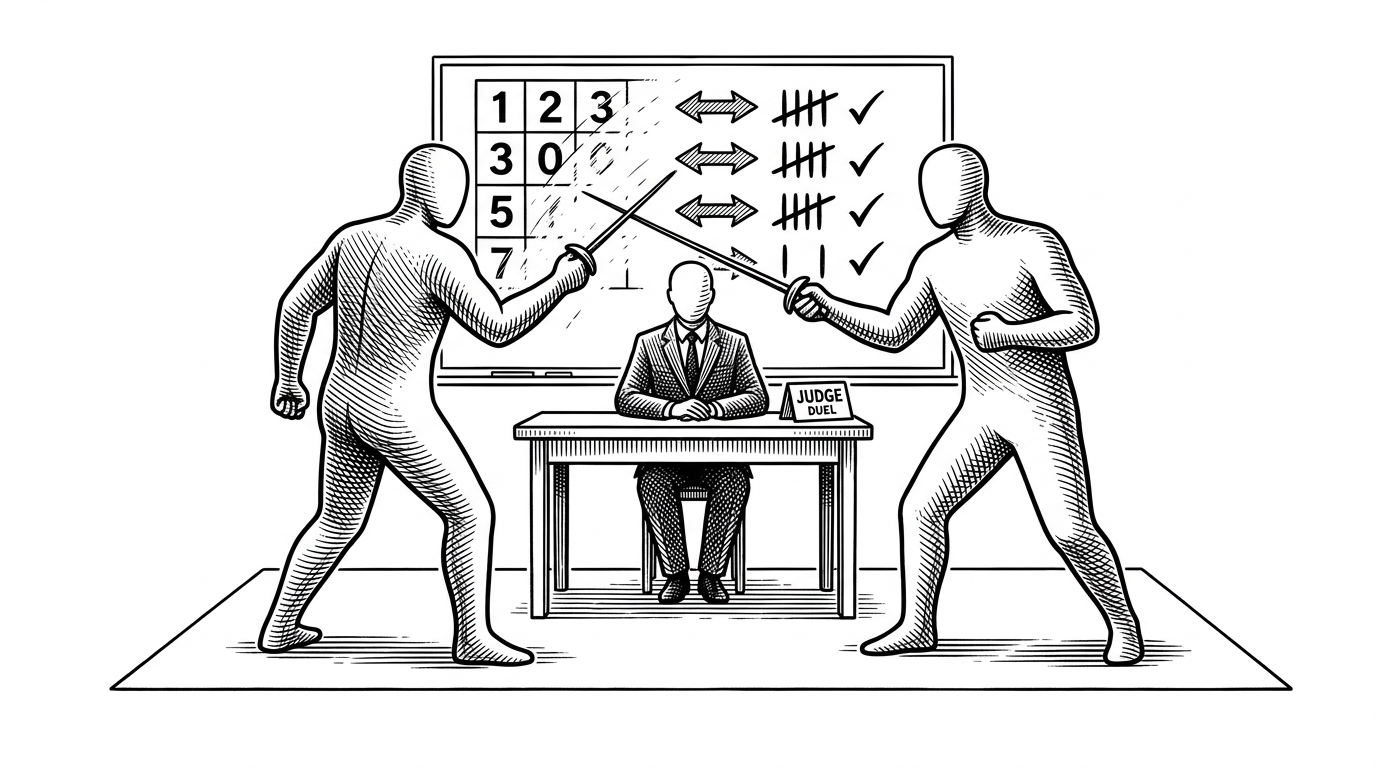
- DuelingUCB matters because it learns from comparisons, which is often closer to how humans and ranking systems actually judge quality.
- Its core loop is classical UCB, but the confidence lives on pairwise win rates instead of single-arm rewards.
- The repo's value is clarity: it turns a research idea into a small, readable baseline instead of a framework.
- In the bandit family, it sits between textbook UCB and modern neural dueling methods, favoring interpretability over breadth.
Why pairwise wins are more honest than scores
Most bandit algorithms start with a number. Clicks, rewards, points, losses, some scalar signal that can be averaged and optimized. DuelingUCB starts somewhere more awkward, and more realistic: which of these two options is better? That shift sounds small until you notice how often real judgment works that way.
People are rarely good at assigning calibrated scores. They are better at choosing between alternatives. Search ranking, recommendation, human preference tests, and model evaluation all lean on that fact, which is why preference learning keeps showing up wherever absolute reward is noisy or unavailable.
This repository reads like a compact research implementation from someone who cares more about the idea than the scaffolding. That is a strength, not a weakness. It gives you a clean view of the algorithmic move: replace scores with duels, then let uncertainty drive the next matchup.
What DuelingUCB is actually learning
The mental model is simple. The learner imagines a preference matrix, where P(i, j) is the probability that option i beats option j. Each round, it selects a pair, watches the winner, updates its counts, and revises how confident it is about that relationship.
The UCB part is the familiar optimism trick. If the algorithm has seen very few duels between two arms, it should not act certain. So it adds a confidence bonus to the win estimate and keeps uncertain pairs in play longer than a naive tally would.
That matters because the goal is not just to find a winner, it is to avoid being confidently wrong too early. In dueling bandits, regret is often the cost of wasting rounds on the wrong comparisons, so the confidence term is doing real work, not decorative math.
The part that makes it different
The most interesting thing about DuelingUCB is not that it uses UCB. It is that it uses UCB on relationships instead of raw rewards. That makes the algorithm feel like a better fit for messy judgment tasks, where you can often say "A is better than B" long before you can justify a numeric score for either one.
That is why dueling bandits keep resurfacing in modern evaluation workflows. A human rater, a search ranker, or a language model judge can often compare two outputs more reliably than it can place them on an absolute scale. Preference learning treats that as the primary signal, not a workaround.

In that sense, the repo is less a product than a proof of interface. It shows how a hard epistemic problem, learning preference from noisy comparisons, can be expressed with a very small set of moving parts.
How it compares with the rest of the bandit family
| Approach | Feedback signal | Strength | Trade-off |
|---|---|---|---|
| Standard UCB | Numeric reward | Simple, fast, and widely understood | Assumes a score exists and is meaningful |
| Classical dueling bandits, including RUCB | Pairwise preference | Matches head-to-head judgments more naturally | Adds bookkeeping and pairwise complexity |
| DuelingUCB in this repo | Pairwise wins plus an optimism bonus | Compact, readable, and easy to reason about | Needs structured comparisons and a preference-style setting |
| Neural dueling bandits | Comparisons over learned representations | Can handle richer inputs and more complex patterns | Heavier models, less transparency, more moving parts |
The table is really about interface design. Standard UCB asks, "What was the reward?" Dueling methods ask, "Which one won?" Neural methods add representation learning on top. DuelingUCB sits at the clean classical center, where the math is visible and the trade-offs are easy to inspect.
Why a small research repo still matters
There is a real virtue in a repository that stays focused on one idea. It becomes easier to test, easier to teach from, and easier to compare against newer methods. For a topic like preference learning, that clarity matters because the underlying question is already slippery.
This is the kind of code that bridges theory and practice without trying to become a platform. If you want a baseline that makes the mechanics legible, DuelingUCB does that well. If you want production tooling, you would build around it. The repo's value is that it makes the idea feel executable.