OsEngine: The C# Trading Terminal That Made Room for an AI Co-Pilot
A desktop algorithmic trading platform with its own data pipeline, execution engine, and hybrid charting stack, now wired for agent-driven workflows through MCP.
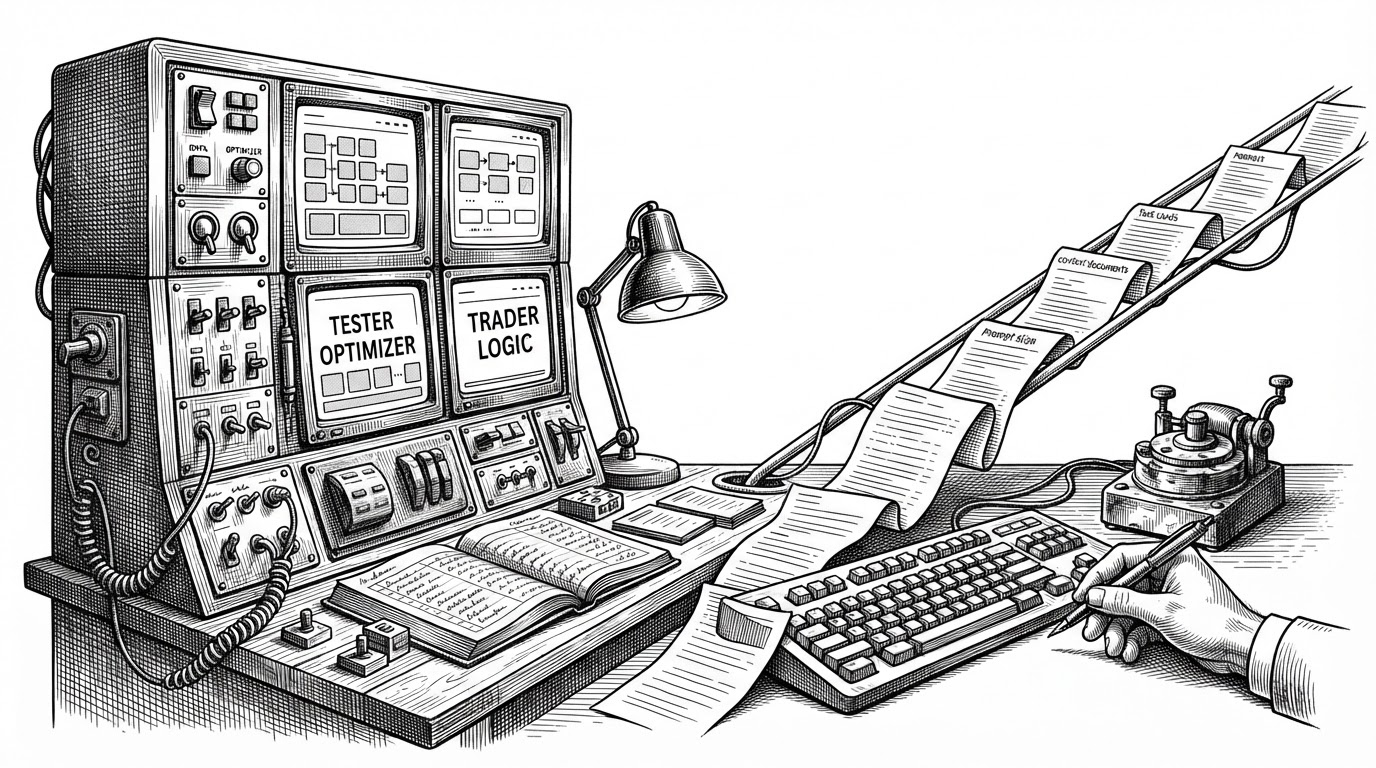
- OsEngine is interesting because it makes a traditional trading terminal legible to AI agents without abandoning the desktop workflow traders already trust.
- Its architecture splits data, testing, optimization, execution, and charting into distinct parts, which is what makes the MCP layer practical instead of cosmetic.
- The platform treats candle construction as a configurable abstraction, so strategies can consume different market bars through the same interface.
- OsEngine competes on a different axis from Lean or Backtrader: visual control, C# native ergonomics, and a live workstation feel.
Why OsEngine matters now
OsEngine is not trying to win by looking modern. It is trying to win by making a serious trading terminal readable to both humans and agents. That is why its recent MCP support matters: the project is not just a bot framework anymore, it is a workstation that an LLM can help operate.
OsEngine becomes an AI-driven terminal: an agent (Claude, Kimi, ChatGPT or any other MCP client) downloads market history, creates and configures robots, runs backtests and walk-forward optimization, connects exchanges, reviews equity and reconciles positions with the exchange — right from the chat.
That shift is bigger than it sounds. Most trading tools either stay manual and visual, or become headless engines built for code-first users. OsEngine sits in the middle: a desktop application with source-level structure, a backtesting flow, and enough context scaffolding for an agent to move through the same workflow a power user would.
A trading terminal, not just a library
The repo is organized like a full trading product, not a single engine. The platform is split into OsData for historical data, OsTester for backtesting, OsOptimizer for parameter search and walk-forward testing, and OsTrader for live execution.
That shape matters because it makes the workflow inspectable. A trader can look at the same platform that collects data, simulates strategies, tunes parameters, and places orders. The system does not hide the handoff points. It exposes them.
The pipeline that turns raw ticks into decisions
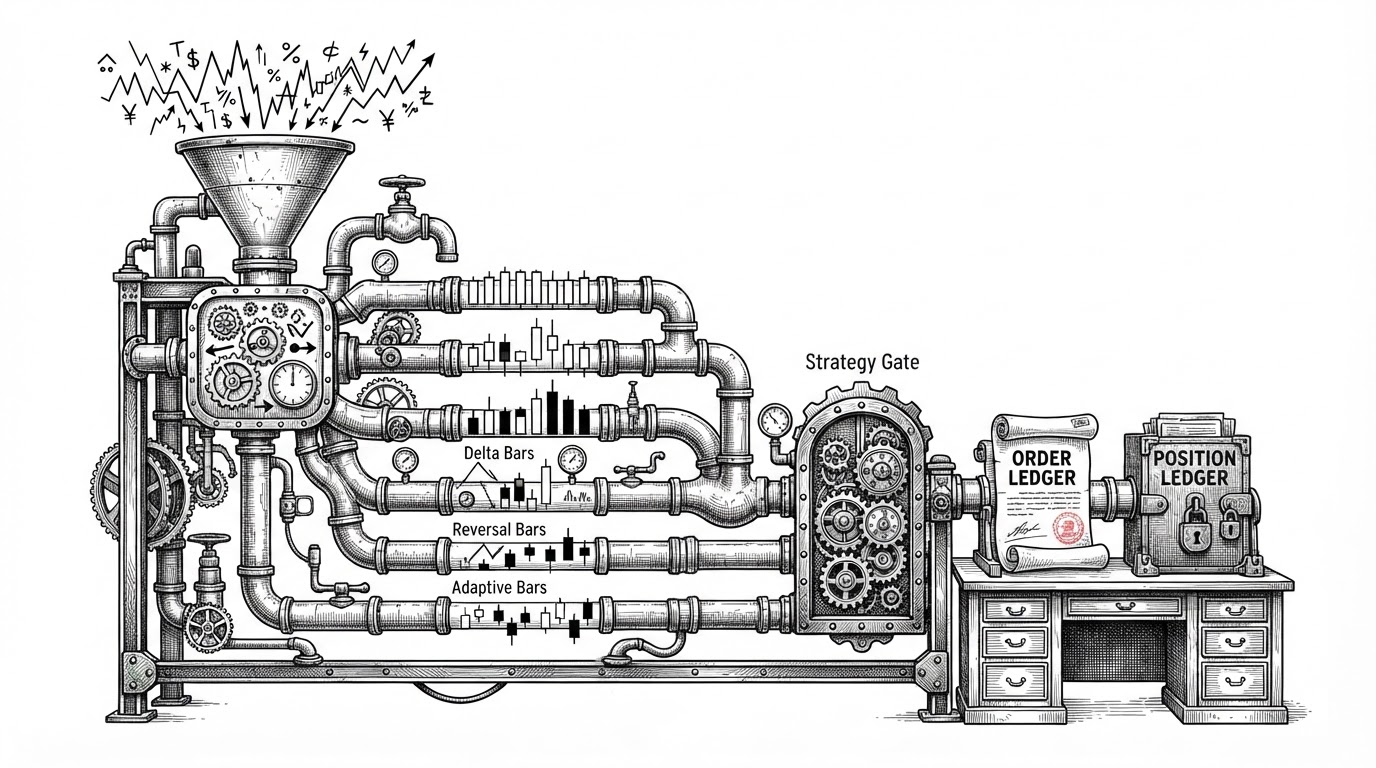
This is where OsEngine gets subtle. CandleManager sits between raw server data and strategy code, routing trades and depths into standardized candle series. The important part is that the rest of the engine does not need to care whether the series is time-based, tick-based, volume-based, or something more adaptive.
That is a strong design choice. It means time is not treated as a law of nature. It is treated as a data product, something the platform can reshape before a strategy consumes it.
// Conceptual flow
serverData -> CandleManager -> CandleSeries -> strategy

// The strategy reads the same interface
foreach (var candle in candles)
{
    if (candle.Close > candle.Open)
    {
        // signal logic
    }
}
Why the charting layer is half the product
OsEngine's UI story is not ornamental. Trading software lives or dies on how quickly a user can see state changes, inspect positions, and compare simulation to live behavior. The codebase uses a pragmatic hybrid of WPF and WinForms so it can keep a modern shell while leaning on fast rendering where it matters most.
That compromise is very on brand for the project. This is not a purity play about one framework beating another. It is a trader's answer to a latency problem. If the chart lags, the workflow breaks.
What happens inside a trade
The execution model is similarly explicit. Order.cs tracks a trade through its lifecycle, including partial fills and execution volume. Position.cs links open and close orders into a relationship that supports netting and hedging style behavior instead of reducing everything to a single opaque number.
That gives the platform room to model real market friction. Orders are not abstract intentions. They are stateful objects with execution history. Positions are not just balances. They are collections of related events with accounting and risk implications.
Market event -> strategy decision -> order creation -> partial fills -> position update -> chart and equity refreshHow OsEngine differs from the rest of the field
| Platform | Primary language | Desktop UI | Backtesting | Live trading | AI readiness | Setup complexity | Best fit |
|---|---|---|---|---|---|---|---|
| OsEngine | C# | .NET desktop shell | Built in | Built in | MCP and context files | Moderate | Desktop traders who want visual control and agent support |
| Lean | C# | Limited local UI | Strong | Strong | Indirect | High | Quant teams that prefer a headless engine and cloud workflows |
| Backtrader | Python | Minimal | Strong | Possible with extensions | Indirect | Low to moderate | Python users who want script-first research |
| StockSharp | C# | Desktop oriented | Strong | Strong | Low to moderate | Moderate to high | Users in the C# ecosystem who want a commercial-grade platform |
OsEngine is not trying to beat Lean at global scale or Backtrader at Python familiarity. It is optimizing for a different user: someone who wants a desktop terminal, source access, and a visual workflow, then wants an LLM to help carry some of that load.
The open-source project behind the terminal
One of the key areas of our team's expertise is creating trading robots. We trade ourselves, serve algorithmic funds, and individual algo traders. Throughout the process of creating hundreds of different projects for trading automation, a framework for building robots has emerged. It is open, modern, and highly expandable.
The project has clear roots in a long-running trading practice, not a generic startup cycle. AlexWan is the dominant contributor, and the docs reflect a platform shaped by years of production use, exchanges, and community feedback. That history shows up in the code style too. The repo favors explicitness over minimalism, which is often what serious financial software looks like when humans need to trace every step.
The layer for creating robots is similar to the Wealth-Lab script and Ninja Script. It's simple. We do not change it with every release and support backward compatibility.
That backward compatibility story is one reason the platform feels durable. In a domain where users build trust slowly, keeping the robot layer stable is a feature, not a constraint.
Bottom line
OsEngine is what a serious trading terminal looks like when it is built for humans first, then made legible enough for AI to operate. Its real differentiator is not just that it trades. It is that it organizes data, execution, visualization, and context into a shape that both a trader and an agent can navigate.