ViMax: The Open-Source Film Studio That Teaches AI Video to Remember
A deep dive into the agentic pipeline, the camera tree, and the structured shot logic that try to solve the hardest problem in video generation: staying coherent from scene to scene.
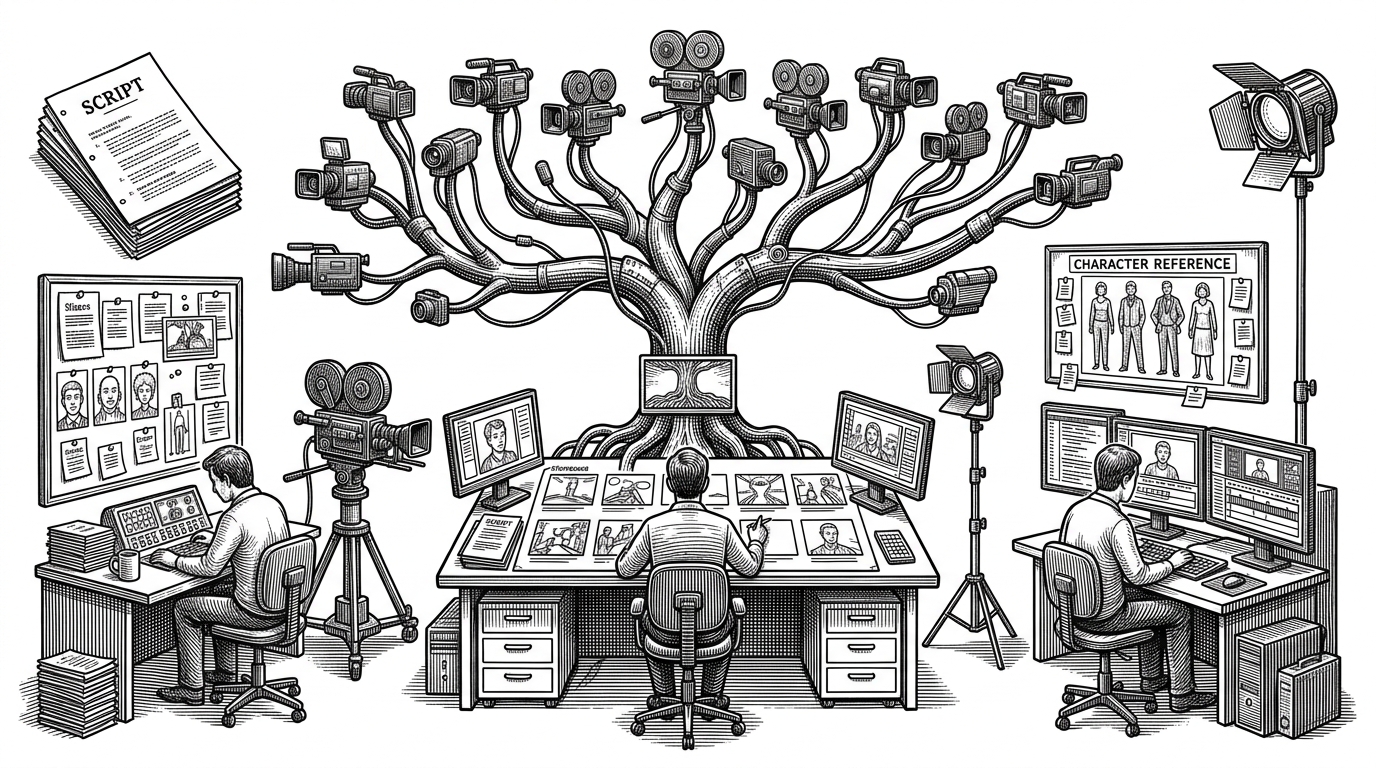
- ViMax’s real invention is not agent choreography, but a continuity system that keeps characters and scenes stable across multiple shots.
- The camera tree turns one anchor shot into a reusable source of visual identity for downstream scenes.
- Structured shot data matters because prose alone is too loose for reliable video assembly.
- ViMax is closer to a production pipeline for synthetic filmmaking than a standalone text-to-video model.
Most AI video demos are easy to admire and hard to trust. They look good until the second shot, when a face changes, a jacket mutates, or the scene starts forgetting what it was supposed to be about. ViMax, from HKUDS/ViMax, is interesting because it treats that failure as the main problem.
The hardest part of AI video is not generation. It is continuity.
Single-shot generation is a solved marketing problem, not a solved storytelling problem. If you want a ten-second clip, a model can often give you something cinematic enough to fool the eye. If you want a scene, then another scene, then a return to the same character with the same coat, posture, and room layout, the system starts to fracture.
ViMax is built around that fracture. The repo frames video as a production pipeline, not a prompt contest, and that changes the shape of the whole system. Continuity becomes a first-class object, which means the model is no longer asked to improvise everything at once.
ViMax’s answer: a camera tree, not a pile of prompts
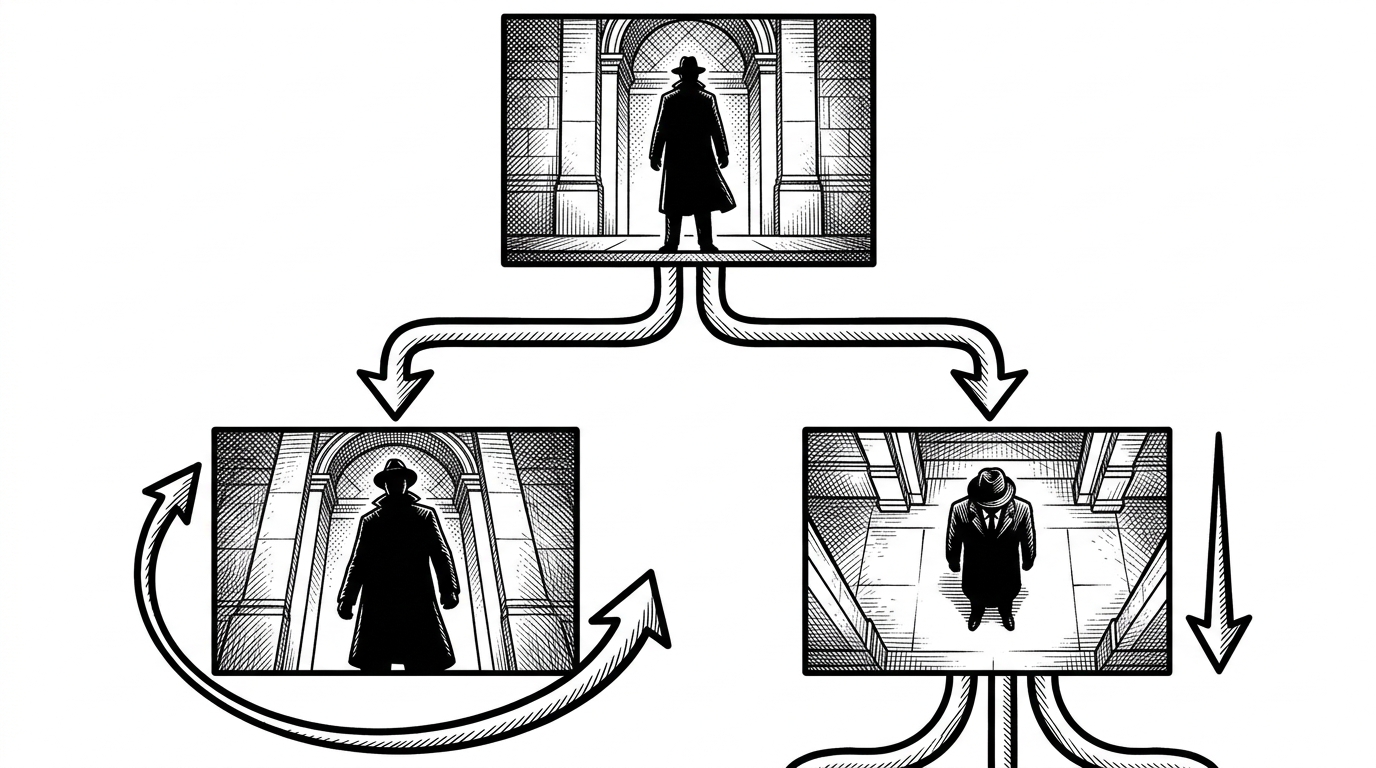
The camera tree is the repo’s most revealing idea. A priority shot acts like an anchor: it establishes the character, framing, background geometry, and tone. Downstream shots inherit that state, so the system is not guessing the visual world from zero every time.
A film crew made of agents
ViMax is a multi-agent video framework that enables automated multi-shot video generation while ensuring character and scene consistency. Our system seamlessly translates your ideas into corresponding videos, allowing you to focus on storytelling rather than technical implementation.
That quote captures the project’s stance well. The agents are not decorative. They are the mechanism that lets the pipeline separate writing, planning, character extraction, and shot design into different jobs with different constraints.
Why structured shot data matters
ViMax avoids handing raw prose from one step to the next. Instead, it uses structured interfaces such as `ShotDescription`, which split a shot into machine-friendly fields like `first_frame_description`, `last_frame_description`, and `dynamic_motion`. That matters because video models need anchors, not just vibes.
from pydantic import BaseModel

class ShotDescription(BaseModel):
    scene_id: str
    shot_id: str
    first_frame_description: str
    last_frame_description: str
    dynamic_motion: str
    characters_in_scene: list[str]
    camera_angle: str
    camera_movement: str

shot = ShotDescription(
    scene_id="scene_03",
    shot_id="shot_03_01",
    first_frame_description="A woman in a red coat stands beside a rain-streaked window",
    last_frame_description="She turns toward the door as the light shifts",
    dynamic_motion="slow pan left with subtle handheld drift",
    characters_in_scene=["Mina"],
    camera_angle="medium close-up",
    camera_movement="pan"
)
This is the real engineering move. Once the scene is decomposed into fields, the pipeline can validate, reuse, checkpoint, and hand off state cleanly. Text still matters, but text is no longer the only carrier of meaning.
The pipeline is resumable on purpose
The entry pipeline is designed like work you would actually rerun. It checks for existing artifacts, lets humans intervene, and can pick up after a partial run instead of forcing a full restart. That is a small detail with big implications: the system is not pretending production is a single uninterrupted pass.
def run_idea_to_video(idea):
    story = load_or_generate_story(idea)
    characters = load_or_extract_characters(story)
    portraits = load_or_generate_portraits(characters)
    shots = plan_or_resume_script(story, characters)
    if needs_manual_review(shots):
        pause_for_editing(shots)
    video = render_shots(shots, portraits)
    return assemble_timeline(video)
That resumable design matters because creative pipelines are messy. A writer may want to fix the story after the first pass. A producer may want to swap a character reference. A rendering job may fail halfway through. ViMax assumes those realities instead of sweeping them away.
What makes ViMax different from the rest of the video stack
| Project type | Strength | Weakness | Where ViMax fits |
|---|---|---|---|
| Single-clip text-to-video | High-fidelity shots with strong visual polish | Weak long-range continuity and manual stitching | ViMax sits above these models as the orchestration layer |
| Video editing assistant | Helps search, trim, and remix existing footage | Depends on footage already being captured | ViMax generates the narrative source material first |
| Prompt-only multi-step pipeline | Fast to prototype and easy to hack together | Brittle state handoffs and inconsistent outputs | ViMax replaces ad hoc glue with typed structure and checkpoints |
The comparison is simple once you see it. Generators make clips. Editors manipulate footage. ViMax tries to run the studio in between, where continuity, planning, and state management live.
Who this is for, and where it stops
ViMax is compelling for creators who care about coherence more than instant spectacle. That includes novel adaptation, branded video workflows, rapid prototyping, and teams that want a controllable assembly line instead of a single opaque model call.
| Good fit | Why it works | Poor fit | Why it misses |
|---|---|---|---|
| Novel-to-video experiments | The pipeline can segment long narratives into structured scenes | One-click cinematic toys | The system is built around structure, not spontaneity |
| Marketing and product explainers | Reusable characters and repeatable shot logic help consistency | Pure improvisational visuals | The camera tree rewards planning and inheritance |
| Technical teams | Typed interfaces and resumable jobs are easy to integrate | Users who want no workflow at all | ViMax assumes you want control, checkpoints, and state |
That is also the boundary. If someone wants a magic box that turns one sentence into a finished film with no structure, ViMax is probably too opinionated. If they want an open system that makes continuity a designed property, this repo is the more serious bet.