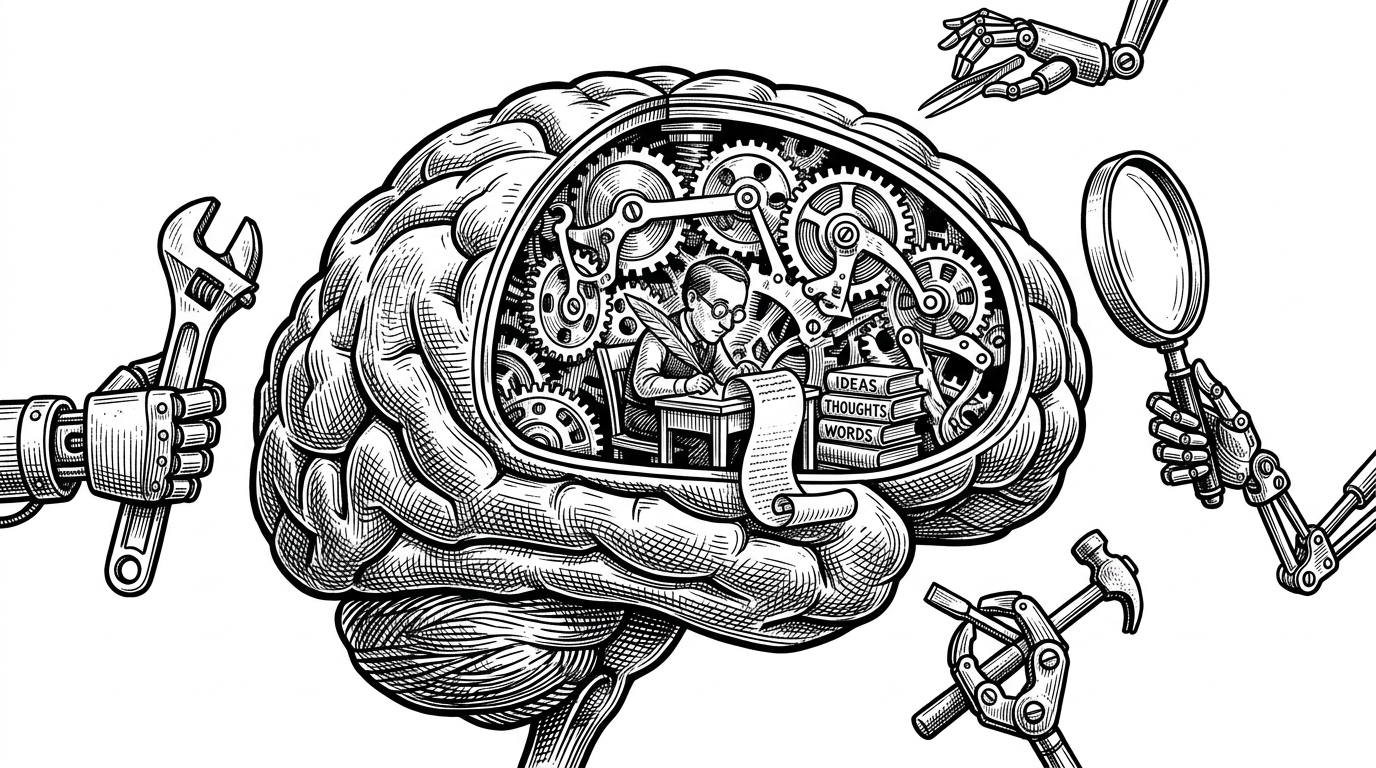
Mini-Agent prioritizes reasoning over immediate action, using interleaved thinking to plan before executing tools.
Key Takeaways
Mini-Agent prioritizes reasoning by interleaving thinking and tool execution to maintain a continuous chain of thought.
The system reduces context bloat by fetching detailed documentation through a skill loader only when a task requires it.
Native Model Context Protocol support allows the agent to connect to standardized external tools like GitHub and Postgres.
Middle-out truncation and persistent session notes prevent token limit crashes while preserving critical task memories.
Reasoning Before Responding
The agentic workflow has become a buzzword soup of bloated frameworks and infinite loops. Most agents are action-first. They blindly execute scripts and hope the output makes sense. Mini-Agent takes a different path. It is a minimalist professional implementation that proves you do not need hundreds of thousands of lines of code to build a production-grade executor.
The secret lies in the thinking-first architecture. Mini-Agent leverages the MiniMax M2.5 model to interleave thinking with tool execution. It plans, verifies, and self-corrects before touching the disk. This maintains a continuous chain of thought even when interrupted by tool outputs.
Leveraging an Anthropic-compatible API, it fully supports interleaved thinking to unlock M2's powerful reasoning capabilities for long, complex tasks.
A common pitfall in agent design is context bloat. Loading every tool manual into the system prompt wastes tokens and confuses the model. Mini-Agent solves this through progressive disclosure.
The agent does not start with a comprehensive manual. Instead, it utilizes a skill loader. It fetches detailed documentation only when a specific task demands it. This keeps the initial context incredibly lean.
# role you are an interactive # repo technical summary ## Metadata & Structure Analysis This research report provides a technical deep-dive into the **MiniMax-AI/Mini-Agent** repository, a reference implementation for building high-performance LLM agents using the MiniMax M2.5 model. --- ### 1. Architecture Overview Mini-Agent is a **single-agent execution framework** designed to demonstrate "production-grade" agentic workflows. Unlike simple "chat" wrappers, it implements a rigorous **Reasoning-Acting (ReAct) loop** where the agent can think, execute tools, observe results, and refine its plan. **Key Directory Structure:** * `mini_agent/agent.py`: The "brain" of the project, managing the execution loop and state. * `mini_agent/llm/`: An abstraction layer supporting both Anthropic-compatible and OpenAI-compatible APIs. * `mini_agent/skills/`: A sophisticated library of 15+ "Claude Skills" (documents, design, etc.) integrated via git submodules. * `mini_agent/acp/`: Implementation of the **Agent Communication Protocol**, allowing the agent to be used as a backend for editors like Zed. * `mini_agent/config/`: Centralized management for system prompts and tool configurations. ### 2. Technical Stack * **Language:** Python (Core logic), with JavaScript/HTML/Shell supporting the "Skills" and "Artifacts" ecosystem. * **Build System:** **uv** (Astral). The project leans heavily on `uv` for dependency management and tool installation, reflecting modern Python best practices. * **Key Dependencies:** * `mcp`: Native support for the **Model Context Protocol** (Anthropic’s standard for tool sharing). * `httpx` & `pydantic`: For robust API communication and data validation. * `tiktoken`: For precise context window management and summarization. * `prompt-toolkit`: For the interactive CLI experience. ### 3. Core Abstractions * **The Execution Loop (`agent.py`)**: Manages "interleaved thinking." It handles the transition between the model's internal reasoning and external tool calls. * **Session Note Tool**: A specialized persistent memory mechanism. Instead of relying solely on context, the agent can explicitly "write notes" to itself that persist across sessions. * **Context Manager**: Implements **Intelligent Context Management**. When the token limit is reached, it doesn't just truncate; it summarizes the history to maintain the "infinite task" capability. * **LLM Wrappers**: Standardizes the interface between different model providers, specifically optimized for the MiniMax M2.5 model's reasoning capabilities. ### 4. Unique & Interesting Features * **Interleaved Thinking Support**: The project is specifically tuned for the MiniMax M2.5 model, which supports a "thinking" phase similar to OpenAI's o1 or Claude's extended thinking, allowing for complex multi-step planning before action. * **Skill Submodules**: It doesn't just provide tools; it imports a massive library of "Claude Skills" (found in `mini_agent/skills`), including complex logic for generating `.docx` files, brand guidelines, and even algorithmic art. * **ACP & MCP Convergence**: It is one of the few demo projects that simultaneously implements **ACP** (for editor integration) and **MCP** (for tool discovery), making it a "universal" agent bridge. ### 5. Scale & Maturity * **Stars/Forks:** ~2,090 stars and 306 forks indicate high community interest for a project created in late 2025. * **Maturity:** While labeled a "demo," the inclusion of `MANIFEST.in`, comprehensive logging, and production guides suggests it is intended as a boilerplate for commercial-grade agents. * **Code Size:** Primarily Python (~850KB), but the inclusion of design assets and schemas makes it a "heavy" repository for a "mini" agent. ### 6. Key Code Patterns * **Provider Selection Pattern**: `examples/05_provider_selection.py` shows a clean strategy for switching between global and regional API endpoints. * **Retry Logic**: `mini_agent/retry.py` implements sophisticated backoff strategies, essential for agentic workflows where tool or API failures are expected. * **Schema-Driven Development**: Extensive use of JSON schemas (`mini_agent/schema/schema.py`) to ensure the LLM receives perfectly formatted tool definitions. ### 7. Potential Reading Angles * **"The Death of the Chatbot, the Rise of the Executor"**: How Mini-Agent moves from Q&A to a shell-accessing, file-editing worker. * **"Standardizing the Agentic Web"**: A deep dive into how MCP and ACP are used together to make agents "plug-and-play" with tools and IDEs. * **"Memory Beyond the Context Window"**: Analyzing the "Session Note Tool" as a pattern for long-term agent autonomy. ### 8. Files to Read The following files represent the core logic and entry points of the repository. ## Source Code Analysis This technical editorial provides a deep-dive into the **Mini-Agent** repository, a framework designed to leverage MiniMax’s M2.5 model capabilities—specifically its support for extended thinking and tool-calling—within a robust, terminal-based agentic loop. --- ### 1. Core Orchestration: `mini_agent/agent.py` **What it does:** This is the "brain" of the system. It manages the conversation state (`self.messages`), handles the execution loop, and coordinates between the LLM and the toolset. **Why it matters:** It implements the critical "Agentic Loop." Unlike a simple chatbot, this class manages stateful interactions where the LLM can pause to call tools, receive results, and continue reasoning. **Key Patterns:** * **Token Management:** It uses `tiktoken` with the `cl100k_base` encoding to accurately track context window usage. It includes a sophisticated `_estimate_tokens` method to handle complex message structures (thinking blocks, tool calls). * **Workspace Injection:** It automatically enforces a "Current Workspace" context in the system prompt, ensuring the LLM understands its file-system boundaries. * **Graceful Interruption:** The `_cleanup_incomplete_messages` method is an elegant touch; if a user cancels an execution (e.g., via Esc), it rolls back the message history to the last stable state to prevent "hallucinated" or orphaned tool calls from corrupting the next turn. --- ### 2. Multi-Provider LLM Interface: `mini_agent/llm/` **Files:** `llm_wrapper.py`, `anthropic_client.py`, `openai_client.py` **What it does:** This layer abstracts the differences between Anthropic and OpenAI API protocols. While MiniMax M2.5 is the primary target, the agent can speak different "dialects." **Why it matters:** It allows the agent to be provider-agnostic. Interestingly, it handles a specific quirk of the MiniMax API: it automatically appends `/anthropic` or `/v1` to the base URL depending on the chosen provider mode. **Key Abstractions:** * **Protocol Mapping:** `anthropic_client.py` is particularly important because it maps the internal `Message` schema to Anthropic’s specific content block format, including the `thinking` type. * **Thinking Blocks:** The system explicitly supports "Extended Thinking." In `_convert_messages`, it constructs content blocks that separate reasoning from tool usage, allowing the model to "think out loud" before acting. --- ### 3. Configuration & Prompting: `mini_agent/config/` **Files:** `config-example.yaml`, `system_prompt.md` **What it does:** Defines the operational parameters and the "personality" of the agent. **Why it matters:** The `system_prompt.md` reveals the **Progressive Disclosure** pattern. Instead of loading every tool's full documentation into the context (which wastes tokens), the agent sees metadata first and must explicitly call `get_skill()` to load detailed instructions. **Key Patterns:** * **Environment Enforcement:** The prompt contains a "CRITICAL" instruction to use `uv` for Python operations. This ensures the agent manages dependencies in a portable, isolated way rather than polluting the system Python. * **Hierarchical Config:** The `config-example.yaml` shows a clear priority ladder (Dev -> User -> Package), allowing for flexible deployment. --- ### 4. Resilience: `mini_agent/retry.py` **What it does:** A decoupled, decorator-based utility for handling transient API failures. **Why it matters:** Agentic workflows are prone to network jitter or rate limits. This file ensures that a single failed API call doesn't crash a multi-step task. **Key Abstractions:** * **Exponential Backoff:** It uses a standard `initial_delay * (base^attempt)` formula but adds a `max_delay` cap to prevent the agent from hanging indefinitely. * **Non-Invasive Design:** By using `TypeVar` and `functools.wraps`, the retry logic stays entirely separate from the LLM logic, making the code cleaner and easier to test. --- ### 5. Interactive UX: `mini_agent/cli.py` **What it does:** The entry point for the user. It sets up a rich terminal interface using `prompt_toolkit`. **Why it matters:** It transforms a script into a tool. It handles history, auto-suggestion, and provides a "Log Directory" management system to help users debug long-running agent sessions. **Key Patterns:** * **Tool Initialization:** This is where the "Skill" tools, "Bash" tools, and "MCP" (Model Context Protocol) tools are instantiated and passed to the Agent. * **Cross-Platform Utility:** It includes helper methods to open log directories in the native file manager (Finder/Explorer/xdg-open), emphasizing a developer-friendly "local-first" philosophy. --- ### Summary of Data Flow 1. **Input:** User enters a task in `cli.py`. 2. **Context:** `Agent` loads `system_prompt.md` and injects workspace info. 3. **Reasoning:** `LLMClient` (via `AnthropicClient`) sends messages to MiniMax. 4. **Action:** The LLM returns a `tool_use` block. 5. **Execution:** `Agent` executes the tool (e.g., `BashTool`) and appends the result as a `tool` role message. 6. **Loop:** The process repeats until the LLM provides a final text response. ## Deep Dive This technical analysis explores the core architecture of the **Mini-Agent** repository, focusing on its tool execution framework and LLM integration. The codebase reveals a sophisticated approach to "Agentic Workflows," specifically emphasizing long-running tasks, external tool interoperability (MCP), and "Progressive Disclosure" of capabilities. --- ### 1. The Tool Foundation (`mini_agent/tools/base.py`) **What it does:** Defines the abstract contract for all tools. It uses Pydantic for structured output (`ToolResult`) and provides methods to export tool definitions into both Anthropic and OpenAI JSON schemas. **Why it matters:** It ensures the Agent is "model-agnostic" at the tool level. By providing `to_schema()` and `to_openai_schema()`, the same tool logic can be consumed by different LLM providers without modification. **Key Patterns:** * **Schema Dual-Homing:** The inclusion of both Anthropic and OpenAI schema generators suggests the agent is designed to bridge the gap between the two most common tool-calling formats. * **Structured Failure:** The `ToolResult` enforces a `success` boolean and an `error` string, forcing developers to handle tool failures gracefully rather than relying on raw exceptions. --- ### 2. The Shell Execution Engine (`mini_agent/tools/bash_tool.py`) **What it does:** Implements a robust, asynchronous shell execution environment. It supports background processes, real-time output monitoring, and regex-based output filtering. **Why it matters:** Most agents struggle with long-running shell commands (like starting a server or running a long build). This file solves that by introducing a `BackgroundShellManager` that tracks processes across multiple turns of a conversation. **Key Patterns & Surprises:** * **Stateful Backgrounding:** Unlike simple "run and return" tools, this uses a `bash_id` to allow the agent to "check back in" on a process later. * **The Monitor Loop:** The `start_monitor` method uses `asyncio.wait_for` on `stdout.readline()` with a short timeout. This prevents the agent from hanging while waiting for output, allowing it to remain responsive. * **Automatic Formatting:** The `BashOutputResult` uses a Pydantic `model_validator(mode="after")` to automatically synthesize a human-readable `content` string from raw `stdout` and `stderr`. This ensures the LLM always receives a consistent view of the terminal. --- ### 3. File Operations & Token Management (`mini_agent/tools/file_tools.py`) **What it does:** Provides `ReadTool` and `WriteTool` for filesystem interaction, featuring a critical utility: `truncate_text_by_tokens`. **Why it matters:** Reading large source files can easily blow out an LLM's context window. This module implements "Intelligent Truncation" to keep the agent functional even when dealing with massive files. **Key Patterns:** * **Middle-Out Truncation:** The `truncate_text_by_tokens` function doesn't just cut the end of a file; it preserves the "head" and "tail" (the beginning and end) while snipping the middle. This is an elegant heuristic, as the top of a file (imports/headers) and the bottom (exports/main logic) are often the most informative. * **Line Numbering:** The `ReadTool` automatically injects line numbers (`6d|content`). This is a "best practice" for coding agents, as it allows the LLM to reference specific lines for editing or debugging. --- ### 4. Progressive Disclosure & Skills (`mini_agent/tools/skill_tool.py`) **What it does:** Implements "Level 2 Progressive Disclosure." Instead of loading every possible instruction into the system prompt (which wastes tokens), it provides a `get_skill` tool. **Why it matters:** As an agent grows, its "System Prompt" becomes a bottleneck. By treating complex instructions as "Skills" that must be explicitly fetched, the agent stays "lean" until it encounters a task requiring specialized knowledge. **Key Abstractions:** * **On-Demand Loading:** The agent sees a list of available skills in its system prompt but must call `get_skill(skill_name)` to see the actual implementation details. This mimics how a human might consult a manual only when needed. --- ### 5. MCP Integration (`mini_agent/tools/mcp_loader.py`) **What it does:** Integrates the **Model Context Protocol (MCP)**, allowing the agent to connect to external tool servers via STDIO, SSE, or HTTP. **Why it matters:** MCP is the emerging standard for agent-tool interoperability. This file allows Mini-Agent to instantly gain hundreds of capabilities (Google Search, GitHub, Slack) by simply connecting to an MCP server. **Key Patterns:** * **Timeout Protection:** The `MCPTool` wrapper is heavily defensive. It uses `asyncio.timeout` for both connection and execution, preventing a slow third-party MCP server from freezing the entire agent. * **Session Management:** It uses `AsyncExitStack` to manage the lifecycle of complex connections, ensuring that resources are cleaned up even if the agent crashes. --- ### 6. The LLM Bridge (`mini_agent/llm/openai_client.py` & `base.py`) **What it does:** Implements the communication layer with the LLM, specifically optimized for MiniMax's `M2.5` model and OpenAI-compatible endpoints. **Why it matters:** This is where "Interleaved Thinking" is handled. It ensures that the model's internal reasoning (the "thinking" block) is preserved across the conversation history. **Elegant Details:** * **Reasoning Preservation:** In `_convert_messages`, the code explicitly handles `reasoning_details`. It notes that this is **"CRITICAL for Interleaved Thinking to work properly."** By passing the model's previous thoughts back to it in the next turn, the agent maintains a continuous "Chain of Thought," preventing it from getting confused during multi-step tool use. * **Tool Schema Translation:** The `_convert_tools` method is highly flexible; it can take raw dicts (Anthropic style) or Tool objects and normalize them into the OpenAI `type: function` format on the fly. --- ### Summary of Data Flow 1. **Initialization:** The `SkillLoader` and `MCPServerConnection` discover available capabilities. 2. **Prompting:** The `LLMClient` converts internal `Message` objects (including previous "thinking" and "tool results") into the provider's format. 3. **Execution:** If the LLM returns a `ToolCall`, the agent dispatches it to the appropriate `Tool` (Bash, File, or MCP). 4. **Feedback Loop:** The `ToolResult` is formatted (and truncated if necessary by `file_tools.py`) and fed back into the `LLMClient` for the next iteration. This architecture is notably **production-ready**, prioritizing token efficiency (via truncation and progressive disclosure) and system stability (via background process management and MCP timeouts). # diagram instructions Base this on what you know about the repo. A 3D Venn Diagram style flow showing a central 'System Prompt' core. Surrounding it are various 'Skill Modules' (like File Read, Search, Execute). A glowing, animated tether pulls a specific skill module into the central core only when requested. Nodes should include 'Core Agent', 'Skill Loader', and 'External Skill'. Show an interaction where clicking 'Request Skill' animates the pulling of docs into the core. # **important visual styles** represent each item or node faithfully. The shape or object you decide to depecit it should match what its function is.
Plugging into the Agentic Web
Building custom integrations for every API is unsustainable. Mini-Agent bypasses this entirely by adopting the Model Context Protocol (MCP). It treats external tools not as custom code, but as standardized plugins.
Through MCP, the agent gains instant superpowers. It can talk to editors like Zed or tools like GitHub and Postgres simultaneously. It acts as a universal bridge, standardizing the agentic web.
The Model Context Protocol allows Mini-Agent to interface with diverse external tools using a single standardized format.
Surviving the Infinite Context
Long-running tasks eventually hit the token wall. When an agent reads massive source files, it risks forgetting its original instructions. Mini-Agent implements intelligent context truncation to survive these infinite workflows.
The truncation logic uses a middle-out approach. It preserves the beginning and end of a file while snipping the middle. Combined with a persistent Session Note tool, the agent retains critical memories across extended sessions without overwhelming the context window.
Middle-out truncation preserves the crucial headers and footers of files while discarding the bulky middle sections.
Feature
Mini-Agent
Heavy Frameworks
Raw Scripts
Setup Complexity
Minimal (Single Core)
High (Many Abstractions)
Manual (Boilerplate)
Tool Standard
Native MCP
Custom Wrappers
Ad-Hoc Functions
Thinking Support
Interleaved (Native)
Prompt-Based
None
Context Handling
Middle-out Truncation
Blind Sliding Window
Hard Crash on Limit
In a landscape dominated by bloated architectures, Mini-Agent proves that less is more. By focusing on fundamental reasoning loops and standard protocols, it provides a lean, resilient foundation for the next generation of digital workers.