TensorRT-RTX-EP-ABI: NVIDIA TensorRT RTX Execution Provider: The Plugin That Turns ONNX Runtime Into a Hardware Socket
A deep look at how NVIDIA split high-performance RTX inference out of the monolith, using ORT’s EP ABI, adaptive JIT compilation, and GPU memory tricks to make desktop deployment feel surprisingly modular.
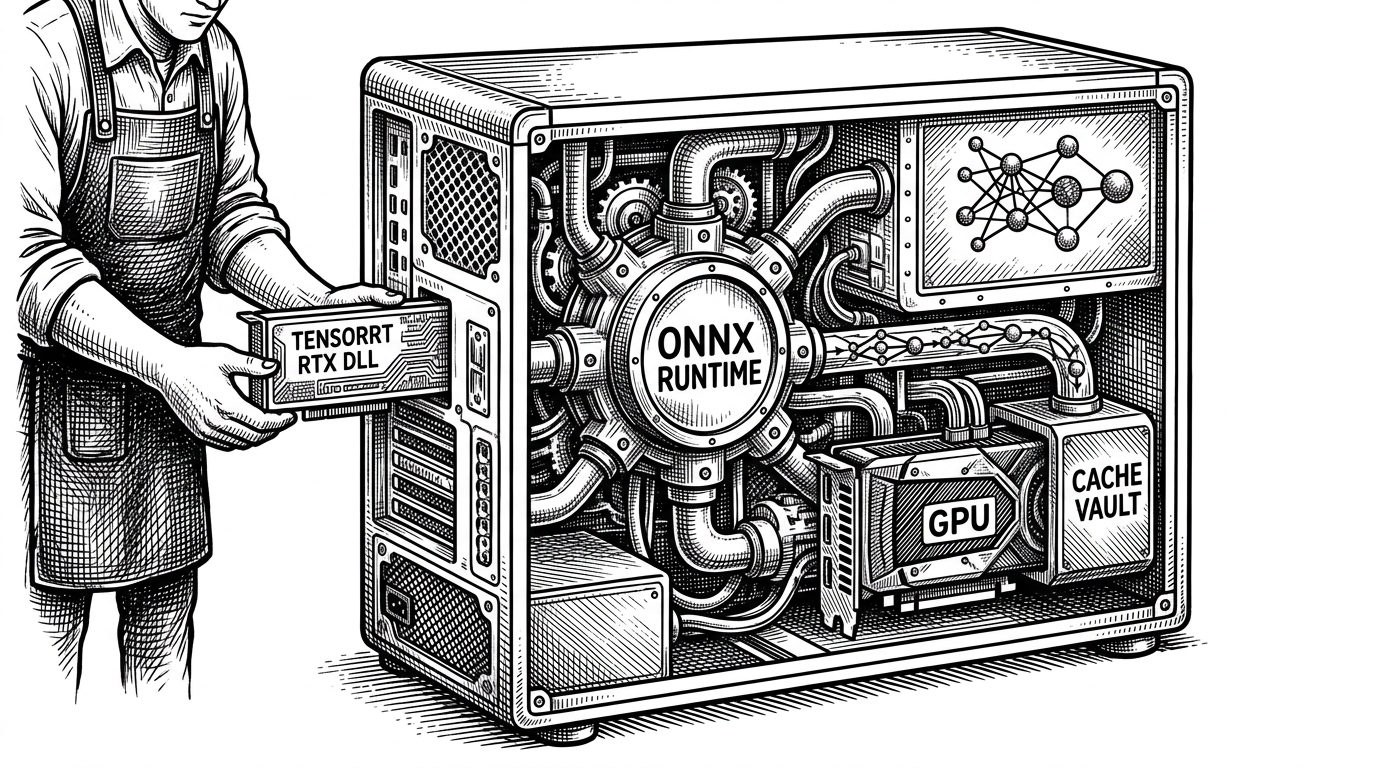
- TensorRT RTX EP matters because it turns ONNX Runtime into a host for loadable acceleration, not a runtime that must be rebuilt around the accelerator.
- Its real product win is deployment friction, with smaller binaries, faster startup, and a cleaner path for shipping RTX inference to desktop apps.
- The most interesting engineering problem is dynamic output shape handling, where the EP must satisfy TensorRT’s buffer rules while still adapting at runtime.
- NVIDIA’s stack adds client-grade hardening and memory discipline, but it also makes a clear trade-off by not supporting plugins yet.
The most interesting thing about TensorRT RTX Execution Provider is not that it accelerates ONNX Runtime. It is that it changes what ORT is allowed to be. With the EP ABI, NVIDIA can ship a standalone DLL that plugs into an existing runtime instead of asking developers to rebuild the world around a monolith.
TensorRT for RTX introduces adaptive inference—engines that optimize automatically at runtime for your specific system, progressively improving compilation and inference performance as your application runs.
The new unit of deployment is the DLL
Classic accelerator integration tends to pull developers toward heavier builds and tighter coupling. This project goes the other way. ORT exposes an execution-provider ABI, and TensorRT RTX ships as a loadable provider factory with exported entry points such as CreateEpFactories and ReleaseEpFactory.
That shift matters because it changes the integration contract. Instead of bundling hardware support into a custom ORT fork, NVIDIA can hand apps a GPU-optimized extension that looks closer to a platform feature than a framework rebuild.
Why desktop inference needs a different shape
Client-side AI has different constraints than server inference. Binary size matters. Cold start matters. Portability across RTX cards matters. The repository is built around that reality, with Windows hardening, CUDA checks, and a package footprint that is meant to feel shippable rather than heroic.
| Dimension | TensorRT RTX EP | CUDA EP | Standard TensorRT EP |
|---|---|---|---|
| Deployment | Standalone plugin for existing ORT installs | Built into ORT, more general-purpose | Powerful, but less modular for desktop distribution |
| Primary goal | Client-side RTX inference with low friction | Broad GPU acceleration across workloads | Highest-performance TensorRT execution |
| Startup behavior | Optimized for JIT compile and reuse | Often relies on finer-grained kernel selection | Can involve heavier engine workflows |
| Packaging story | Side-loadable DLL | Part of the runtime ecosystem | Usually more coupled to the deployment stack |
| Plugin support | Not supported today | Supported in broader TensorRT ecosystem | Supported in the generic TensorRT world |

Inside the execution provider
The repository is small enough to read as a system map. The factory layer handles the ORT handshake. The execution provider core translates ONNX subgraphs into TensorRT RTX engines. Memory helpers manage arena allocation and CUDA mempool behavior. Utility code keeps the CUDA, filesystem, and loading path sane.
// Conceptual shape of the ABI boundary
extern "C" OrtStatus* CreateEpFactories(
    OrtSessionOptions* options,
    OrtEpFactoryInterface** factories,
    size_t* count);

extern "C" void ReleaseEpFactory(OrtEpFactoryInterface* factory);
That boundary is the design center. It tells you NVIDIA is optimizing for isolation, versioning, and deployment, not just kernel speed. The provider can be updated without dragging the whole ORT stack through a rebuild.
The TensorRT EP can also fuse such operation blocks. At the same time, it evaluates the whole graph and collects all possible paths to execute the graph.
The hardest problem is not speed. It is shape
The most instructive part of the implementation is output allocation. Some tensors do not have fully known shapes until runtime. That means the provider has to negotiate memory after inference starts, not only before it begins.
The code has to honor a strange but important rule. Even when an output tensor is empty, TensorRT still wants a valid pointer. So the allocator is not only picking sizes. It is also preserving runtime contracts under awkward shape conditions.
That is why the memory story and the shape story are the same story. The EP uses a BFC arena for general device memory and a CUDA mempool for activation memory, then shrinks the latter when the model is idle. It is trying to feel light without becoming brittle.
What NVIDIA adds beyond raw TensorRT
The repo is not just a thin adapter. It includes custom op domain registration, FP4 and FP8 support paths, secure Windows loading, and build hardening. That is the difference between a benchmark demo and something you can actually distribute to desktop users.
Plugins are not supported in TensorRT-RTX
That missing feature matters. It is the cleanest reminder that this stack is still a product with edges, not a universal drop-in for every TensorRT workload. The deployment story is better, but the extensibility story is narrower.
Where it wins, and where it does not
| Question | TensorRT RTX EP | CUDA EP | DirectML |
|---|---|---|---|
| What is the main advantage? | Modular RTX acceleration with a better desktop deployment story | Flexible general-purpose GPU execution | Windows-native compatibility across more hardware |
| What does it optimize? | Whole-graph execution with adaptive runtime behavior | Fine-grained operator execution | Broad device coverage and portability |
| What is the packaging trade-off? | Depends on the EP ABI and NVIDIA's DLL model | Less specialized, but more familiar | Usually easier to explain, less specialized |
| What is the key limitation? | No plugin support yet | Less whole-graph specialization | Lower performance on NVIDIA RTX in this context |
The simplest way to read the comparison is this: CUDA EP is the flexible toolbox. TensorRT RTX EP is the prewired power module. If you want the cleanest path to RTX inference on a desktop app, that distinction is the whole game.
The implication: ORT is becoming a platform
The deeper story is not about one accelerator. It is about a runtime that can host specialized acceleration without surrendering control to a single monolithic build. That makes ONNX Runtime feel less like an engine and more like a platform socket.
If that model sticks, vendors can ship optimized inference in smaller pieces, apps can stay lighter, and the integration burden shifts away from developers. NVIDIA is not just accelerating graphs here. It is trying to make the runtime itself modular.