Cybronix_projects: The Hybrid Agency Stack That Refuses to Become a SPA
A multi-page marketing site with React islands, a non-blocking lead pipeline, and animation systems that make static pages feel alive.
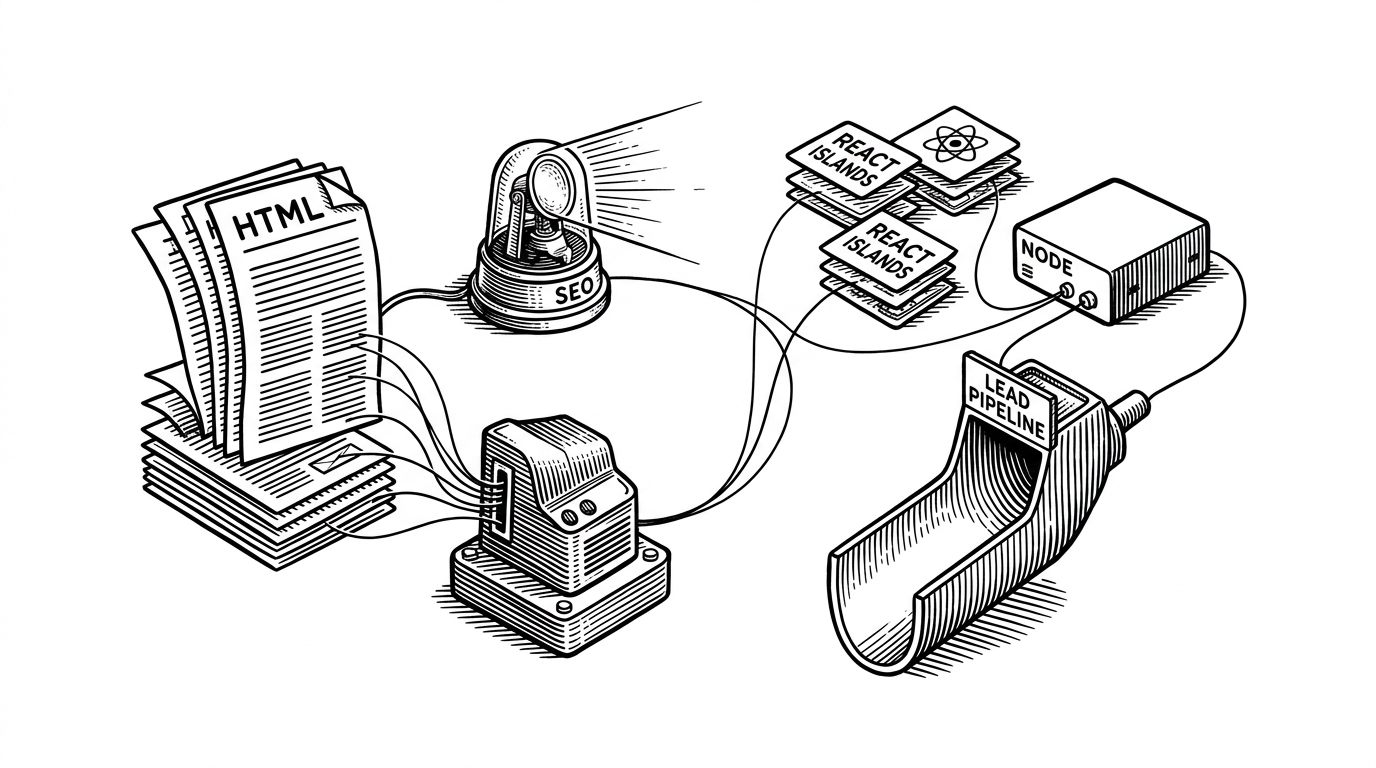
- Cybronix_projects uses selective complexity to make a marketing site feel premium without turning it into a bloated SPA.
- The repo keeps discovery on static HTML pages, then adds React only where motion and interaction actually matter.
- Its visual polish comes from custom CSS and canvas systems, not decorative third-party effects stacked on top of each other.
- The lead flow is designed to respond fast first, then finish the email work in the background so conversion never stalls.
Why This Agency Site Is Built Like a Product
The most interesting thing in this repo is not the branding, and not even the animations. It is the decision to treat a marketing site like a product system: separate concerns for discovery, motion, and conversion, each handled by a different layer of the stack.
That matters because agency sites usually drift in one of two directions. They become all-in-one SPAs that are heavy to ship, or they stay static and never feel alive. Cybronix_projects splits the difference on purpose.
| Approach | SEO | Performance | Motion | Lead handling |
|---|---|---|---|---|
| WordPress or Elementor-style site | Usually fine, but theme-driven | Can get bulky fast | Often plugin-based | Basic forms, often tied to plugins |
| SPA-first React marketing site | Can be weaker without extra work | Often heavier than needed | Easy to overbuild | Usually bundled into the app flow |
| Cybronix_projects hybrid stack | Static pages do the indexing work | Keeps interactive code scoped | Custom motion where it counts | Dedicated server path with non-blocking email |
The Static Pages Do the SEO Heavy Lifting
The repo keeps root-level HTML pages in play instead of hiding everything behind client-side routing. That is an old-school choice with modern benefits: clean page ownership, direct entry points, and fewer moving parts for search and sharing.
That split also explains why the codebase can stay readable. The pages do their job without needing a component framework everywhere, while the richer UI gets added selectively instead of forcing the whole site into one rendering model.
The Visual Engine Lives in CSS and Canvas
The standout craft detail is that the premium feel does not come from a giant animation library. It comes from custom CSS layers and a canvas particle system, which gives the site its texture without forcing every interaction through a heavy framework.
That is a smart trade. The site gets visual richness, but it also keeps control over the edges that usually get sloppy: animation state, visibility handling, and motion reduction for users who need it.
React Appears Only Where Motion Matters
React is used like a surgical tool here, not a religion. Components such as SocialBurst and TestimonialsSection add concentrated moments of motion and social proof, then get out of the way.
That pattern is why the stack feels disciplined. The site does not ask React to manage every page turn, every text block, or every decorative flourish. It asks React to do the high-impact jobs that are worth the extra complexity.
The Lead Pipeline Is Fast by Design
The conversion path is built for speed. A form submission gets validated, saved to MongoDB, and then the email notification runs in the background, so the user gets a fast response without waiting on SMTP.
That is a small implementation choice with a big product effect. It protects the experience at the exact moment when a prospect is most likely to bail, and it reduces the chance that a slow email service turns into a lost lead.
| Step | What happens | Why it matters |
|---|---|---|
| Validation | Input is checked before persistence | It catches bad submissions early |
| Database save | Lead data is written to MongoDB | The lead is not lost if email lags |
| Immediate response | The client is answered right away | The form feels fast and reliable |
| Background email | Notification is sent asynchronously | Delivery problems do not block the user |
What This Repo Suggests About Modern Agency Builds
Cybronix_projects points to a useful rule for modern agency work: premium does not have to mean monolithic. The smartest stacks keep the parts that help discovery simple, then spend complexity only where it clearly improves the experience.
That is the deeper lesson here. The repo is not trying to be the flashiest possible frontend. It is trying to be a durable marketing machine that can rank, move, and convert without fighting itself.
| Question | Monolithic SPA | Cybronix_projects |
|---|---|---|
| Does every page need app-level interactivity? | Usually yes | No, only the moments that benefit from it |
| Does SEO get a clean path? | Sometimes | Yes, through multi-page HTML |
| Does motion add weight everywhere? | Often | No, it is scoped and intentional |
| Does conversion depend on a slow client flow? | Often | No, the server handles the lead pipeline |