Shopify-AI-Toolkit: Shopify AI Toolkit: The Local Judge for Shopify Agents
How Shopify turns AI-assisted coding into a constrained loop of search, generation, validation, and repair, so agents can work against live Shopify rules instead of stale model memory.

- Shopify’s toolkit is built around trust boundaries, not open-ended chat, so the model has to prove correctness before its answer is useful.
- The repo packages domain knowledge as skills, scripts, and validators, which makes agent behavior more like a compiled workflow than a loose plugin.
- Search, draft, validate, and repair form the real product, because Shopify is moving documentation from something humans read into something machines must obey.
- The strategic bet is commerce-specific reliability, not general autonomy, which is why this looks more like a judge than a framework.
The agent does not get to answer first
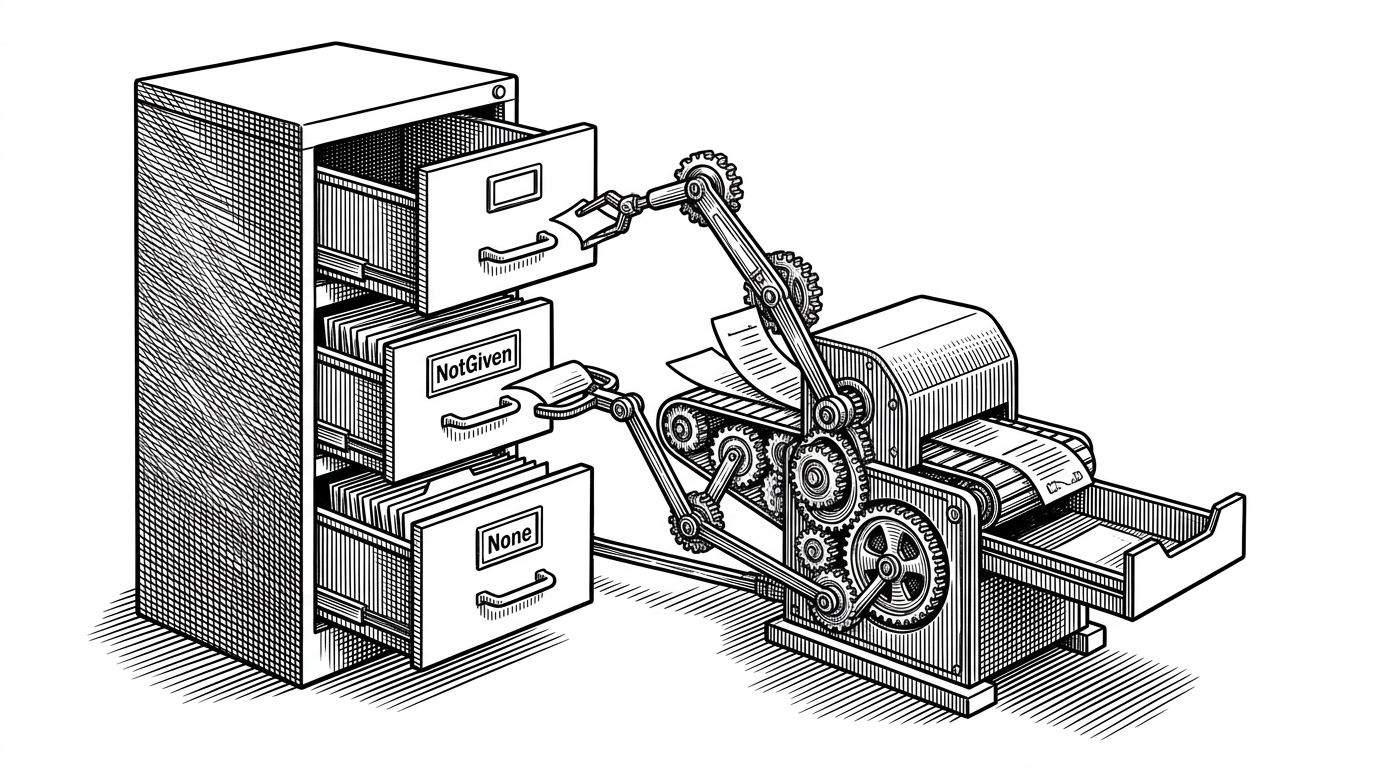
Shopify’s AI Toolkit is easiest to understand as a refusal. It refuses to treat model output as trustworthy until it survives a local check. That matters because Shopify code is not generic code. It has schemas, theme rules, GraphQL shape constraints, and domain-specific failure modes that a plain LLM can only guess at.
These days, so many people are vibe testing their LLM Systems and thinking that it’s good enough; it’s not. Vibe testing, or creating a “Vibe LLM Judge” that’s like “Rate this 0-10”, is not going to cut it. It needs to be principled and statistically rigorous, otherwise you should be shipping with a false sense of security.
That quote captures the toolkit’s philosophy. Shopify is not asking agents to be clever. It is asking them to be inspectable. The output is useful only after it passes through a process that can fail loudly.
What the toolkit actually ships
The repo is less a single app than a delivery system for agent behavior. Platform manifests like .claude-plugin, .cursor-plugin, and .codex-plugin tell different tools how to load the same domain skills. Under skills/, each capability bundles its own instructions, scripts, and assets.
.claude-plugin
.cursor-plugin
.codex-plugin
skills/
  shopify-admin/
    SKILL.md
    scripts/
      search_docs.mjs
      validate.mjs
    assets/
      schema.json.gz
  shopify-liquid/
    SKILL.md
    scripts/
      search_docs.mjs
      validate.mjs
That shape matters. It means the toolkit is not trying to centralize every capability in one giant prompt. It is distributing narrow, domain-specific behaviors that each know how to search, draft, and validate within their own rules.
The loop that keeps agents honest
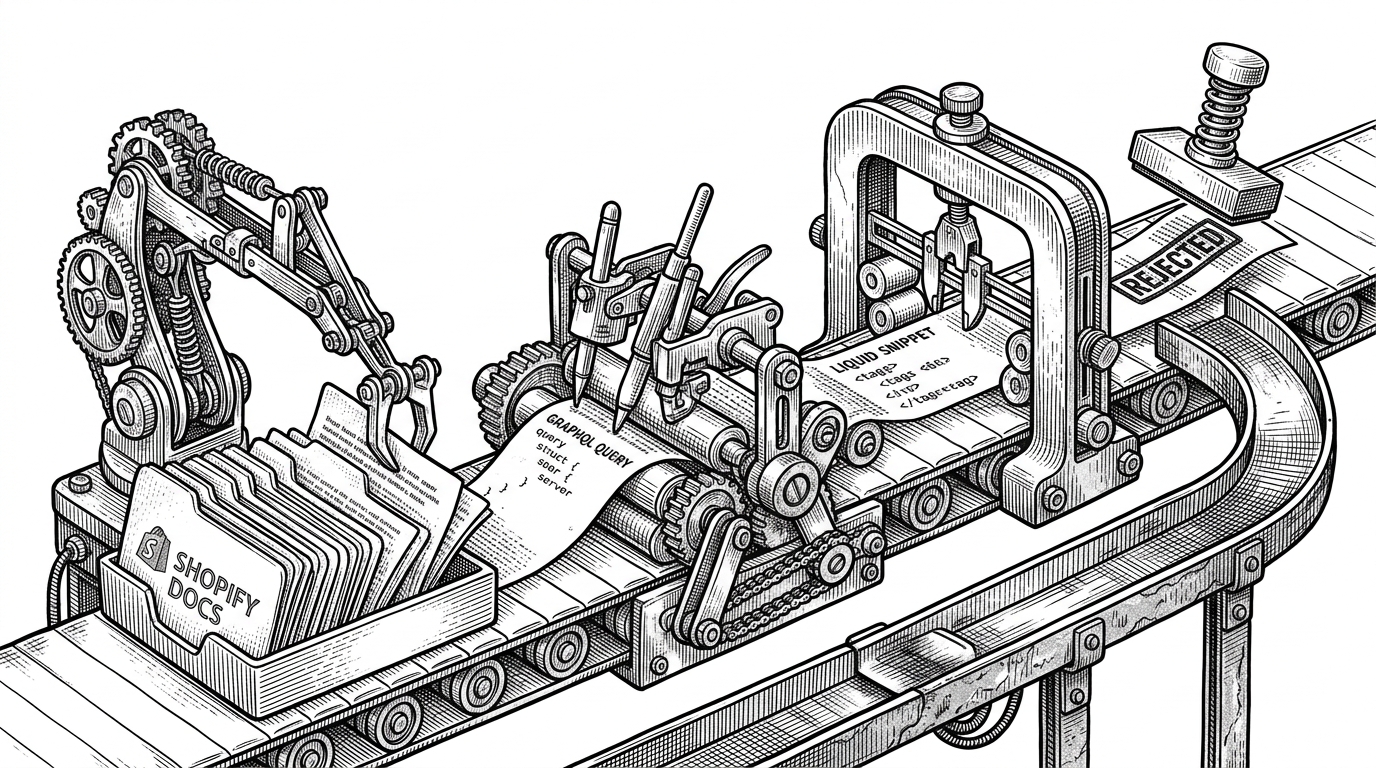
The core pattern in SKILL.md is blunt on purpose: Search → Write → Validate → Fix. The agent does not get to jump straight to an answer. It has to pull in live Shopify context, produce a draft, run the draft through local checks, and then repair whatever breaks.
// Simplified flow
const context = await search_docs(query)
const draft = await write_solution(context)
const result = await validate(draft)

if (!result.pass) {
  const fixed = await fix(draft, result.errors)
  await validate(fixed)
}
The interesting part is not that validation exists. It is where validation lives. By putting search_docs.mjs and validate.mjs inside the skill itself, Shopify makes the workflow portable. The rules travel with the agent, instead of living in a separate human handbook.
Why Shopify wants validation to happen locally
The validators are the real product. In the research trail, they include GraphQL AST parsing, schema checks, theme-check simulation, and compressed assets that let the agent validate against the same rules Shopify cares about in production. That is the point of the local judge. It shrinks the distance between first draft and failure.
If an agent is writing GraphQL, the check should not be a vague confidence score. It should be a parser, a schema, and an error message the model can actually use. If an agent is writing Liquid, the check should look enough like a theme environment to catch the kinds of mistakes merchants would feel immediately.
A simpler way to read the loop
| Dimension | General-purpose agent stack | Shopify AI Toolkit |
|---|---|---|
| Reliability model | Model confidence | Local validation and repair |
| Source of truth | Broad training memory | Live Shopify docs and schemas |
| Primary user | Anyone building agents | Shopify developers and merchants |
| Scope of autonomy | Wide open | Narrow and bounded |
| Failure handling | Often implicit | Explicit, visible, and retryable |
| Best fit | Exploration | Production workflows |
This is agent-first documentation
SKILL.md reads like documentation, but it behaves more like executable context. It tells the machine what to do, when to search, when to validate, and when to stop pretending that a draft is good enough.
Roast is a convention-oriented workflow orchestration framework designed specifically for creating structured AI workflows that interleave non-deterministic AI behavior with normal non-AI code execution. It provides a declarative approach using YAML configuration and markdown prompts, giving AI agents the guardrails needed to solve developer productivity problems at scale.
That is the same move here, just in a different package. Shopify is turning docs into enforcement. The machine does not merely read guidance. It executes it, then gets judged by it.
Why this looks more like a judge than a framework
The cleanest comparison is not with a full agent platform, but with a courtroom. General frameworks try to give agents more freedom. Shopify is doing the opposite. It is reducing freedom until the output is narrow enough to trust.
| System | Goal | Behavior | What it optimizes for |
|---|---|---|---|
| Shopify AI Toolkit | Correct Shopify work | Search, draft, validate, fix | Reliability in a specific domain |
| LangChain-style stack | Composable agent building | Many tools, many chains | Flexibility and breadth |
| Autonomous coding assistant | Maximize task completion | Looser reasoning and tool use | Speed and reach |
| Traditional docs plus SDKs | Help humans build | Read, copy, ship | Human comprehension |
That choice reveals the strategy. Shopify is not selling general intelligence. It is building a commerce-native control layer where the cost of a wrong answer is too high to leave validation to chance.
What this says about Shopify’s AI strategy
The toolkit points to a larger bet: Shopify wants AI to operate as a constrained worker inside Shopify’s own rules, not as a free agent wandering through them. That makes the docs, schemas, and validators part of the product surface.
In practice, that is a better fit for commerce than a loose chat layer. Commerce has structure. Orders, themes, APIs, and storefront rules are all things a machine can check against. Shopify’s move is to make those checks the default path, not an afterthought.