openai/openai-python: The Generated SDK That Still Feels Hand-Built
A deep dive into the Python client that turns a moving API into a typed, async-ready, production-friendly interface without sacrificing ergonomics or correctness.
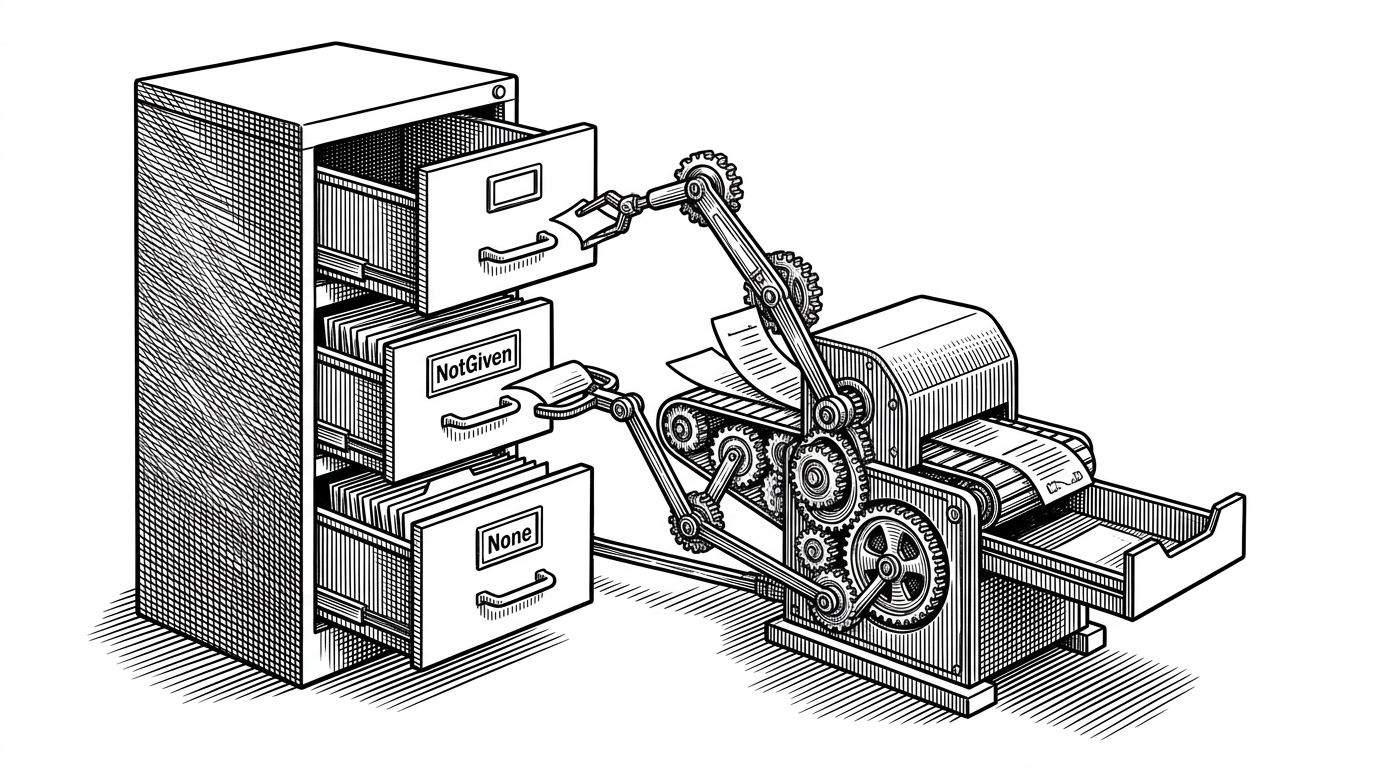 NotGiven, and a drawer labeled None. The scene explains how the SDK distinguishes omission from explicit null so Python intent survives serialization." data-prompt="Create an editorial illustration rendered entirely in black ink on a pure white background. The image depicts a medium-wide scene of a pristine filing cabinet connected to a mechanical request conveyor. Three drawers are visible: one is completely empty and slightly open, one is labeled NotGiven, and one is labeled None. A clerk-like mechanism routes paper slips from the drawers into a serializer machine, where the empty drawer leaves no trace, the None drawer becomes a marked null token, and the NotGiven drawer is stripped away before reaching the output tray. The artist uses tightly packed crosshatching lines layered at different angles to build up shadow and form, with clean open areas of white for highlights. The line work has the quality of a classic metal engraving, precise and deliberate, with varied line weights where bold contour lines define shapes and finer interior lines create tonal depth. The overall style evokes vintage newspaper editorial illustrations from The Economist or Wall Street Journal. No color, no gradients, no grey fills. Only black lines on white. The background MUST be pure white #FFFFFF. No paper texture, no cream, no off-white, no noise, no grain. Perfectly clean flat white background." loading="lazy">
- openai/openai-python treats omitted arguments as a first-class design problem, and that one choice keeps Python semantics intact all the way to the wire.
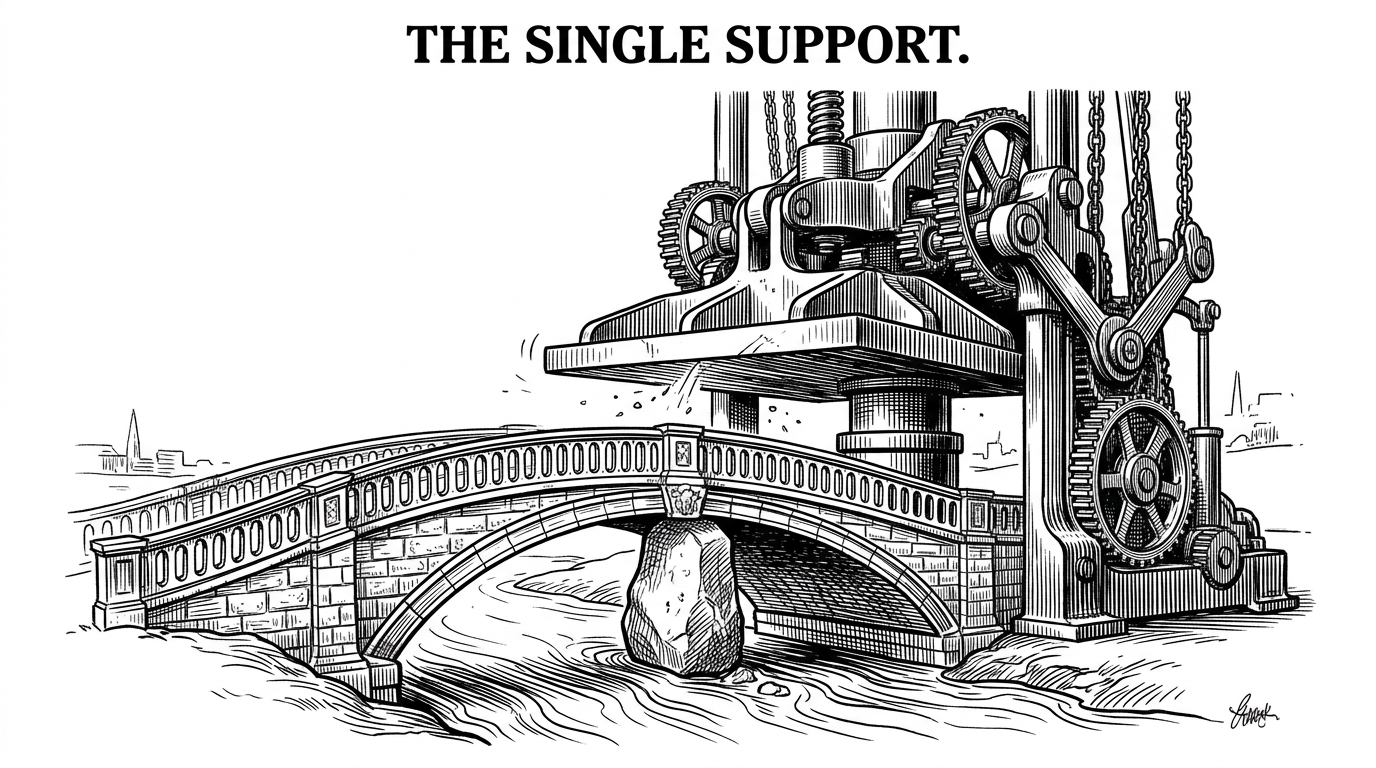
- The repo is generated, but the generated surface is carefully shaped so the client still feels idiomatic, typed, and intentionally small.
- Most of the complexity lives below the public API in resource routing, retries, pagination, and sync-async parity, where the SDK behaves like infrastructure rather than a wrapper.
- The broader lesson is that modern SDKs can scale through generation without losing craft if the seams are designed with precision.
The tiny sentinel that saves the API
The sharpest idea in this repo is not chat, images, or streaming. It is a sentinel: NotGiven. That tiny type lets the SDK tell the difference between "the caller said nothing" and "the caller explicitly passed None".
That distinction sounds small until you ship an API client. Omission often means "leave the server default alone." None often means "send null and override the field." If a client collapses those two states, it quietly breaks intent.
OpenAI's Python SDK preserves that intent all the way through request shaping. The payload builder strips NotGiven values before serialization, but keeps explicit nulls. In other words, the SDK does not merely move JSON around. It translates Python semantics into API semantics.
from openai import OpenAI, NOT_GIVEN

client = OpenAI()

# omitted entirely
client.responses.create(model="gpt-4.1", input="hello", user=NOT_GIVEN)

# explicit null, if the endpoint allows it
client.responses.create(model="gpt-4.1", input="hello", metadata=None)This is a generated SDK, and that is the point
The repo is not trying to pretend it was hand-written line by line. It is built on Stainless, which means the library starts from a spec and is projected into a Python package with consistent structure, typing, and naming.
That matters because the API surface is large and moving. Generation gives OpenAI a way to keep endpoints, types, and resource names aligned across releases without turning the codebase into a maintenance trap. The trick is that the output still feels carefully curated.
We now have builtin support for `aiohttp` usage, please try it out and let us know if you run into any issues!
That quote is a good example of the repo's posture. It does not freeze around one transport choice. It adapts when real workload pressure appears, then folds the fix back into the official surface.
The surface is tiny. The machinery is not
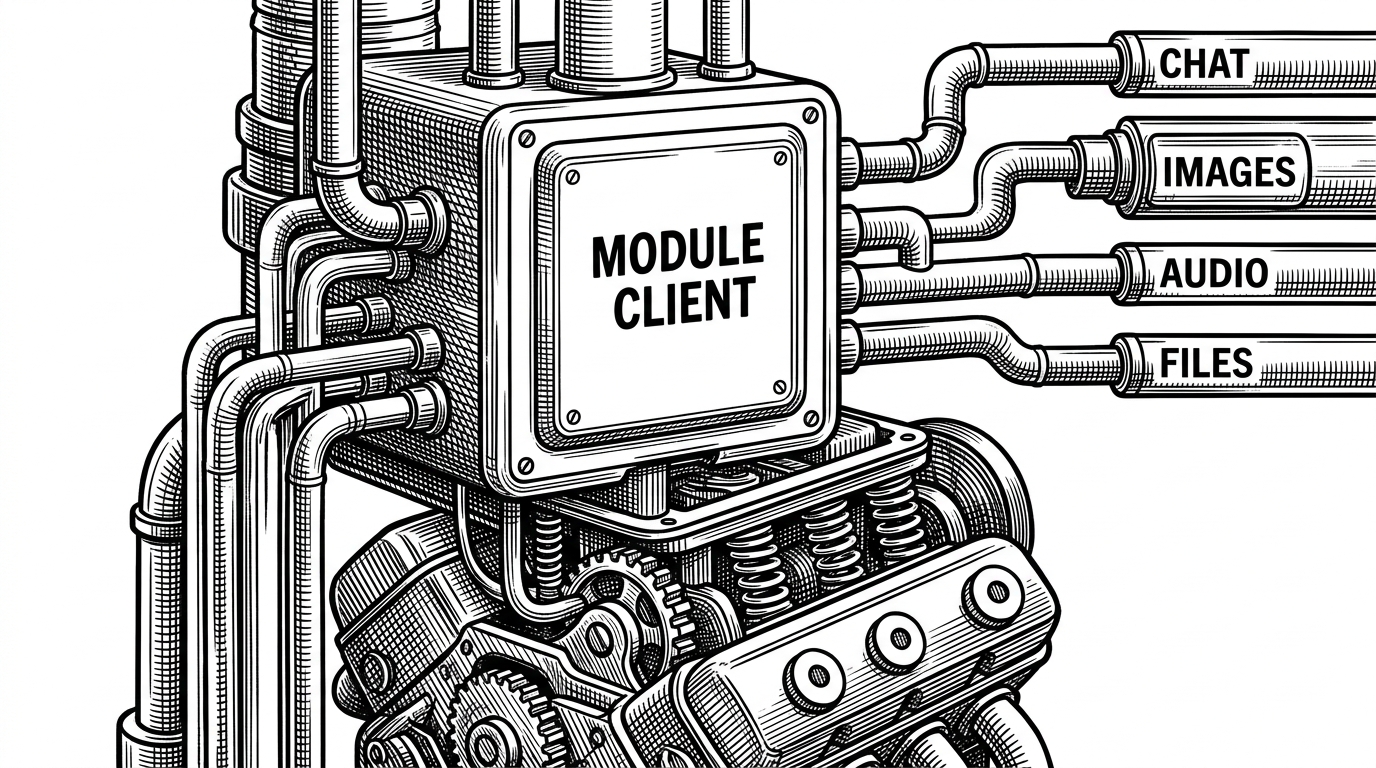
The public ergonomics are deceptively simple. You write code like client.chat.completions.create(...), and the resource tree reads like the product surface instead of a transport map.
Underneath, the base client handles the boring parts that make a library feel trustworthy: request construction, retries, pagination, parsing, error mapping, and shared sync-async behavior. That separation is what keeps the package from becoming a monolith.
| Layer | What you see | What it hides |
|---|---|---|
| Resource object | <code>client.chat.completions</code> | Endpoint naming, method routing, parameter shaping |
| Base client | Not visible in normal use | Retries, pagination, parsing, transport defaults |
| Generated spec | Not visible at runtime | Consistency across endpoints and releases |
The design choice here is not just organizational. It is editorial. The SDK exposes the thing users want to think about and hides the thing they do not.
Why sync and async look the same
OpenAI's Python client keeps the sync and async surfaces nearly parallel. That means the mental model transfers: the same resource names, the same request shapes, the same general flow.
The payoff is obvious for teams. A codebase can start with synchronous calls and later move hot paths to AsyncOpenAI without relearning the SDK. The implementation can share internals while the call style stays natural in each context.
- The sync client is simple to read in scripts and server handlers.
- The async client preserves the same resource layout for event loops and high-concurrency apps.
- Shared transport and parsing logic reduce duplicate edge cases.
- The result is one mental model, not two unrelated APIs.
The repo is optimized for production, not demos
This is where the library stops looking like a convenience wrapper and starts looking like infrastructure. The codebase is built around strict typing, resilient HTTP behavior, pagination, and response handling that can survive real workloads.
It also shows up in the ecosystem choices. The repo leans on httpx for transport, uses pydantic for schema discipline, and pulls in jiter for faster JSON handling. Those are not decorative dependencies. They are signals about where the bottlenecks are.
| Production concern | How openai-python handles it | Why it matters |
|---|---|---|
| Retries | Centralized in the base client | Transient failures do not leak into user code |
| Pagination | Built into list resources | Large result sets stay ergonomic |
| Typing | Rich request and response types | Editors and linters can catch mistakes early |
| Transport | httpx with async support | One client can fit sync and async applications |
| Parsing | Optimized JSON tooling | Less overhead when response payloads grow |
The presence of workload identity support also matters. It shows the SDK is not just for local API-key scripts. It is being shaped for cloud runtimes where short-lived credentials and managed identity are the norm.
What it looks like next to other official LLM SDKs
Compared with other official Python clients, openai-python stands out because the generated shape is so visible. That can look rigid at first, but it also keeps the surface consistent as the API expands.
Against a hand-maintained SDK, it is usually more uniform and more explicit about types. Against other official LLM libraries, it is especially strong on sync-async parity and on treating omission as a real state instead of a serialization accident.
| Axis | openai-python | Typical alternative |
|---|---|---|
| API surface | Resource-oriented and generated | More hand-shaped or ad hoc |
| Type safety | Strong request and response typing | Often lighter or less exhaustive |
| Sync/async parity | Near mirror images | Sometimes separate idioms |
| Request semantics | NotGiven preserves omission | Omitted and null can blur together |
| Release velocity | Spec-driven and fast-moving | Varies with manual upkeep |
| Production readiness | Retries, pagination, identity support | Often less complete at the edges |
The larger lesson is not that one style wins forever. It is that the generated, spec-driven SDK has become good enough to feel deliberate. When the seams are designed well, automation does not flatten the product. It sharpens it.
Why this library matters beyond OpenAI
openai/openai-python is a model for how API clients may evolve in the AI era. The hard part is no longer just exposing endpoints. It is preserving intent, typing, and ergonomics while the underlying platform changes fast.
That is why the repo is interesting even if you never call OpenAI APIs. It shows how generation, transport, and semantic request shaping can coexist without making the developer experience feel robotic.