aidenybai/home: The personal infrastructure repo that turns a house into software
A bespoke home setup built for one maintainer, one environment, and one opinionated automation loop.
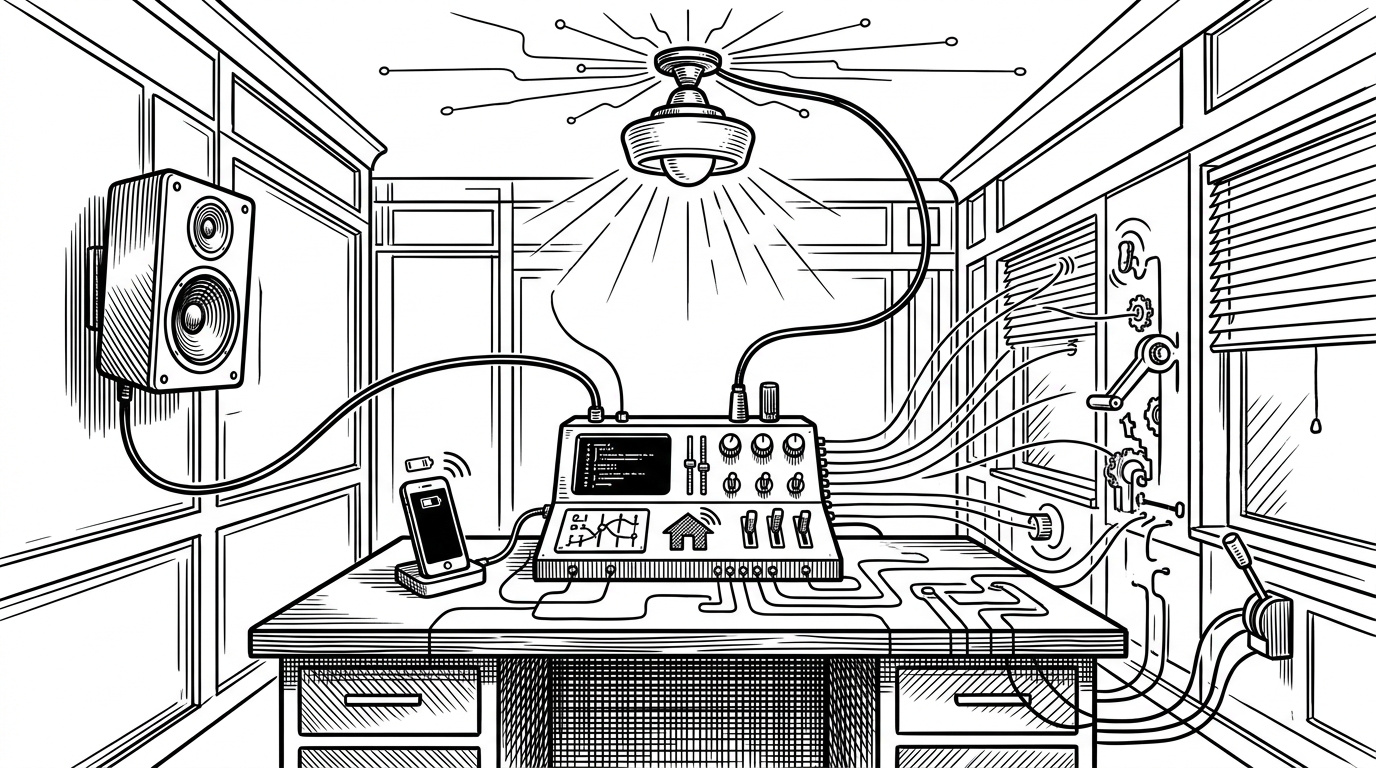
- aidenybai/home is compelling because it treats a house as private software, not as a product for everyone.
- Its real differentiator is orchestration: one event can fan out into speech, notifications, and state updates.
- The repo’s strength comes from refusing generality, which makes the system easier to own in one environment.
- Compared with Home Assistant and openHAB, it behaves more like a custom instrument than a platform.
A house wired like software
Most home automation projects try to become platforms. This repo does the opposite. It reads like a working system built around one house, one maintainer, and one set of habits, which is exactly why it is interesting.
The repository description says the quiet part out loud: “this is my personal setup, not a framework.” That line is the whole thesis. The code is not chasing broad adoption. It is encoding a way of living, with the friction and the precision that come with that choice.
this is my personal setup, not a framework.
Why specificity beats portability here
Aiden Bai is better known for performance-minded frontend work and Million.js, so the instinct to build a tight, opinionated system tracks. The interesting move is not that he built home automation code. It is that he applied a builder’s bias toward control, clarity, and minimal wasted motion to his own living space.
That makes the repo feel closer to infrastructure as autobiography than to a showcase project. It is public, but not generalized. Useful, but only on its own terms.
The core trick: one event, many outputs
The most revealing idea in the project is the fan-out. A single trigger does not just update a dashboard or flip a device. It can become speech, a notification, and a state change that keeps the system from repeating itself.

How the pipeline is organized
At a practical level, the architecture is easy to grasp once you stop looking for a framework. There is a trigger, a decision layer, and a set of outputs. The point is not the number of components. The point is that the system makes the path from event to human-facing response explicit.
That matters because home automation gets messy when every rule is a special case. This repo suggests a cleaner rule: separate the decision from the delivery, then let the delivery layer speak, ping, or update state as needed. It is a small design choice with a big maintenance payoff.
Why this is not Home Assistant
Home Assistant and openHAB are both platforms. They are designed to support many users, many devices, and many integration styles. Home Assistant optimizes for breadth. openHAB optimizes for a pluggable automation core. This repo optimizes for one household and one maintainer.
| Dimension | aidenybai/home | Home Assistant | openHAB |
|---|---|---|---|
| Intended audience | One maintainer, one house, one workflow | Broad home automation users | Technical users who want a pluggable platform |
| Setup philosophy | Custom code that matches existing habits | Integrate devices and services into a shared UI | Compose bindings and rules around a generic engine |
| Generality | Specific by design | General purpose | General purpose |
| Speech and notifications | Core paths, not afterthoughts | Supported through integrations | Supported through integrations |
| Maintenance model | Tight ownership, fewer abstractions | Community ecosystem and integrations | Platform maintenance plus plugins |
That is the real comparison. Not features, but intent. Platforms try to absorb variation. This repo narrows it.
What the repo teaches about software for one user
Open source usually rewards abstraction, but good software does not need to be universal to be valuable. Sometimes the sharpest design comes from refusing to design for everyone. In this case, that refusal creates a system that is legible, opinionated, and easy to live with because it was shaped around actual life, not imagined scale.
That is why aidenybai/home lands as more than a home automation repo. It is a reminder that the best personal tools can be more coherent than many public platforms, precisely because they are allowed to be specific.