The Compiler in the Chatbox: How anthropics/prompt-eng-interactive-tutorial Formalizes the Black Art of Prompting
Moving beyond "vibes" to build deterministic, production-grade systems with Claude’s hidden structural levers.
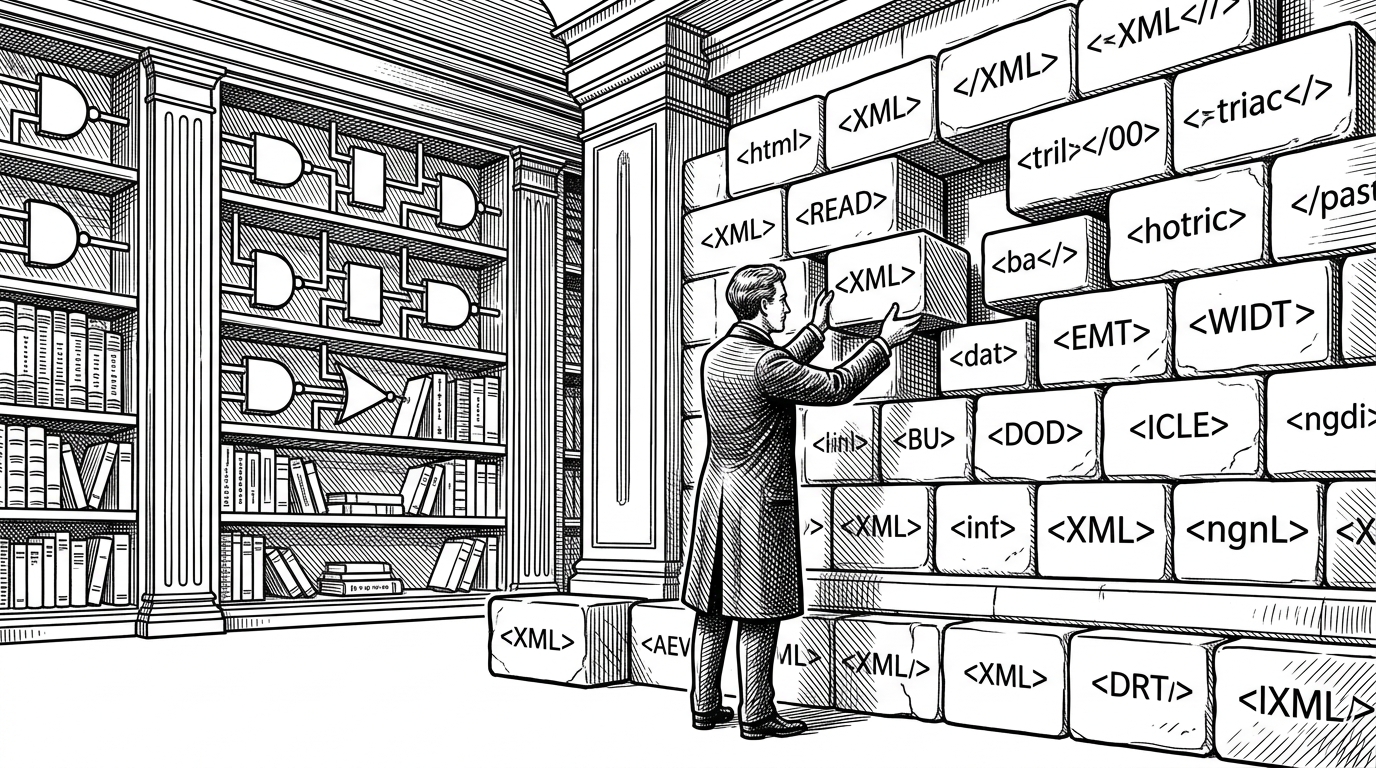
- Pre-filling the assistant's response forces the model into a deterministic state machine by bypassing conversational filler.
- XML tags serve as structural delimiters that prevent user input from overriding system instructions.
- Explicit thinking blocks expand the model's working memory to improve reasoning for complex tasks.
- Setting the API temperature to zero transforms the model from a probabilistic generator into a reproducible compiler.
The tech industry has spent years treating large language models like unpredictable artists. We beg them to format output correctly. We ask them nicely to ignore previous instructions. We treat prompting as a dark art of "vibes" and intuition.
Anthropic's interactive prompt engineering tutorial rejects this premise entirely. The repository reveals that interacting with Claude is less like having a conversation and more like programming a compiler. By leveraging XML tags, strict schema validation, and "pre-filling" the assistant's mouth, the tutorial teaches developers how to stop chatting with the model and start building deterministic state machines.
The Assistant’s Stolen Script
The most counter-intuitive technical trick in the repository is found in Chapter 5. It is a pattern called "Speaking for Claude." Instead of asking the model to return a JSON object and hoping it skips the polite preamble, developers can force the output format by pre-filling the assistant's response.
message = anthropic.messages.create(
    model="claude-3-haiku-20240307",
    max_tokens=1000,
    temperature=0,
    messages=[
        {"role": "user", "content": "Extract the user's name and age from this text: 'Hi, I'm Alice and I am 30 years old.'"},
        {"role": "assistant", "content": "{\n  \"name\": "}
    ]
)
By ending the message array with an assistant turn that already contains the opening bracket of a JSON object, the model has no choice but to continue generating valid syntax. It bypasses conversational filler entirely. This technique transforms a probabilistic text generator into a strict data extraction engine.

Programming with Tags
The repository aggressively pushes the use of XML tags. In traditional prompting, developers rely on line breaks or capitalization to separate instructions from user data. This leads to "Instruction Injection," where malicious or confusing user input overrides the system prompt.
Anthropic solves this by treating XML tags as impenetrable fences. Claude is explicitly trained to prioritize instructions outside of data tags and to treat anything inside a `
I talk to ai like a caveman mostly. Instead of over optimizing my prompt I just try to find the minimal amount of representation to get the llm to understand my problem and solve it for me and I have been very productive with this strategy. What would someone like me get out of prompt engineering?
The answer to this common skepticism lies in scale. Talking like a caveman works for one-off tasks. It fails catastrophically when you need to process ten thousand documents reliably through an automated pipeline. The tutorial bridges the gap between ad-hoc usage and enterprise architecture.
The Myth of Silent Thought
Chapter 6 introduces "Precognition" and dismantling a common misconception: LLMs do not think silently. For a language model, generating tokens is the entirety of its cognitive process. If it does not print the steps, it did not do the work.
The tutorial mandates the use of `
From Chatbot to Compiler
Most prompt engineering guides focus on natural language phrasing. Anthropic's interactive notebooks treat prompting as structured data manipulation. Every exercise requires the developer to set the API temperature to zero, removing randomness to ensure the "interactive" learning is strictly reproducible.
| Traditional Prompting | Anthropic Structured Style |
|---|---|
| "Please format this as JSON..." | Pre-filling assistant with `{` |
| Natural language paragraphs | Strict XML delimiters `<data>` |
| Relying on model intuition | Explicit `<thinking>` blocks |
| Post-processing regex cleanup | Forced state machine outputs |
By providing this curriculum in executable Jupyter Notebooks and Google Sheets, Anthropic has created a blueprint for corporate AI adoption. It is a necessary shift in the job description of an AI Engineer: moving away from writing clever prose, and moving toward defining rigid, unbreakable schemas.