WPSubscription: The WordPress Plugin That Treats Recurring Billing Like a Real System
A deep dive into how <a href="https://github.com/converslabs/subscription" target="_blank" rel="noopener noreferrer">converslabs/subscription</a> combines WooCommerce, custom billing state, cron-driven renewals, and a surprisingly framework-like codebase to make subscriptions feel engineered instead of improvised.
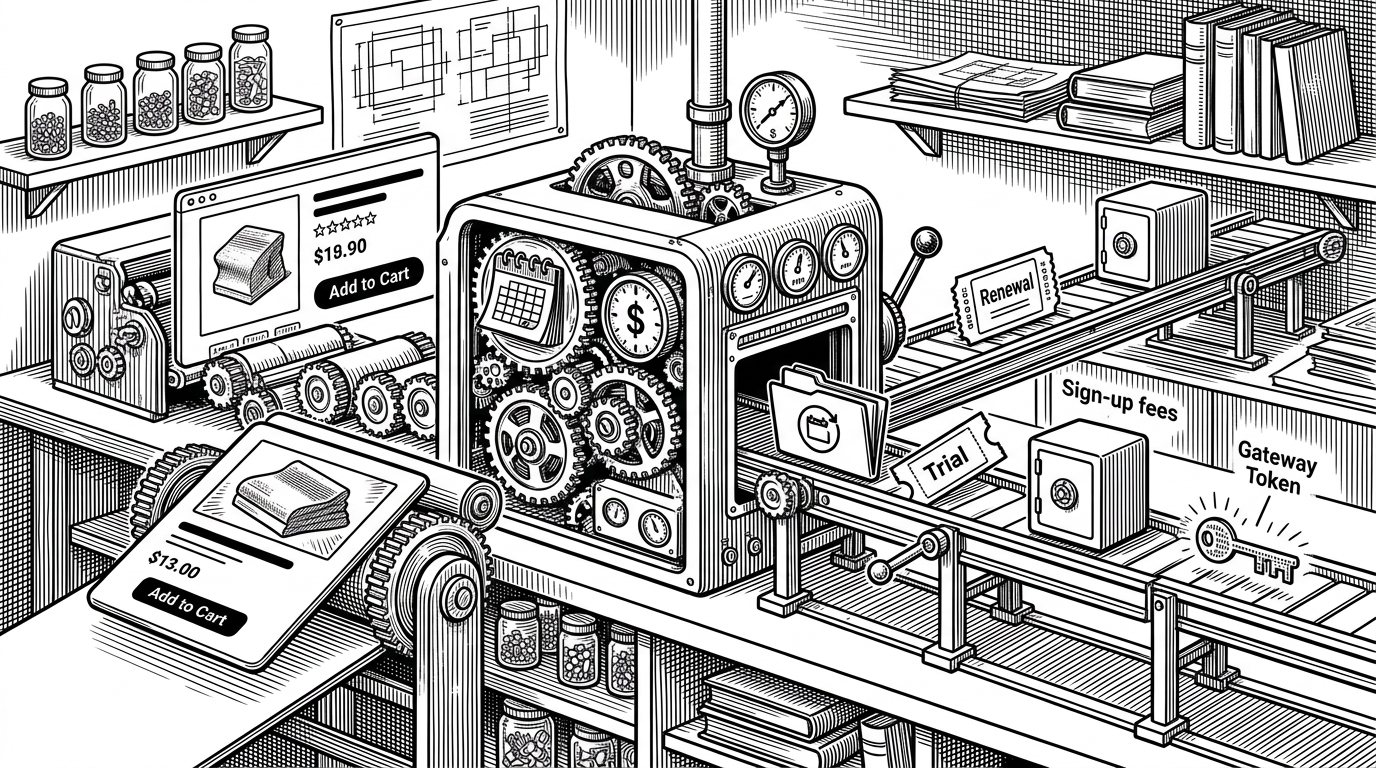
- WPSubscription stands out because it treats recurring billing as stateful infrastructure, not a checkbox feature added to WooCommerce.
- The core engine calculates future subscription dates, then uses cron to enforce them on the server side.
- Stripe support matters here because off-session renewals, saved payment tokens, and mandate-sensitive methods add real billing complexity.
- The repo’s `.agents` and `.claude` directories hint at a second story: this codebase is being maintained with explicit AI-assisted workflow rules.
A WooCommerce plugin that thinks like a platform
Most WordPress plugins look like a pile of hooks with a settings page attached. This one reads more like a small billing platform that happens to ship as a plugin. The signal is everywhere: PSR-4 namespaces, an includes/Illuminate engine room, separate Admin and Frontend codepaths, custom subscription records, and HPOS compatibility.
That matters because subscriptions are not a simple feature. They are a sequence of state changes, payment attempts, grace periods, and expiry rules. The repo’s structure suggests the authors understood that early and designed around it instead of bolting it on later.
WPSubscription maximizes recurring revenue on WooCommerce. Set flexible subscriptions and automated billing with support for Stripe, PayPal, and more, all with zero technical hassle.
The billing brain lives in Order.php
The important job is not creating a subscription row. It is calculating what happens next. In the billing engine, the subscription gets a start date, a next billing date, and possibly a trial window, then those dates become the source of truth for every later decision.
// Conceptual flow from the billing engine
$subscription->start_date = $startDate;
$subscription->next_date  = $nextBillingDate;
$subscription->trial_end  = $trialEnd;

if ($trialActive) {
    $subscription->status = 'trialing';
}

if ($billingInterval === 'monthly') {
    $subscription->next_date = sdevs_wp_strtotime('+1 month', $subscription->next_date);
}
That is the right model for recurring commerce. A subscription system should not just remember that money is due. It should know when money is due, how that date shifts over time, and which state the customer should see between now and then.
Renewals are not automatic. They are scheduled.
This is where the implementation becomes operational, not theoretical. A daily cron task scans subscriptions whose next renewal date has arrived, then routes each one through expiration, cancellation, or another billing attempt. The system is not waiting for a user to click anything. It is running on the server, on schedule.
That design makes the failure modes explicit. If the payment path succeeds, the next cycle is created. If it fails, the customer can fall into grace logic instead of being cut off immediately. The code is doing what a real billing engine should do: managing time, access, and exceptions.
Stripe integration is where the complexity appears
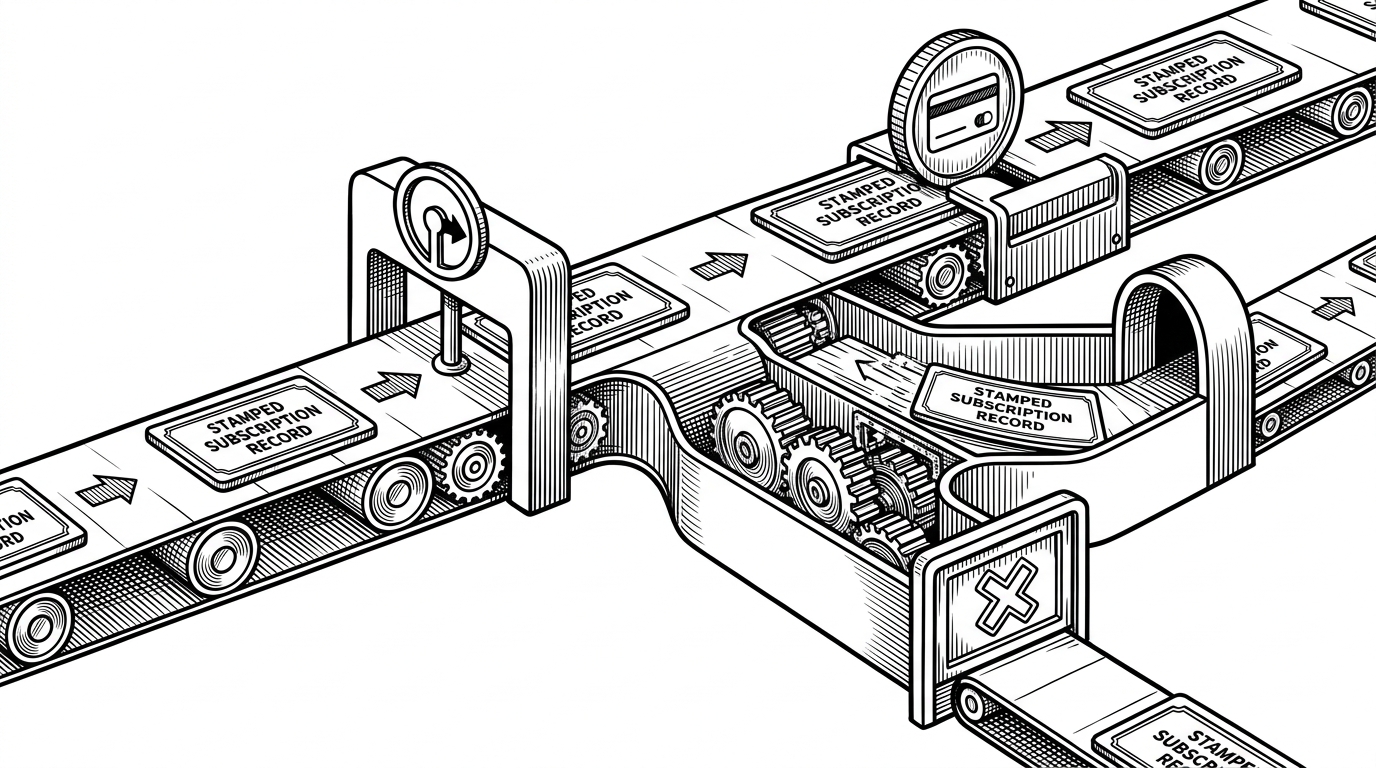
The gateway layer is where subscriptions become real money movement. Off-session billing requires saved payment methods, recurring authorization, and careful handling of methods that need mandates, like SEPA or iDEAL. That is a very different problem from simply collecting payment once at checkout.
| Dimension | On-session payment | Off-session renewal | Why it matters |
|---|---|---|---|
| Customer present | Yes | No | Renewals must work without a live checkout page. |
| Payment method | Any supported method | Only methods that can be charged later | The plugin has to respect gateway rules, not just user preference. |
| Failure handling | Immediate checkout feedback | Retry, grace, or expiry logic | Recurring revenue depends on recovery paths. |
| State tracking | One transaction | A long-lived billing relationship | Subscriptions need dates, not just receipts. |
The point is not that Stripe is supported. The point is that the plugin is handling the hard part of recurring billing correctly: payment tokens, renewal timing, and gateway-specific constraints. That is what separates a demo from a system.
Why this codebase feels more disciplined than the average WordPress plugin
The repo keeps trying to impose order on a chaotic ecosystem. You can see it in the naming, in the split between frontend and admin code, in the modern asset stack, and in the general preference for explicit organization over loose procedural sprawl.
| Dimension | Typical WP plugin | WPSubscription | Why it matters |
|---|---|---|---|
| State handling | Stored as ad hoc metadata | Subscription lifecycle is modeled explicitly | State is easier to reason about and maintain. |
| Renewal mechanism | Often user-triggered or loosely scheduled | Daily cron enforces due renewals | Billing becomes predictable and auditable. |
| Architecture style | Flat includes folder with mixed concerns | Illumination-style separation and engine layer | The code is easier to extend without breaking everything. |
| Developer tooling | Basic linting, minimal structure | Composer, scripts, CI, linting, tests | The team can ship changes with more confidence. |
| Extensibility | Feature additions often feel bolted on | Gateway and billing logic are separated | New payment paths are less likely to tangle core flows. |
The Illuminate naming choice is especially telling. It borrows the feel of Laravel without pretending to be Laravel. That is a cultural signal as much as an architectural one: WordPress code can be more structured than its reputation suggests.
The AI-maintenance layer is the most unusual part
The repo’s .agents and .claude directories are the meta-story. They suggest that the codebase is being maintained with explicit AI workflow rules, performance guidance, and plugin-development standards baked into the repository itself.
That is rare, and it is interesting because it changes what the repo is. It is not only a subscription tool. It is also a snapshot of how modern open-source maintenance is starting to formalize AI as part of the development process.
What WPSubscription is really competing against
The competition is not just other plugins. It is the default WordPress habit of growing features through patchwork. Against that backdrop, WPSubscription’s trade-off is clear: more structure than a lightweight plugin, less heft than a large official subscription suite, and a more opinionated internal model than either extreme.
| Dimension | Typical WordPress subscription plugin | WPSubscription | Why it matters |
|---|---|---|---|
| Product philosophy | Feature-first | System-first | The code follows the billing workflow instead of hiding it. |
| Operational model | Checkout-centric | Cron-driven renewal engine | Recurring billing keeps working after the browser closes. |
| Gateway support | Often broad but shallow | Broad with explicit renewal logic | Support matters less than what happens at renewal time. |
| Maintenance style | Mostly human-maintained | Human plus AI workflow rules | The repo hints at a future maintenance model. |
| Best fit | Simple membership use cases | Stores that want disciplined recurring billing | The structure pays off when subscriptions get serious. |
The most useful way to read this repo is not as a plugin versus a plugin. It is as a sign that WordPress commerce is learning to look more like software engineering and less like improvisation. That shift is the real product.