dataminerbr/base64: The Smallest Possible Trust Trap
A one-file GitHub repo hides a Base64-encoded URL, but the real story is how a harmless-looking challenge can steer curiosity toward an external delivery gate.
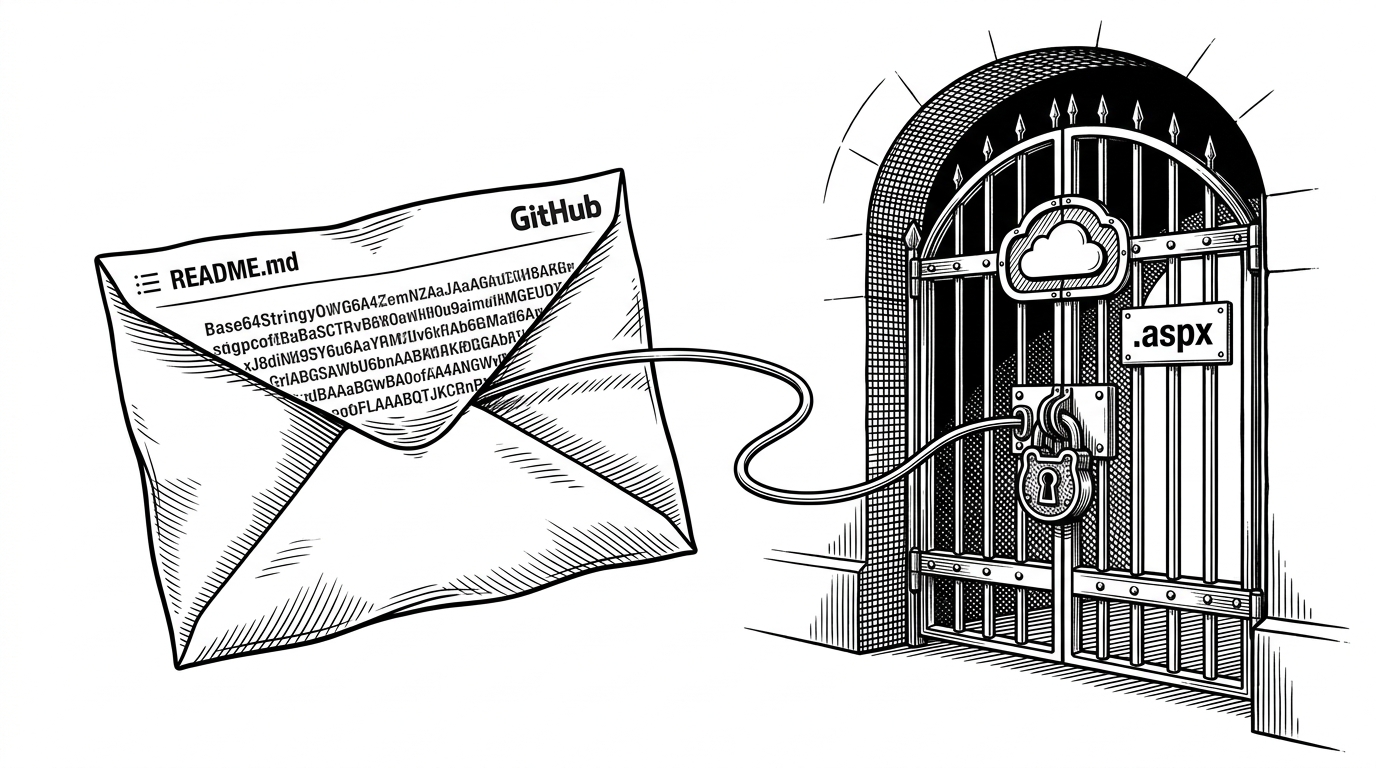
- This repository is less a Base64 utility than a persuasion device that uses GitHub's trust halo to make an external link feel worth opening.
- Its core trick is not the encoding itself, but the way a tiny README becomes a staged handoff from curiosity to a gated download endpoint.
- The .aspx path on a Cloudflare Workers host is the tell, because it mixes legacy enterprise signaling with modern serverless delivery.
- Compared with normal Base64 tools, the project optimizes for behavior, not utility, and that makes it an unusually compact social-engineering artifact.
A README That Is Really a Gate
This repo is almost offensively minimal. One file. One prompt in Portuguese. One encoded string. That is enough to turn GitHub into the first layer of trust and curiosity into the mechanism that moves the reader forward.
The instruction is simple: decode the value below. That framing matters more than the payload, because it makes the page feel like a challenge instead of a handoff. By the time the reader reaches for a decoder, the repo has already done its job.
The Payload Behind the Puzzle
The encoded string resolves to a URL on a Cloudflare Workers domain: https://gon.klab.workers.dev/download.aspx?file=.... The query string carries three parts that read like a controlled download flow: file, expiry, and mac.
Encoded:
aHR0cHM6Ly9nb24ua2xhYi53b3JrZXJzLmRldi9kb3dubG9hZC5hc3B4P2ZpbGU9cDlrWkdqOG1kNmZOcEtONVY2TXd5ZUUzYmNnOHR2ZHR6dFNMSlRvbEVZJTJCVnVIc1I5YVB2OGg5aUhuZ3Y1ZXc3JmV4cGlyeT0wTFZqUitmUkhwNzM2S01wcmV4d1pBJTNEJTNEJm1hYz1jOWVmOGEyYTNkNWFhNDhkN2E5OTU1N2I0M2FlMGI3NGJmNThjOTVlOWY2MDU0OTQ0MzJjOTk2MmI1YjY1MDcy

Decoded:
https://gon.klab.workers.dev/download.aspx?file=p9kZGj8md6fNpKN5V6MwyeE3bcg8tvdtztSLJTOlEY%2BVuHsR9aPv8h9iHngv5ew7&expiry=0LVjR%2BfRHp736KMprexWZA%3D%3D&mac=c9ef8a2a3d5aa48d7a99557b43ae0b74bf58c95e9f605494432c9962b5b65072Why the URL Looks Legitimate

That mismatch is the clue. .aspx signals old Microsoft-era web infrastructure, while .workers.dev signals a modern Cloudflare runtime. Put together, the URL reads like a costume: legacy naming on top of serverless delivery.
The query parameters make the behavior even clearer. file looks like the payload pointer, expiry suggests a time-bounded link, and mac implies the server checks integrity before serving anything. This is not a static file link. It is a controlled gate.
GitHub as the First Layer of Trust
GitHub changes the reader's posture. A repo feels inspectable, reversible, and public. That makes a one-file challenge much more effective than a random pasted URL, because the platform itself lowers suspicion before the user ever leaves the page.
The word Desafio matters too. It frames the action as a puzzle, not a transfer. That small rhetorical shift gives the reader a reason to comply with the decode step, which is exactly what any trust trap needs.
| Pattern | Purpose | Transparency | Destination | Trust signal |
|---|---|---|---|---|
| Normal Base64 utility | Encode or decode text | Explicit | Stays local | Utility and documentation |
| Transparent challenge repo | Teach a concept openly | High | Usually self-contained | Pedagogical framing |
| This repo | Drive attention toward an external gate | Low | Cloudflare Workers download endpoint | GitHub trust plus puzzle framing |
What This Is Not
It is not a normal Base64 library, and it is not trying to be useful in the way an encoding tool is useful. There is no reusable API, no package metadata, and no implementation to inspect beyond the message embedded in the README.
That is why the repo is interesting. It compresses social engineering, delivery design, and platform reputation into a single Markdown file. The artifact is tiny, but the behavioral design is complete.
The Broader Pattern
Seen broadly, this is a pattern for moving a user through a sequence of trust handoffs. Start with a benign platform. Hide a prompt. Ask for a decode. Reveal a link that looks ordinary enough to follow, yet is actually part of a gated delivery chain.
The lesson is not that Base64 is dangerous. The lesson is that a minimal README can function as a persuasion layer when it sits inside the right social context. The encoding is just the wrapper.