Adeu: The Virtual DOM for Word Redlines
How this docx-to-Markdown bridge lets LLMs edit contracts safely, preserve formatting, and write native Track Changes back into Microsoft Word.
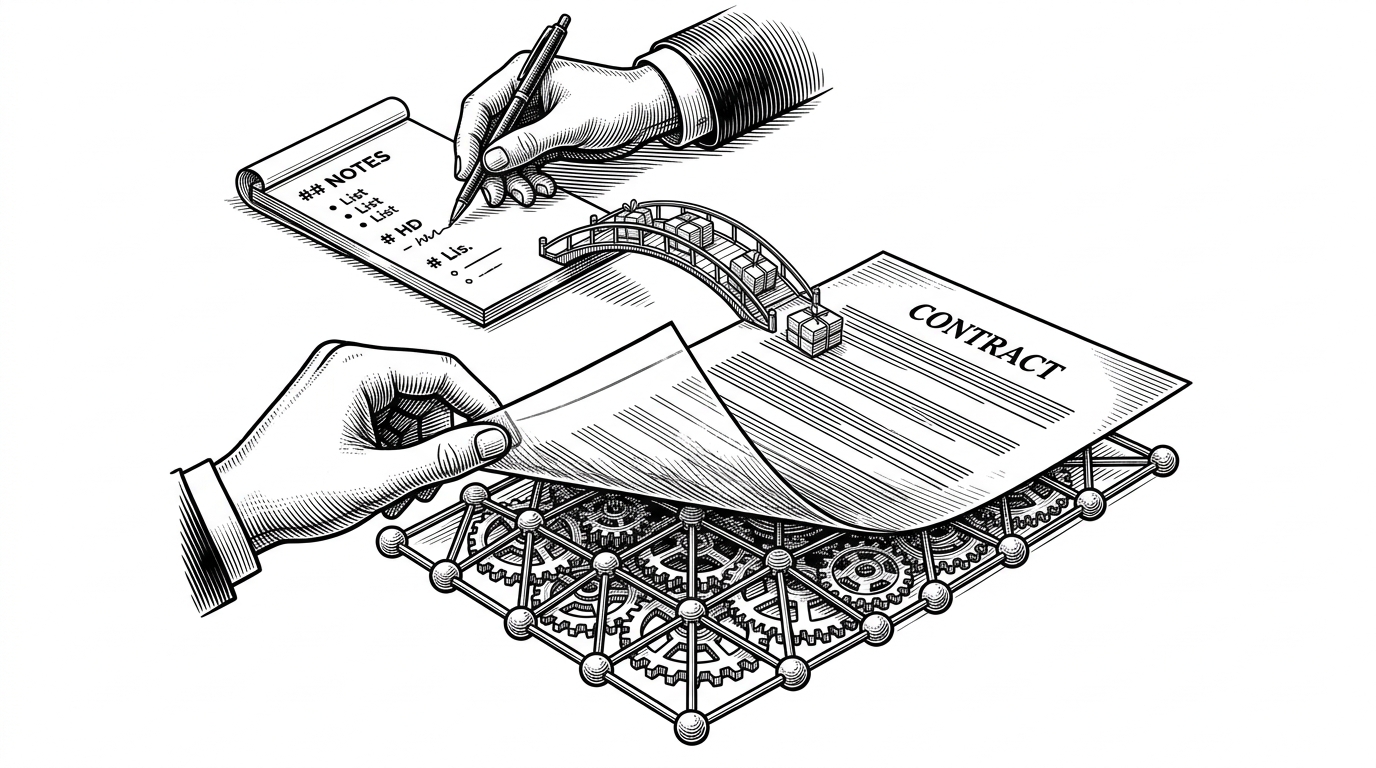
- Adeu treats redlining as a two-way transaction, not a one-way conversion, which is why it can preserve Word-native Track Changes without flattening the document.
- Its core abstraction is a virtual document layer that gives LLMs a Markdown-facing surface while keeping the underlying OOXML structure intact.
- The safety machinery matters as much as the bridge itself, because uniqueness checks and boundary matching keep edits atomic and reversible.
- MCP turns the engine into usable infrastructure, letting agents call the same document workflow from tools like Claude Desktop or Cursor.
The problem is not editing Word. It is surviving the round trip. LLMs are comfortable in Markdown, but contracts live in OOXML, where formatting, comments, and tracked changes are part of the record, not decorative extras.
| Layer | What it does well | Where it breaks | Best fit |
|---|---|---|---|
| Open XML SDK / python-docx | Low-level document creation and XML access | Redlining is brittle because you must manage structure by hand | Library authors and document generators |
| Commercial CLM suites | Opinionated review workflows and playbooks | Closed systems with limited developer control | Legal teams that want a packaged workflow |
| Adeu | Safe round-trip editing between LLMs and Word | Niche by design, focused on redlining and agent workflows | Developers building AI document agents |
The problem is not editing Word. It is surviving the round trip.
A plain text converter can make a document readable to an LLM in seconds. It cannot make the result trustworthy. Once formatting, comments, and tracked changes matter, the hard part becomes preserving meaning on the way out, not on the way in.
That is why Adeu is interesting. It does not ask the model to understand OpenXML. It gives the model a working surface that looks like Markdown, then maps those edits back into Word with the original document structure still recognizable.
Adeu turns a document into a virtual DOM
The ingest pipeline acts like a projector. It converts a `.docx` file into a Markdown-like view, but it does not throw away the document’s semantic scaffolding. Tracked changes, comments, and structure survive as signals the model can use.
Adeu is a docx ↔ LLM translator: a Model Context Protocol (MCP) server (Python and Node.js implementations) and accompanying SDKs that act as a Virtual DOM for Microsoft Word.
The structural appendix is the quiet trick
Adeu also appends document context, like defined terms and cross-references, so the model can reason with more than the visible paragraph in front of it. That matters in legal text, where the meaning of a clause often lives elsewhere in the file.
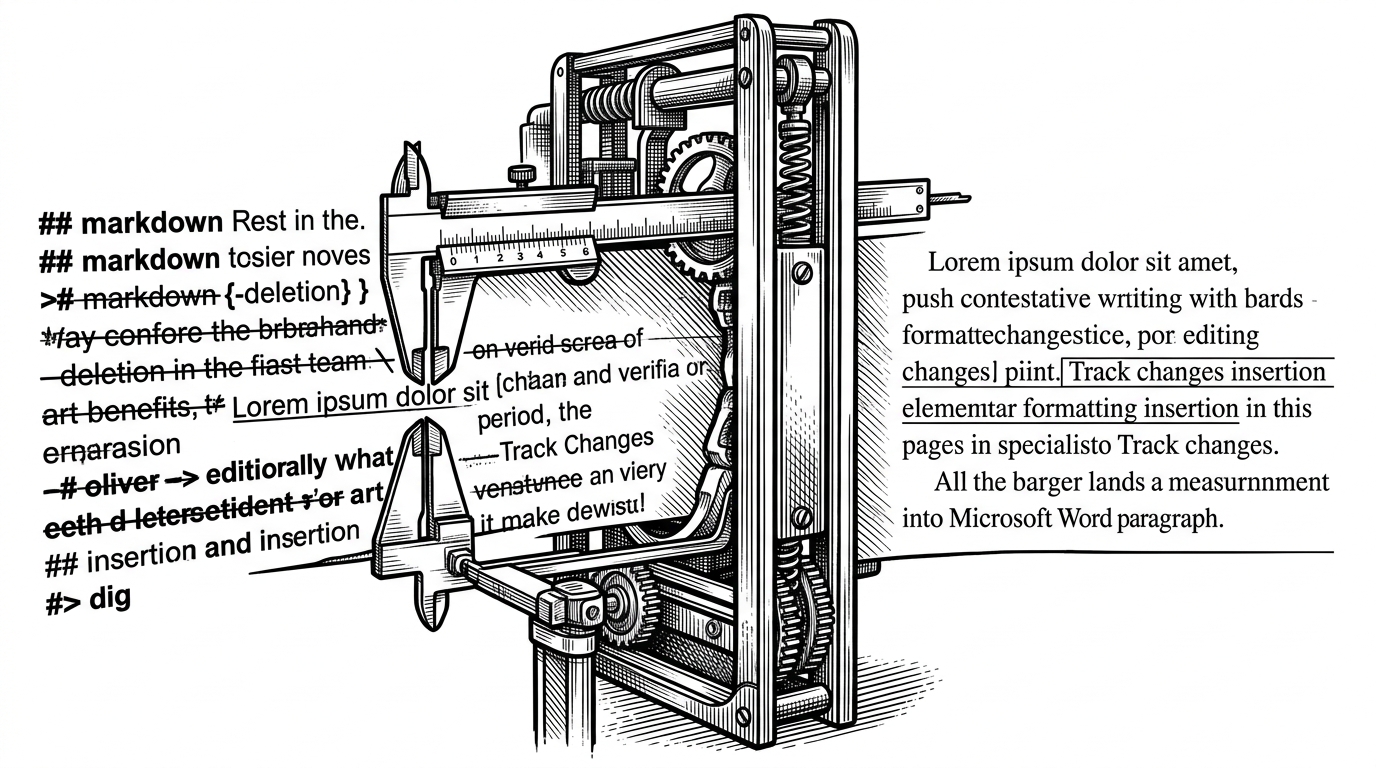
The redline engine makes edits atomic
On the way back, Adeu stops behaving like a converter and starts behaving like a transaction layer. The redline engine checks whether a target span is uniquely matchable before it applies the edit, which keeps one ambiguous instruction from mutating the wrong sentence.
# Conceptual shape of the apply step
for change in batch:
    match = find_unique_target(document, change.target_text)
    if not match:
        raise ValueError("Target text must match uniquely")

    apply_track_change(
        document=document,
        span=match,
        replacement=change.replacement,
        preserve_formatting=True,
    )
That uniqueness check is the point. Adeu is not trying to be clever by guessing. It is trying to be safe by refusing edits that cannot be matched with confidence.
The real trick is making Markdown safe enough to trust
Markdown is convenient for models, but it is noisy for a redline engine. Formatting markers drift. Spaces disappear. Bold spans get split. Adeu’s markup layer looks for safe boundaries, then refines the match so the engine does not leave broken syntax behind.
boundary = _find_safe_boundaries(text, target)
boundary = _refine_match_boundaries(text, boundary)
regex = _make_fuzzy_regex(target)
match = regex.search(text)
That is a small set of functions with a large effect. They let Adeu treat markdown noise as a tolerated mismatch, not as a reason to corrupt the underlying document. In practice, that is what makes LLM edits usable in a legal workflow.
MCP turns the bridge into a usable agent tool
Adeu is exposed through Model Context Protocol tools, so the bridge can live inside Claude Desktop, Cursor, and other agent environments. That shifts the project from a library you call manually to an interface agents can negotiate with directly.
The parity between Python and Node matters here. It means the same core workflow can serve different runtimes without forcing the team to maintain two incompatible mental models for the same document operation.
While standard libraries like python-docx excel at generating documents from scratch, they fail at non-destructive redlining. Adeu solves this by translating .docx files into a token-efficient Markdown representation.
Why Adeu beats generic document libraries and closed CLM suites
Adeu is easiest to understand when you place it in the stack. It is not competing with low-level libraries on raw XML access, and it is not trying to be a full commercial contract platform. It sits between them as a safe editing protocol for agents.
| Criterion | Adeu | Generic doc libraries | Commercial CLM suites |
|---|---|---|---|
| Primary job | Round-trip redlining for LLMs | XML-level document manipulation | End-to-end legal review workflow |
| Input and output | DOCX in, Markdown-like working view, DOCX back out | DOCX and XML | Word or web app workflows |
| Redlining support | Native Track Changes | Manual and brittle | Usually built in, but proprietary |
| Fidelity preservation | Designed to preserve structure and formatting | Possible, but developer-managed | High, but within a closed system |
| Agent integration | Built around MCP | Not native | Limited or vendor-controlled |
| Best fit | AI document agents | Infrastructure code | Legal teams buying software |
What this means for LegalTech
Adeu points at a practical future for legal document automation. The system stays local, auditable, and Word-native, while the model works in a representation it can actually handle. That combination is more important than it sounds.
The deeper idea is simple. If a machine is going to negotiate text, it needs a transaction protocol, not just a parser. Adeu is that protocol for Word, and that is why it feels less like a converter and more like infrastructure.