Real-Time-Malpractice-Detection-in-classroom: Real-Time Malpractice Detection in Classroom: How a Webcam Becomes an Evidence Machine
A lightweight Flask and OpenCV system does more than spot inattentiveness. It logs behavior, captures proof, and turns a simple face detector into a classroom audit trail.
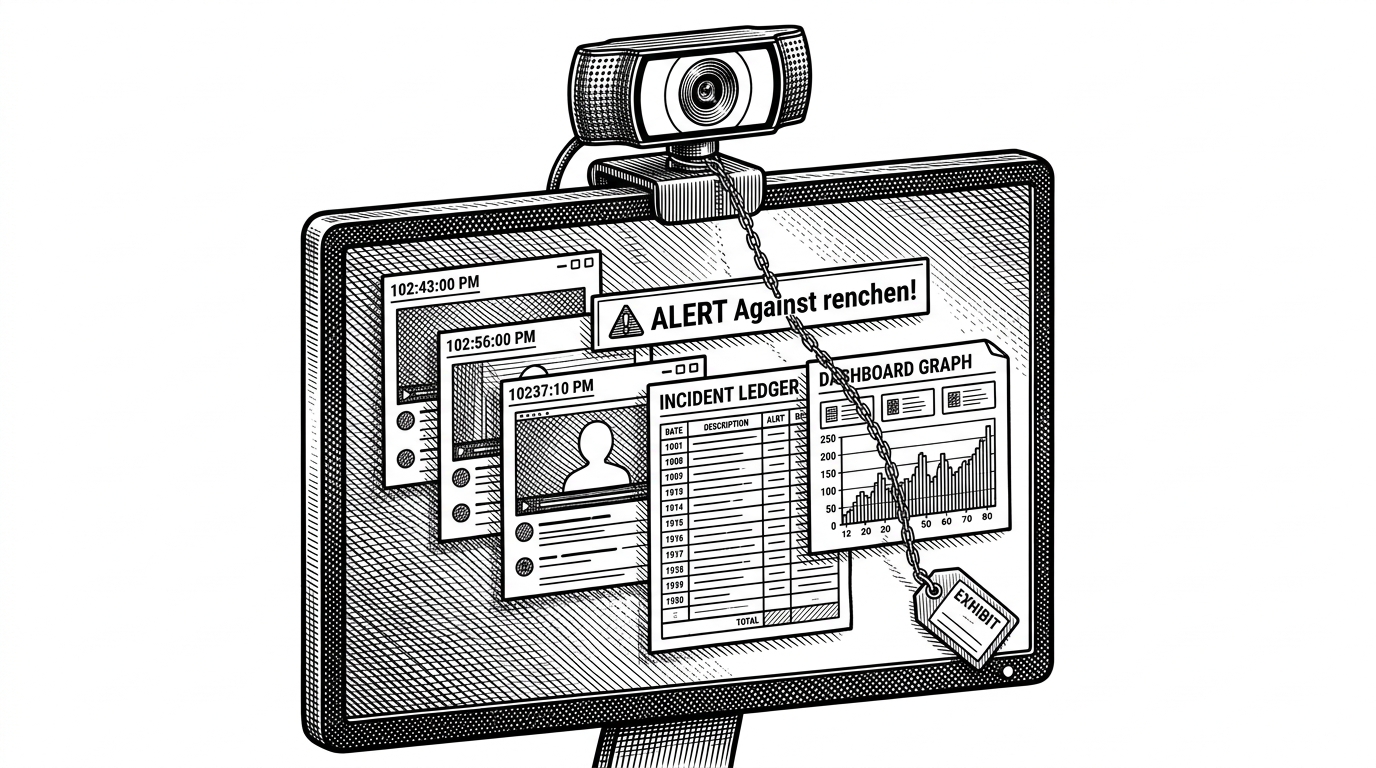
- This repo is interesting because it treats suspicion as something to be audited, not just flagged.
- Its core trick is a lightweight rule system that converts weak visual signals into one attention score and then into logs, screenshots, and alerts.
- The project is more legible and easier to run than heavier classroom CV stacks, but that clarity also makes its assumptions easier to question.
- Its biggest lesson is product-level: prototypes become useful when they preserve context, not just outcomes.
Most classroom monitoring demos stop at the box and the beep. This one keeps going. It turns a brief event, a face leaving frame, into a record that can be reviewed later, which changes the project from a detector into a forensic system.
That is the sharpest thing about divyasree04-git/Real-Time-Malpractice-Detection-in-classroom. The repo is not trying to be a giant model zoo. It is trying to make a simple monitoring loop durable enough to matter.
The real product is not detection, it is proof
The repo’s central design choice is evidence-first monitoring. It watches for inattention, but it also captures screenshots, writes event data, and keeps a history of what the system saw. That gives the project a different feel from most computer vision demos, which often end at a warning overlay.
Here, the output matters as much as the inference. If a student is flagged, the system does not just shout. It leaves a trail.
Why a face detector is enough for the first pass
The monitoring loop is intentionally modest. A webcam stream goes into OpenCV. The code watches for a face, starts a timer when the face disappears, and triggers a warning once that absence lasts long enough. In the research notes, that threshold is three seconds.
That sounds basic, and that is the point. A lot of useful product behavior starts as state logic, not as a giant model. If no face is seen, the system does not need to infer a whole mental state. It only needs to decide whether the absence is long enough to matter.
if len(faces) == 0:
    if inattention_start_time is None:
        inattention_start_time = time.time()
    elif time.time() - inattention_start_time > 3.0:
        trigger_warning()
        save_screenshot()
        log_incident()
else:
inattention_start_time = NoneThe score is a stack of heuristics
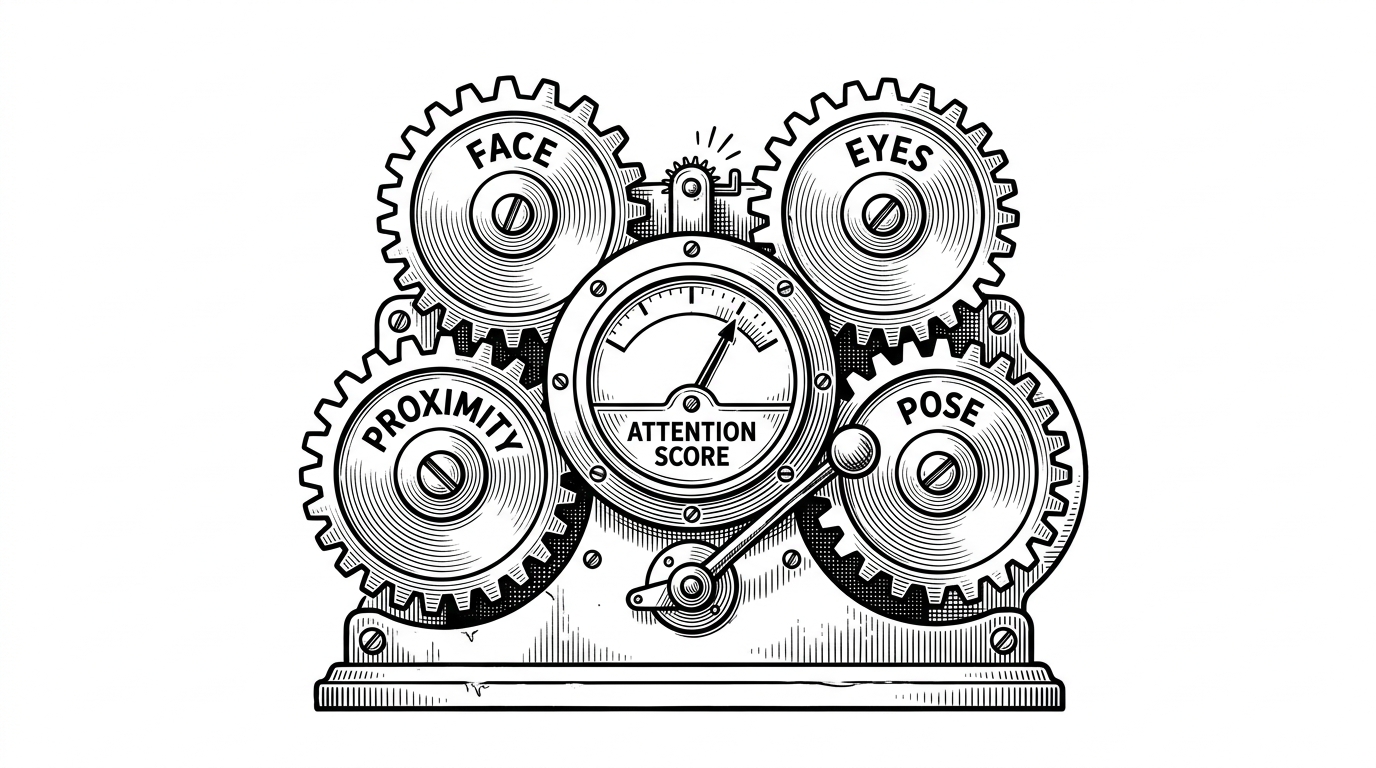
The most interesting code is not a deep model. It is the scoring function. According to the research notes, `calculate_advanced_attention_score` combines face detection, eye detection, proximity, and pose into a weighted total. Face detection contributes 30 percent, eyes 40 percent, proximity 20 percent, and pose 10 percent.
That structure matters. It makes the system legible. You can see why a score changed, not just that it changed. The tradeoff is obvious too. A transparent heuristic system is easier to understand, but it is also easier to break with odd lighting, camera angles, or a student who simply looks different from the default assumption.
| Signal | Weight | What it tells the system | Typical failure mode |
|---|---|---|---|
| Face detection | 30% | Someone is present in frame | Occlusion, side profile, bad lighting |
| Eye detection | 40% | Eyes are visible and likely oriented forward | Glasses, blur, closed eyes, low resolution |
| Proximity | 20% | The face is large enough to feel close to the camera | Camera position varies, laptop distance shifts |
| Pose offset | 10% | Head angle looks centered enough to count as attentive | Normal movement can look like avoidance |
From alerts to audit trails
This is where the repository becomes more than a classroom demo. The research notes describe an `AttentionLogger` class with SQLite tables for sessions, attention events, and look-away incidents. That means the system is not only reacting in real time. It is storing structured telemetry for later review.
That design makes the project feel like a black box recorder. A warning is only the beginning. The interesting part is that the app can later answer questions like when the incident started, how long it lasted, and what the system believed was happening at the time.
| Layer | What it stores | Why it matters |
|---|---|---|
| sessions | Start and end markers for a run | Defines the boundaries of one exam or class |
| attention_events | Timed telemetry snapshots | Captures how the score moved over time |
| look_away_incidents | Threshold-crossing events | Turns a moment into a reviewable case |
Why this feels lighter than the usual CV stack
The project sits in a different class from MediaPipe-heavy or YOLO-based monitoring systems. It is lighter, simpler, and easier to run on modest hardware. The research notes also point out that the pose logic is a kind of poor-man’s estimation, using face position and basic heuristics instead of a larger inference stack.
That makes it easier to deploy, but not magically better. It trades model sophistication for runtime simplicity and interpretability. For this use case, that is the interesting bargain.
| Dimension | This repo | Heavier CV stacks |
|---|---|---|
| Input signal | Basic webcam frames | Webcam frames plus richer feature extraction |
| Model complexity | Low | Higher |
| Hardware demand | Low to moderate | Often higher |
| Interpretability | High | Lower |
| Setup complexity | Lower | Higher |
| Forensic output | Built in | Usually needs extra work |
| Low-end laptop fit | Good | Less certain |
The ethical pressure point
The same thing that makes the project practical also makes it uncomfortable. When the rule is effectively “no face for three seconds,” the system is making a judgment about attention from a very small signal. That can be useful in a narrow monitoring context, but it can also be unfair if read as proof of bad intent.
The virtue of this repo is that it does not hide that tension. Its assumptions are visible in the code. That is better than pretending the system is neutral. It invites the harder question, which is whether a tool this legible is acceptable precisely because its limits are so easy to see.
What this repository teaches
This is a compact case study in how prototypes become products. A simple webcam script becomes a stateful tracker. The tracker grows a web UI. The UI writes to a database. The database feeds analytics. Then the whole thing stops being a demo and starts looking like infrastructure.
The larger lesson is not about cheating detection. It is about product design under constraint. If you need a cheap, understandable system, you often do not need more model. You need better packaging around a small signal so that the signal can survive review.