TFACM: The Cache That Lets Speech Separation Hear in Real Time
A causal separator from Tsinghua that swaps full hindsight for a rolling memory, and tries to erase the usual quality penalty of live audio.
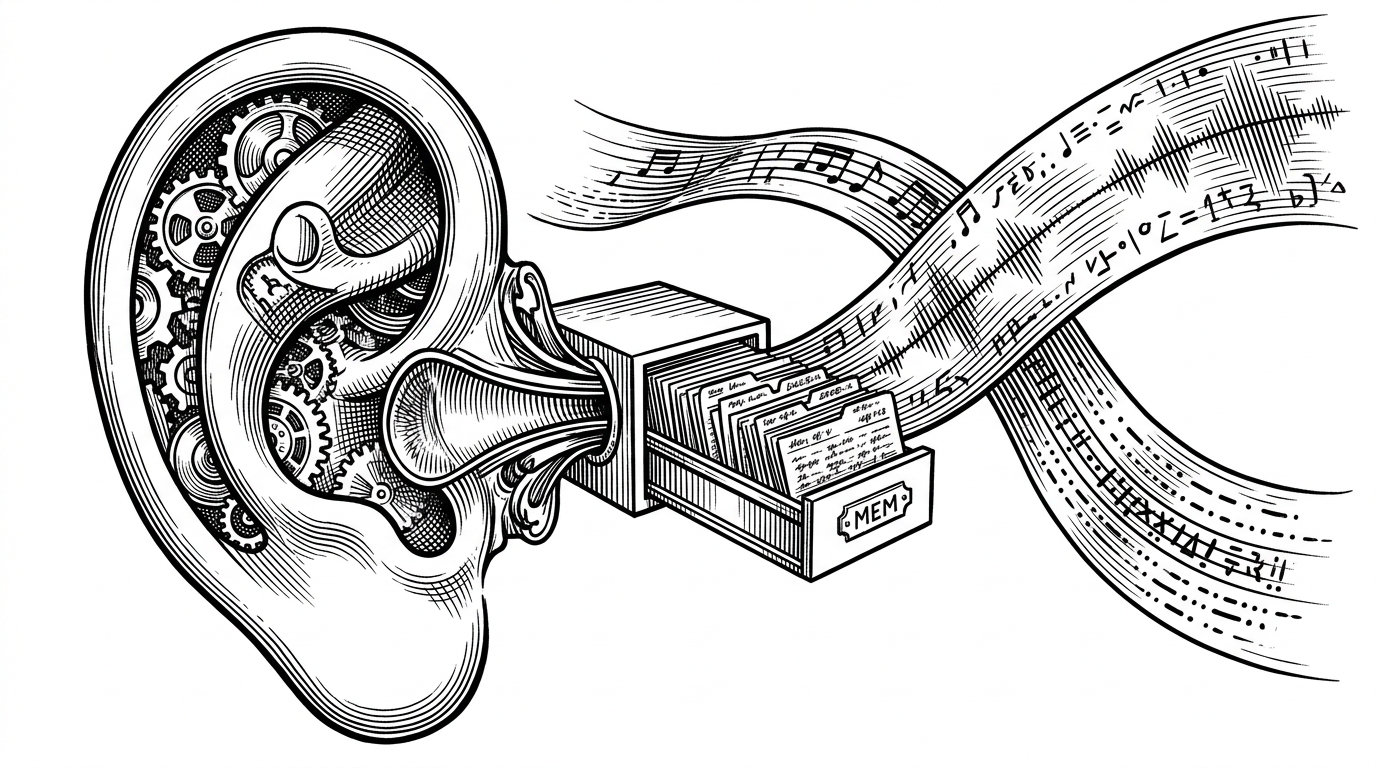
- TFACM’s main move is to reduce the quality penalty that usually comes with causal speech separation.
- Its cache memory is the real invention, because it preserves useful history without turning the model into a full hindsight machine.
- The repo reads like a research prototype that encodes a practical design pattern for streaming audio systems.
- TFACM matters less as branding than as a new way to budget memory in real-time hearing systems.
The Tax on Hearing Live
Speech separation has a stubborn rule: if you want to untangle overlapping voices as audio arrives, you usually pay for it in quality. Non-causal models can look ahead, use more context, and clean things up later. Causal models have to decide now, with less information and less room to recover.
That tradeoff shows up everywhere live audio matters. Transcription engines need to keep latency low. Assistive devices need to stay responsive. Streaming separation systems need to split speakers without introducing the awkward lag that makes real-time output feel broken.
TFACM enters at that pressure point. The repo is not trying to invent a new category of speech task. It is trying to make causality less expensive.
A Cache, Not a Crystal Ball
The most useful way to read TFACM is as a memory budget. Instead of asking the model to hear everything at once, the design asks it to keep the right pieces of the past close at hand. That is what the cache does: it acts like a working set for audio, not a full archive.
That matters because attention over an entire stream is expensive, and pure recurrence can become too blunt. TFACM threads the needle with causal convolution for local structure, cache memory for retained context, and causal attention refinement for selecting what still matters. The model is not guessing the future. It is curating the past.
This is also why the architecture feels practical rather than theatrical. The cache is bounded. The model stays online. The system is built around what streaming separation can afford, not around what a lab benchmark might tolerate.
How TFACM Breaks the Problem Apart
The repo’s training and configuration files point to a conventional research workflow, but the architectural logic is more interesting than the plumbing. In TFACM, causal convolution handles local time structure, while the frequency side of the representation captures harmonic relationships across bins. The model separates the problem into the axis where it needs continuity and the axis where it needs selectivity.
That split is the design’s quiet strength. Speech is not just time. It is time plus spectrum, and the model treats those dimensions differently instead of forcing one mechanism to do all the work. The cache then connects those pieces across frames, so the separator can track a speaker without carrying the full sequence in working memory.
The result is a streaming-first architecture that behaves like a disciplined reader. It does not reread the entire book before every page. It keeps a margin note, then uses it to interpret the next line.
| Typical causal separator | TFACM |
|---|---|
| Uses limited context and often loses separation quality. | Uses limited context plus cache memory to preserve more useful history. |
| Treats causality as a constraint to endure. | Treats causality as a design surface to optimize. |
| Often leans on heavier lookback or larger sequence modeling to recover accuracy. | Keeps memory bounded while still refining frames with retained time-frequency state. |
| Improves latency by simplifying the model, then absorbs the quality loss. | Improves latency while trying to claw back the lost quality. |
Where the Repo Fits in the Landscape
TFACM sits in the same broad neighborhood as other causal speech separators, but the interesting comparison is not name-to-name benchmarking. It is strategy-to-strategy. Some systems try to win by widening the receptive field. Others try to win by making the separator more expressive. TFACM tries to win by making memory smarter.
That gives it a different flavor from a model that simply piles on more context. The repo’s emphasis on cache memory suggests a narrower, more controlled answer to the streaming problem. In practice, that can be easier to reason about, easier to bound, and easier to deploy in systems where latency is non-negotiable.
The codebase reads like a research prototype, but not a loose one. The presence of config files, preprocessing scripts, checkpoints, and benchmark assets suggests a full training and evaluation loop rather than a paper-only release. That makes the repo useful as a pattern, even for people who will never train the exact model.
What to Notice in the Codebase
The repository is Python-first and organized around the standard lifecycle of an audio model. Configs define the experiment shape. Preprocessing scripts prepare the dataset. Training and test entry points handle execution. The architecture is not hiding in a custom framework. It is laid out in the ordinary language of research code, which makes the ideas easier to inspect.
The supporting folders matter too. Benchmark audio under assets, experiment outputs, and dataset preparation utilities all point to a repo meant for reproducibility, not just publication. For a reader, that is the real value: TFACM is not only a model concept. It is a working example of how to package a causal audio system so others can run it.
Why TFACM Stands Out
The most important thing about TFACM is not that it is a new separator. It is that it reframes a familiar compromise. Real-time audio has long been treated as a bargain between speed and quality. TFACM argues that the bargain is too crude, and that a smarter memory system can improve the terms.
That is a strong research direction because it scales beyond this one model. Any streaming system that needs to keep track of evolving context, whether in audio, video, or multimodal interaction, faces the same question: what should be remembered, what should be discarded, and how much should that memory cost? TFACM gives one concrete answer.