SimpleStream: The Video AI Baseline That Wins by Forgetting More
A sliding-window VLM pipeline shows that, for streaming video, the smartest move may be to stop chasing memory and let the model focus on the last few frames.
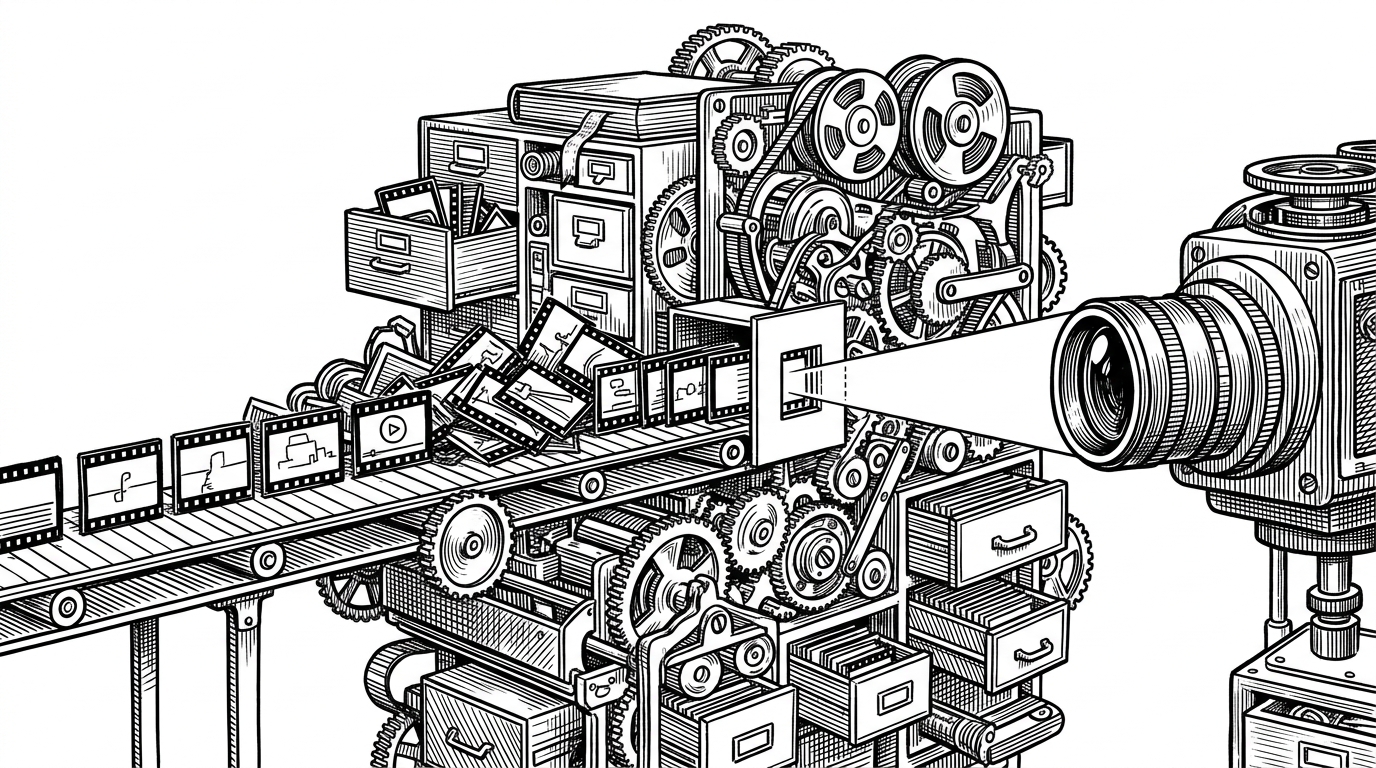
- SimpleStream argues that streaming video QA can improve when a model sees less history, not more.
- The repo’s value is not a clever memory module, but a strict recent-frame baseline that makes the comparison fair.
- Its technical credibility comes from exact frame sampling and cached vision embeddings, not from extra training tricks.
- The bigger lesson is that for many streaming benchmarks, responsiveness can matter more than recall.
Forget More, Win More
Most video AI systems reach for more context when they get stuck. More frames. More memory. More retrieval. SimpleStream takes the contrarian route and asks a sharper question: what if the present frame window is already enough, and the extra history is what muddies the answer?
That is the project’s real wager. It is not trying to invent a new memory architecture. It is trying to prove that, for streaming video question answering, a strong off-the-shelf VLM can do better when it is allowed to stay focused on the latest few frames.
Why Streaming Video Became a Memory Problem
The field drifted toward memory because video is temporal and the obvious failure mode is forgetting. So researchers built memory banks, retrieval layers, compression schemes, and long-context pipelines to preserve continuity across time.
SimpleStream is interesting because it challenges the assumption underneath all of that work. On benchmark-style streaming tasks, the model is often rewarded for being fast and current, not for reconstructing the entire past. If the question is about what is happening now, history can become noise.
| Approach | What reaches the VLM | Extra machinery | What it optimizes | Main risk |
|---|---|---|---|---|
| Memory-heavy streaming | Current frames plus stored history, retrieved snippets, or compressed state | Memory bank, retrieval, compression, long-context logic | Recall across time | Old context can dilute attention to the present |
| SimpleStream | Only the most recent N frames | None beyond precise sampling and model invocation | Immediate perception | Can miss information outside the sliding window |
What SimpleStream Actually Does
At the implementation level, the repo is strict. It does not train a custom video model. It does not bolt on retrieval. It does not build a separate memory system. It samples the latest frames exactly, sends them into an off-the-shelf VLM such as Qwen2.5-VL or Qwen3-VL, and asks the model to answer from that narrow slice of time.
# Conceptual shape of the pipeline
frames = decode_video(video_path)
window = exact_recent_sampling(frames, fps=video_fps, recent_n=4)
vision = vlm.encode_vision(window)
answer = vlm.generate(prompt, vision)
The important word there is exact. The repo’s sampling logic is careful about frame alignment, so the recent window is not a sloppy heuristic. It is calculated against the video’s native timing, which makes the baseline defensible when it is compared with methods that preserve more state.
The Hidden Craft: Exact Sampling and Cached Vision
The technical subtlety lives in two places. First, the sampler maps the recent window to the video timeline precisely, so streaming and non-streaming comparisons do not cheat on frame selection. Second, the evaluation code can cache vision embeddings, which matters when multiple questions hit the same frames and the repo wants to avoid paying the encoding cost twice.

That is why the project feels more serious than its premise. It is not saying, “take fewer frames and hope.” It is saying, “take fewer frames in a way that can be measured, reproduced, and compared honestly.”
class RecentWindowQAModel:
    def generate_with_cached_vision(self, prompt, image_embeds):
        # vision embeddings are reused across questions on the same frames
        tokens = build_prompt_tokens(prompt)
        inputs = inject_vision_tokens(tokens, image_embeds)
        return self.model.generate(inputs)
How It Beats the Fancy Stuff
This is the comparison that matters. Memory-heavy streaming systems are trying to preserve more of the past, but SimpleStream is trying to improve the answer to the current question. Those are not the same objective.
| Method family | Strategy | Training burden | Benchmark posture | Trade-off |
|---|---|---|---|---|
| Memory bank and retrieval | Store and fetch historical cues | Usually higher | Optimizes for recall plus continuity | Can over-privilege old context |
| Compression and long-context methods | Pack more history into the model | Often higher | Preserve more temporal state | Can blur the freshest evidence |
| SimpleStream | Keep only the recent window | Training-free | Sharp baseline for streaming QA | May sacrifice long-horizon recall |
That does not mean memory is useless. It means the burden of proof has shifted. If a small recent window can match or beat more elaborate systems on these benchmarks, then the field has to justify every extra mechanism it adds.
I’m currently working on integrating streaming video benchmarks such as OVOBench and StreamingBench into the framework. These benchmarks often require multi-round generation, where a model interacts with a sequence of video chunks over time, producing responses iteratively based on evolving context.
What This Changes for Video AI
SimpleStream’s lasting contribution is a reframing. The question is not how much video history a model can hold. The question is what the minimum useful input is for the task at hand.
That matters for researchers because it sharpens baselines. It matters for benchmark designers because it exposes when scores reward the wrong thing. And it matters for product teams because it suggests a practical path: if a strong model can answer from a narrow recent window, perhaps the cheapest system is also the best one.
The project is persuasive because it is almost rude in its simplicity. It removes machinery, then shows that the result is still competitive. In a field that often equates complexity with progress, that is a useful correction.