Ridgevision-ai: RidgeVision AI: The Fingerprint Model That Refuses to Be a Black Box
A hybrid biometrics prototype combines Gabor filtering, handcrafted texture features, EfficientNet, and heuristic heatmaps to estimate ABO/Rh blood groups from fingerprints.
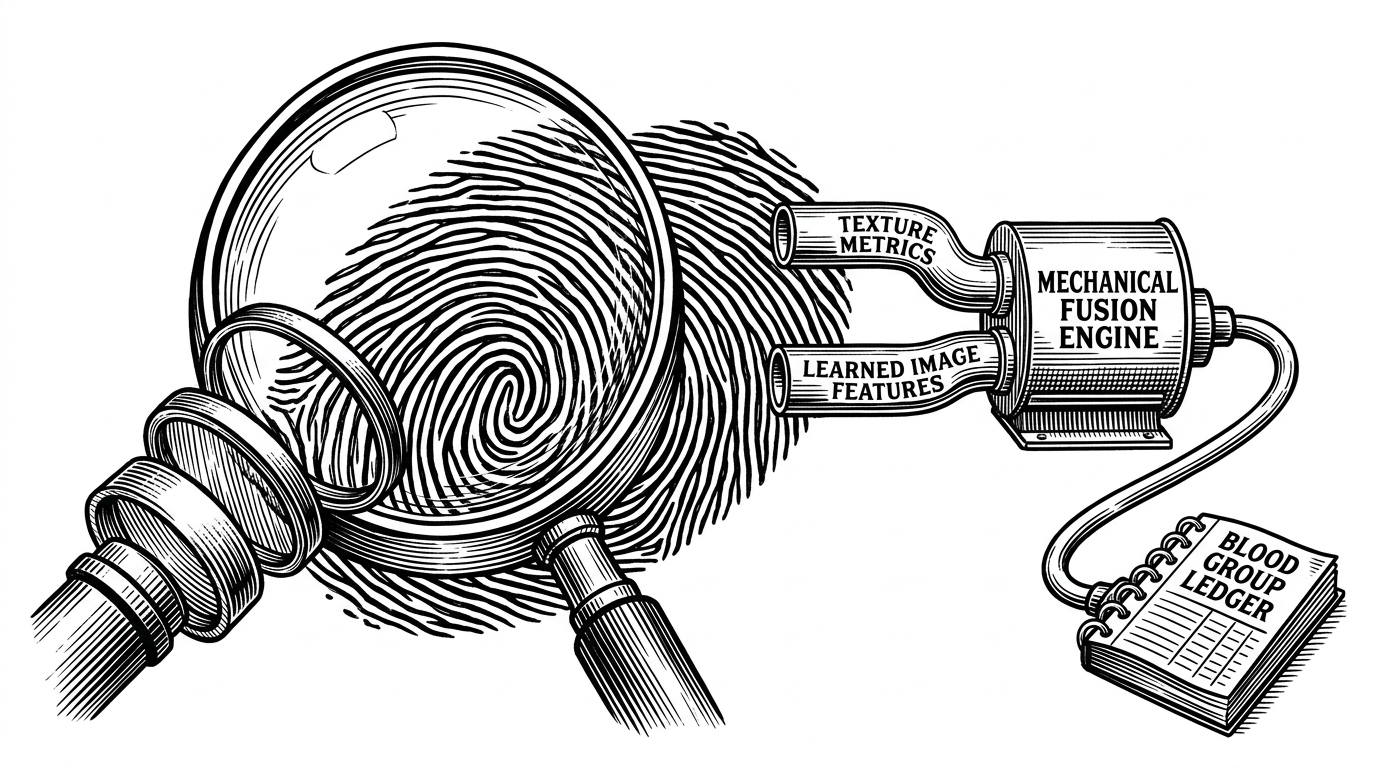
- RidgeVision AI argues that biological vision tasks can improve when handcrafted texture features sit beside deep embeddings instead of being replaced by them.
- The project is interesting less for its blood-group output than for its glass-box design, which keeps preprocessing, feature extraction, fusion, and explanation visible.
- Its feature stack treats ridge structure as signal, using Gabor, LBP, GLCM, ridge density, and orientation strength to ground the model in fingerprint physics.
- The result is a research prototype with production-shaped code, but its own documentation keeps the clinical caveat front and center.
RidgeVision AI starts with a contrarian bet: fingerprints are not just pictures. They are structured biological surfaces, and that means the usual black-box instinct is not automatically the best one. The project pairs a deep image backbone with handcrafted texture features, then adds a lightweight explanation layer so you can see what the system is using instead of trusting it blindly.
This tool lets you upload a fingerprint picture (PNG, JPG, BMP) and instantly receives an estimated ABO/Rh blood type. The result includes the most likely blood group, its confidence score, a full ...
Why This Fingerprint Project Is Different
Most fingerprint systems are built to answer one question: does this print match that person? RidgeVision AI asks a different one: can ridge structure carry enough biological signal to estimate ABO/Rh type? That shift changes everything, from the preprocessing choices to the way the model is explained.
The repository is organized like a serious machine learning system, not a demo script. FastAPI handles serving, the ML code is split into preprocessing, feature engineering, inference, and explainability, and the training notebook acts as the source of truth for the ensemble strategy. That separation matters because the project is trying to argue a method, not just ship an endpoint.
The Biological Bet Behind the Model
The system rests on dermatoglyphics, the study of ridge patterns in skin. RidgeVision AI treats those ridges as a signal worth analyzing with both classic image processing and learned representations. That is why the pipeline starts with enhancement, not just resizing.
The preprocessing stack uses familiar biometric ideas: Gabor filtering to sharpen ridge flow, adaptive thresholding to isolate structure, and orientation analysis to measure how the print bends and turns. The project is not pretending fingerprints are simple. It is trying to preserve the parts of the image that might carry biological meaning.
How RidgeVision Fuses Handcrafted Features With Deep Learning
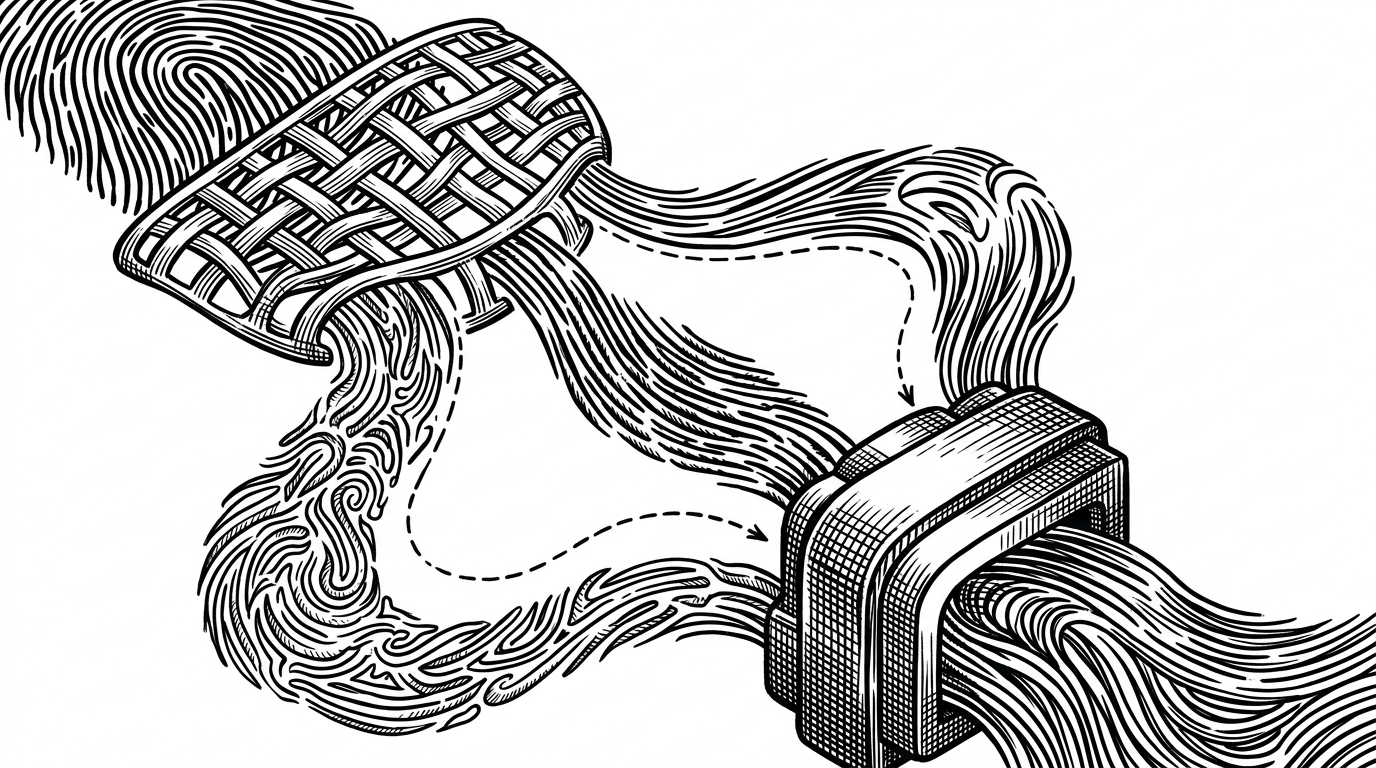
The core architecture is a dual-branch fusion model. One side uses EfficientNetB0 as a transfer-learning backbone. The other side feeds in a handcrafted feature vector, the kind of input many modern classifiers would ignore. The two streams are concatenated and then passed through a CBAM-style attention gate that reweights what matters most.
That is the real design choice here. RidgeVision AI refuses the common false binary between feature engineering and deep learning. In this project, the hand-built descriptors are not a crutch. They are a second source of evidence.
| Approach | Goal | Input signal | Strength | Weakness |
|---|---|---|---|---|
| RidgeVision AI | Estimate ABO/Rh blood group from fingerprints | Fingerprint image plus handcrafted texture vector | Balances learned features with domain signals | Still experimental and not clinically validated |
| Standard fingerprint ID systems | Verify or identify a person | Fingerprint minutiae and ridge patterns | Mature and operationally useful | Does not aim to infer biological traits |
| Pure CNN image classifiers | Predict a label from pixels | Raw fingerprint image | Simple training and deployment | Can be less interpretable and less grounded |
| Classical dermatoglyphics research | Study statistical links between ridges and traits | Measured ridge descriptors | Scientifically explicit and interpretable | Often lacks modern end-to-end deployment |
# Conceptual shape of the inference path
image_features = efficientnet_b0(preprocessed_fingerprint)
texture_features = extract_texture_features(fingerprint)
merged = concatenate([image_features, texture_features])
attended = cbam_gate(merged)
prediction = classifier(attended)
The Feature Stack: Gabor, LBP, GLCM, Ridge Density
The handcrafted branch is not decorative. It extracts a small set of biologically plausible descriptors that try to encode how the ridges behave, not just how they look. Gabor filters enhance directional ridge structure. LBP captures local texture transitions. GLCM adds co-occurrence statistics such as contrast, homogeneity, and energy. Ridge density and orientation strength add direct shape cues from the print itself.
That stack gives the model a grounded vocabulary. Instead of asking one neural network to discover every useful regularity from raw pixels, RidgeVision AI precomputes some of the most relevant ones and lets the deep branch focus on higher-order combinations.
Why the Explainability Layer Matters
The project includes a heuristic Grad-CAM style overlay built from edge magnitude and blur. It is not a textbook gradient-based explanation, and the repository does not pretend otherwise. But it still serves a practical role: it shows where the system appears to focus during inference, usually along ridge structures rather than background clutter.
That honesty is useful. In a controversial biological task, the explanation layer is less about scientific proof and more about sanity checking. If the heatmap lights up noise, the model has a problem. If it tracks ridge contours, the system at least looks internally coherent.
Important: this project is a research and portfolio prototype only. Dermatoglyphic blood group estimation is not clinically validated, and this software must not be used for medical diagnostic purposes.
Inference, Ensembling, and the Accuracy Ceiling
The predictor class is built to load custom Keras objects and support multiple model versions. That matters because the architecture uses custom attention layers, and serialized models need those definitions at load time. The notebook also points to an ensemble mode that averages predictions across models, a pragmatic way to reduce variance in a hard 8-class problem.
This is the part that makes the project feel like applied research rather than a toy. The goal is not elegance for its own sake. It is to squeeze more signal out of a difficult classification task by combining complementary models and not overtrusting any single one.
| Mode | What it does | Why it helps | Trade-off |
|---|---|---|---|
| Single model | Uses one trained classifier end to end | Simpler to run and explain | More sensitive to quirks in one checkpoint |
| Ensemble mode | Averages outputs from two models | Improves robustness across classes | Adds complexity and extra inference cost |
| Heuristic explanation | Overlays ridge-focused heatmaps | Gives a usable sanity check | Less rigorous than full gradient attribution |
What This Project Is, and What It Is Not
RidgeVision AI is polished in the way research prototypes often are when the authors care about engineering. The backend is modular, the frontend is clean, and the ML stack is compartmentalized enough to be auditable. But the project also labels itself correctly: it is experimental, not clinical.
That distinction is the difference between an interesting prototype and a dangerous claim. RidgeVision AI is worth studying because it revives a neglected idea. It says that in biological vision tasks, old texture math can still earn its place beside deep learning, especially when the system is built to show its work.
| Project posture | What RidgeVision AI does | What it does not do |
|---|---|---|
| Research prototype | Explores a hybrid biometrics pipeline | Does not claim clinical validation |
| Glass-box ML | Surfaces preprocessing, features, and heatmaps | Does not hide all reasoning behind a single embedding |
| Biological inference experiment | Tests a controversial ridge-to-trait hypothesis | Does not replace medical diagnostics or lab tests |