VoxCPM: The TTS Model That Tries to Skip the Tokenizer Entirely
An open-source voice system that generates multilingual speech in continuous latent space, blends voice design with cloning, and aims for studio-quality output without the usual codebook bottleneck.
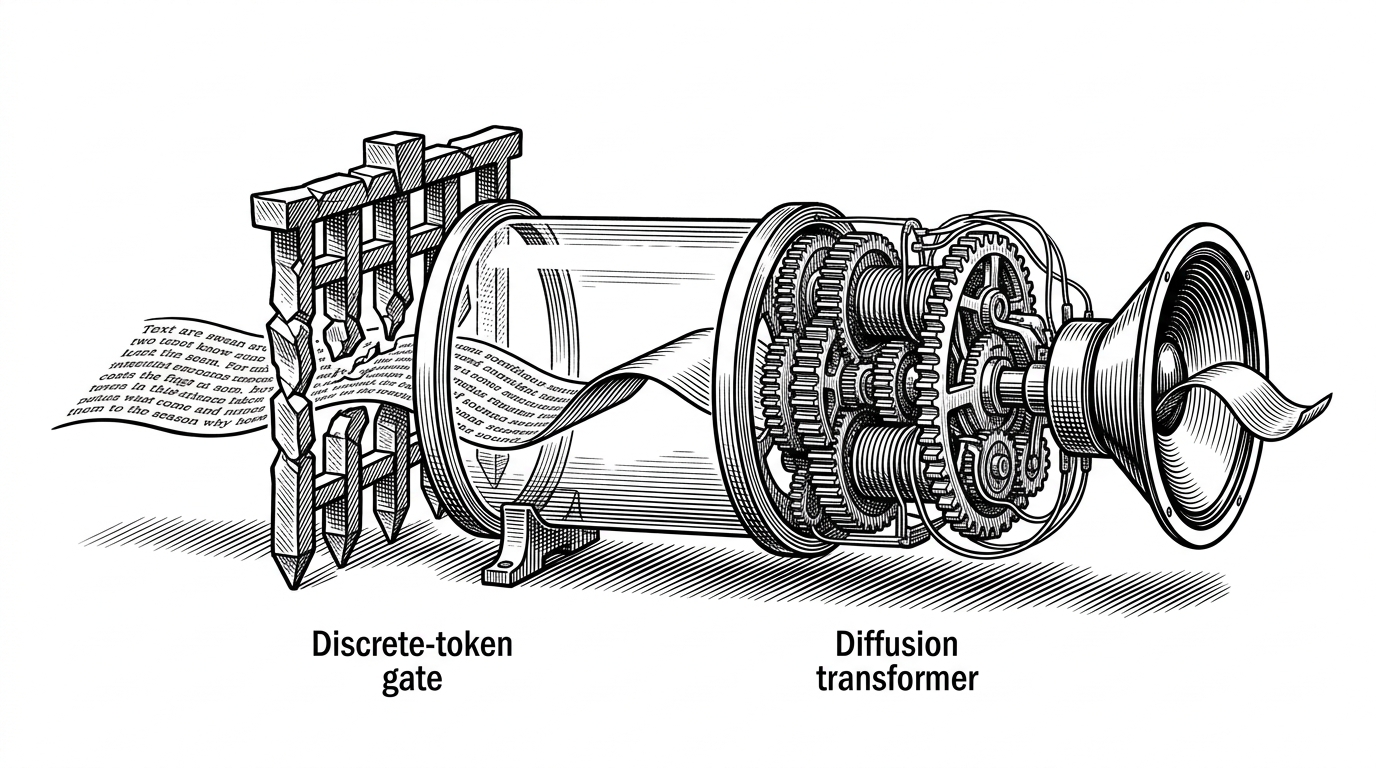
- VoxCPM’s real break from the pack is not scale, it is the decision to generate speech in continuous latent space instead of forcing audio through a tokenizer.
- That design choice makes its voice design and cloning modes feel like a spectrum, from describing a new voice to continuing an existing one with transcript-aware control.
- The stack matters because it pairs a MiniCPM backbone with residual acoustic modeling, diffusion refinement, and an asymmetric AudioVAE that outputs 48kHz audio.
- VoxCPM is compelling, but it is not a universal winner, because multilingual intelligibility and deployment burden still separate it from managed commercial TTS.
Speech Without Codes
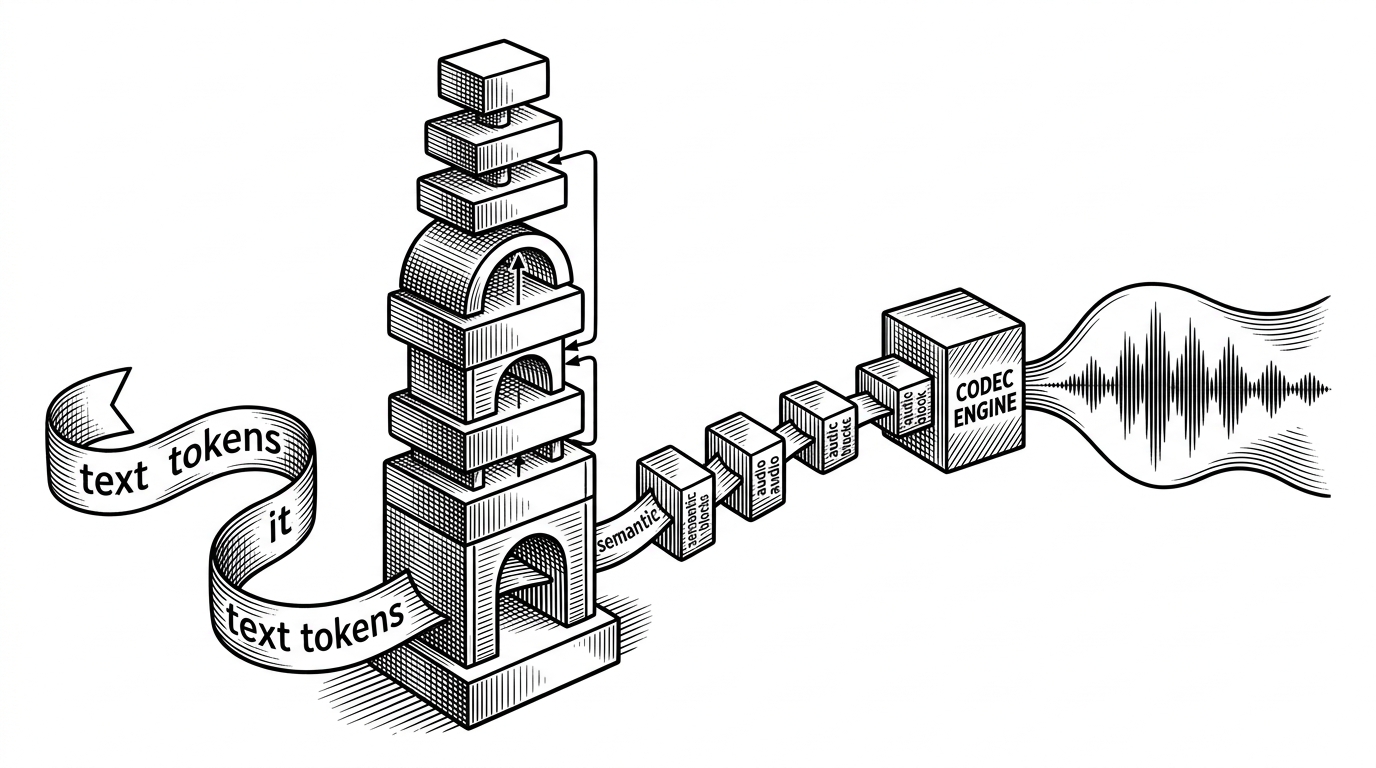
Most TTS systems do some version of the same trick: they compress speech into discrete audio tokens, then ask a model to predict those tokens back into waveforms. VoxCPM tries to delete that middle layer. It treats speech as a continuous object, which is a subtle change with a big payoff for prosody, breath, and inflection.
That is why the repo is interesting. It is not trying to be just another voice API, and it is not only chasing speaker similarity. It is challenging a hidden assumption in modern voice generation: that sound has to be quantized before it can be synthesized.
Why Continuous Audio Sounds More Human
Discrete codes are efficient, but they can also flatten the edges that make speech feel alive. Breath starts, tiny pitch bends, pauses, and emotional drift do not always survive a hard quantization step. VoxCPM’s continuous path is designed to preserve more of that information before the model commits to a waveform.
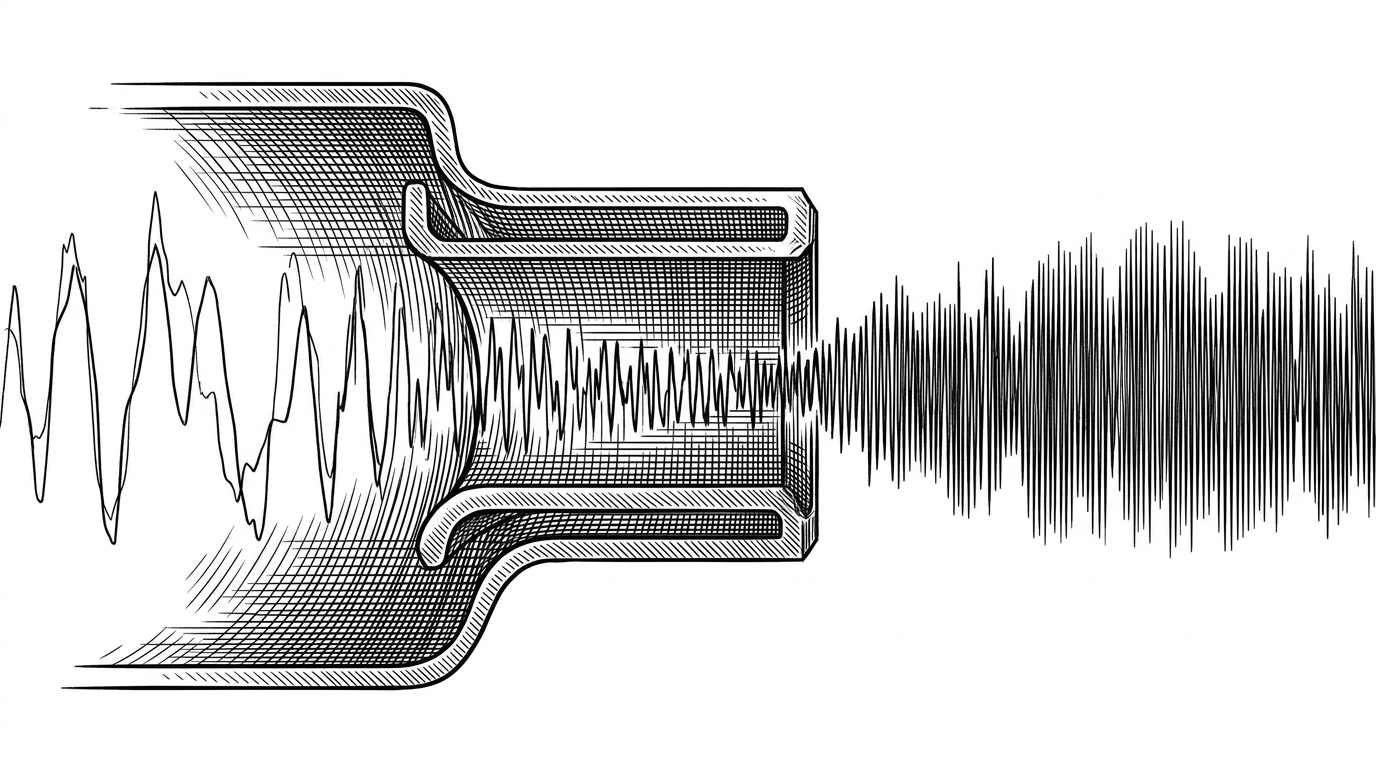
That is also why the native 48kHz path matters. It is a concrete signal that this repo is not just optimizing for model elegance. It is trying to ship output that holds up at the end of the chain, where high-frequency detail is usually the first thing to disappear.
Built on a MiniCPM-4 backbone.
The Stack Under the Hood
The architecture is easier to understand if you split it into three jobs. First, a text-semantic model makes sense of the prompt. Second, a residual acoustic model adds structure and correction. Third, a diffusion-style transformer refines the latent speech before decoding.
Text prompt
  -> MiniCPM text-semantic stage
  -> residual acoustic LM
  -> LocDiT / UnifiedCFM refinement
  -> AudioVAE V2 decoding
  -> 48kHz waveform
In the codebase, that orchestration lives around src/voxcpm/model/voxcpm2.py. The repository also makes the module boundaries legible: audiovae handles compression and decoding, locdit handles diffusion refinement, and minicpm4 supplies the backbone language model.
The important nuance is the prompt-prefix logic. Reference audio is not just a static exemplar. It becomes a conditioning prefix that helps steer the generation process, which is why cloning can move from resemblance to continuation.
Voice Design, Cloning, and Continuation
The product surface is more interesting than the usual text-to-speech menu. VoxCPM splits generation into distinct modes, and each mode changes the role of reference audio.
| Mode | Input | What it optimizes | What it feels like |
|---|---|---|---|
| Voice Design | Text description only | A new voice profile from scratch | Prompting a voice into existence |
| Controllable Cloning | Short reference clip plus style guidance | Similarity with steering | A clone you can direct |
| Ultimate Cloning | Reference audio plus transcript | Maximum continuity and prosody | Continuing a speech sample |
| Basic TTS | Text only | Clean synthesis | The default utility path |
That spectrum is the real user-facing innovation. You can describe a voice, shape one from a short sample, or ask the system to continue an existing voice with transcript-aware precision. In other words, VoxCPM treats voice less like a fixed asset and more like a design space.
Create a brand-new voice from a natural-language description alone (gender, age, tone, emotion, pace …), no reference audio required
The Trade-Offs That Matter
The benchmark story is strong, but not simple. VoxCPM is especially good at voice similarity and expressive continuity, yet multilingual intelligibility is uneven in some languages. That means the model can sound impressive while still missing the reliability bar needed for some commercial use cases.
| Dimension | VoxCPM | Managed commercial TTS | Token-based open source |
|---|---|---|---|
| Generation path | Continuous latent generation | Usually opaque, service-side pipelines | Discrete audio tokens |
| Voice design | Built in | Often limited or product-specific | Usually weaker or absent |
| Cloning quality | Strong similarity focus | Consistent, production-oriented | Varies widely |
| Multilingual intelligibility | Strong in some languages, uneven in others | Usually stronger across languages | Mixed |
| Deployment burden | User owns infra and compliance | Vendor handles ops | User owns infra |
| Commercial posture | Apache 2.0 | Proprietary terms | Usually permissive or mixed |
That last row matters. Open source removes licensing friction, but it pushes infrastructure, safety, and compliance onto the buyer. For teams that want predictable multilingual performance and managed support, that can outweigh the appeal of local control.
Where VoxCPM Sits in the TTS Market
VoxCPM is not trying to win every lane. It is aiming at the intersection of open weights, high-fidelity cloning, and promptable voice creation. That puts it in a different category from both classic token-based open-source systems and managed commercial APIs.
| Project | Best at | Weak spot | Positioning |
|---|---|---|---|
| VoxCPM | Continuous speech generation and voice design | Uneven multilingual intelligibility | Open, expressive, technically ambitious |
| ElevenLabs | Managed quality and deployment | Closed ecosystem | Commercial baseline |
| Qwen3-TTS | Intelligibility | Less differentiated voice design | Strong open competitor |
| FishAudio S2 | Balanced open-source performance | Less distinctive conceptually | Close open-source alternative |
| Bark, XTTS, F5-TTS, CosyVoice | Accessible open TTS | Tokenization ceiling | Useful but more conventional |
The strategic takeaway is simple. VoxCPM is not just another contender in the open TTS race. It is one of the few projects trying to make voice generation feel like promptable media design rather than a text-to-audio translation job.
What This Repo Tells Us About Open Voice
The bigger trend is not that voices are getting cheaper to clone. It is that voice systems are becoming more steerable, more continuous, and more expressive. VoxCPM points to a future where a voice is something you can specify, shape, and continue, not just synthesize from a prompt.
That future is still uneven. But this repo makes a convincing case that the next leap in TTS may come from removing the bottleneck you were never supposed to notice in the first place.