microsoft/VibeVoice: The 7.5 Hz Hack That Broke the Audio Context Barrier
How a hybrid LLM-diffusion architecture squeezed 90 minutes of multi-speaker audio into a single pass, prompting a corporate redaction.

- VibeVoice achieves 90-minute audio generation by compressing data via a 7.5 Hz acoustic tokenizer, bypassing standard LLM context limits.
- The architecture uses a hybrid approach: a Qwen2 LLM handles semantics and turn-taking, while a Diffusion Transformer head renders the acoustic waveform.
- Microsoft redacted the TTS component due to safety concerns over its capability, though the ASR and Realtime models remain open.
- Built for production, the remaining codebase features custom vLLM plugins and streaming caches for high-throughput, low-latency deployment.
In September 2025, a commit to the microsoft/VibeVoice repository silently removed the code for its most powerful component: VibeVoice-TTS. The reason, cited in the README, was brief: "instances where the tool was used in ways inconsistent with the stated intent." This wasn't a standard deprecation. It was a redaction of a model that had suddenly solved one of generative audio's hardest problems.
What makes VibeVoice stand out is its ability to generate audio that lasts up to 90 minutes in a single run, with multiple speakers talking naturally back and forth — something that was essentially impossible with previous open-source tools.
The capability to generate 90 minutes of continuous, natural-sounding dialogue between four distinct voices in a single pass is unprecedented for open-source models. Most audio generators struggle to maintain coherence after a few minutes, succending to hallucinations or robotic artifacts. VibeVoice didn't just push the boundary; it shattered it, creating a tool so effective that its creators felt compelled to recall it. But the architecture that made it possible remains visible in the surviving ASR and Realtime components, offering a masterclass in context window manipulation.
Slowing Down to Scale Up
The secret to fitting an hour and a half of audio into a standard LLM context window isn't a massive increase in memory. It's a massive decrease in token velocity. Most audio tokenizers, like EnCodec, operate at 25 to 50 frames per second. This rapid token generation quickly exhausts the context window of even the largest models.
VibeVoice takes radical approach: it drops the tokenization rate to 7.5 Hz. This represents a 3200x downsampling from a standard 24kHz audio stream. By representing audio with fewer, denser tokens, the model buys itself immense contextual runway. It can remember what was said 45 minutes ago because, in token terms, it wasn't that long ago.
The breakthrough lies in VibeVoice’s architecture: a novel 7.5 Hz continuous acoustic tokenizer combined with next-token diffusion.
The Brain and the Vocal Cords
VibeVoice sidesteps the debate between autoregressive models (good at structure, bad at audio artifacts) and diffusion models (good at texture, bad at global coherence) by using both. It treats speech generation as a two-stage process.
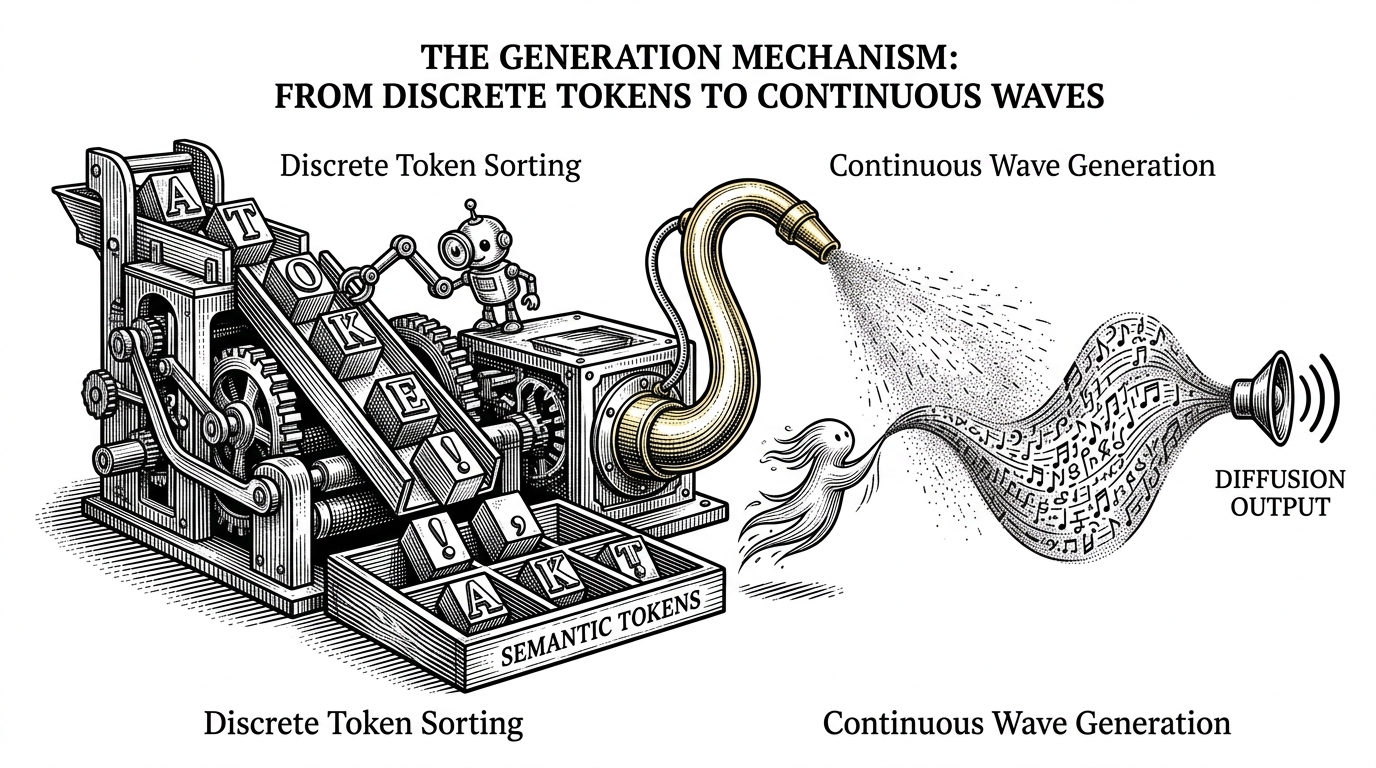
First, a Qwen2-based language model processes the text and semantic context. It decides who is speaking, when to pause, and the overall prosody. Then, instead of predicting discrete audio tokens, it passes its hidden states through a SpeechConnector to a DiT-like (Diffusion Transformer) head. This diffusion head acts as the vocal cords, rendering the high-fidelity acoustic waveform. The result is structural integrity paired with natural vocal texture.
Built for the Rack
While the TTS model is gone, the surviving VibeVoice-ASR (Automatic Speech Recognition) and VibeVoice-Realtime components reveal a system built for production, not just research papers. The repository includes a custom vllm_plugin, enabling high-throughput inference that most open-source audio models lack.
class MockCacheLayer(nn.Module):
    """
    A compatibility layer for transformers >= 4.57 to maintain
    streaming capabilities despite upstream cache refactoring.
    """
    def __init__(self, hidden_size):
        super().__init__()
        self.hidden_size = hidden_size
        # ... cache wrapping logic to prevent streaming breakage
The inclusion of a MockCacheLayer is particularly telling. It shows the developers actively working around upstream changes in the Hugging Face Transformers library to ensure their streaming capabilities—which rely on sliding windows (TTS_TEXT_WINDOW_SIZE = 5)—remain intact and performant.
The Economics of Local Audio
The real disruption of VibeVoice is economic. By achieving ~300ms latency on the Realtime model, it rivals proprietary services while eliminating per-character API costs.
| Feature | Microsoft VibeVoice | Proprietary (ElevenLabs/OpenAI) | Standard Open Source (Kokoro/Whisper) |
|---|---|---|---|
| Max Audio Length | 90 mins (TTS) / 60 mins (ASR) | Typically minutes per request | Usually limited to minutes |
| Multi-Speaker | Native 4-speaker, natural turns | Supported | Limited long-form coherence |
| Latency | ~300ms | ~150ms - 300ms | Varies wildly |
| Cost | Hardware only | Per-request API | Hardware only |
VibeVoice provides a blueprint for the next generation of local-first conversational agents. The redaction of its TTS model highlights the tension between safety and open innovation, but the architectural lessons embedded in its remaining code—specifically the 7.5 Hz tokenizer and hybrid diffusion approach—are already reshaping how developers build long-form audio systems.