Gull-Codec-Training: a codec that listens in frequency first
This repo is the training scaffolding behind Gull, a generative audio codec that compresses and reconstructs sound from subbands instead of raw waveforms.
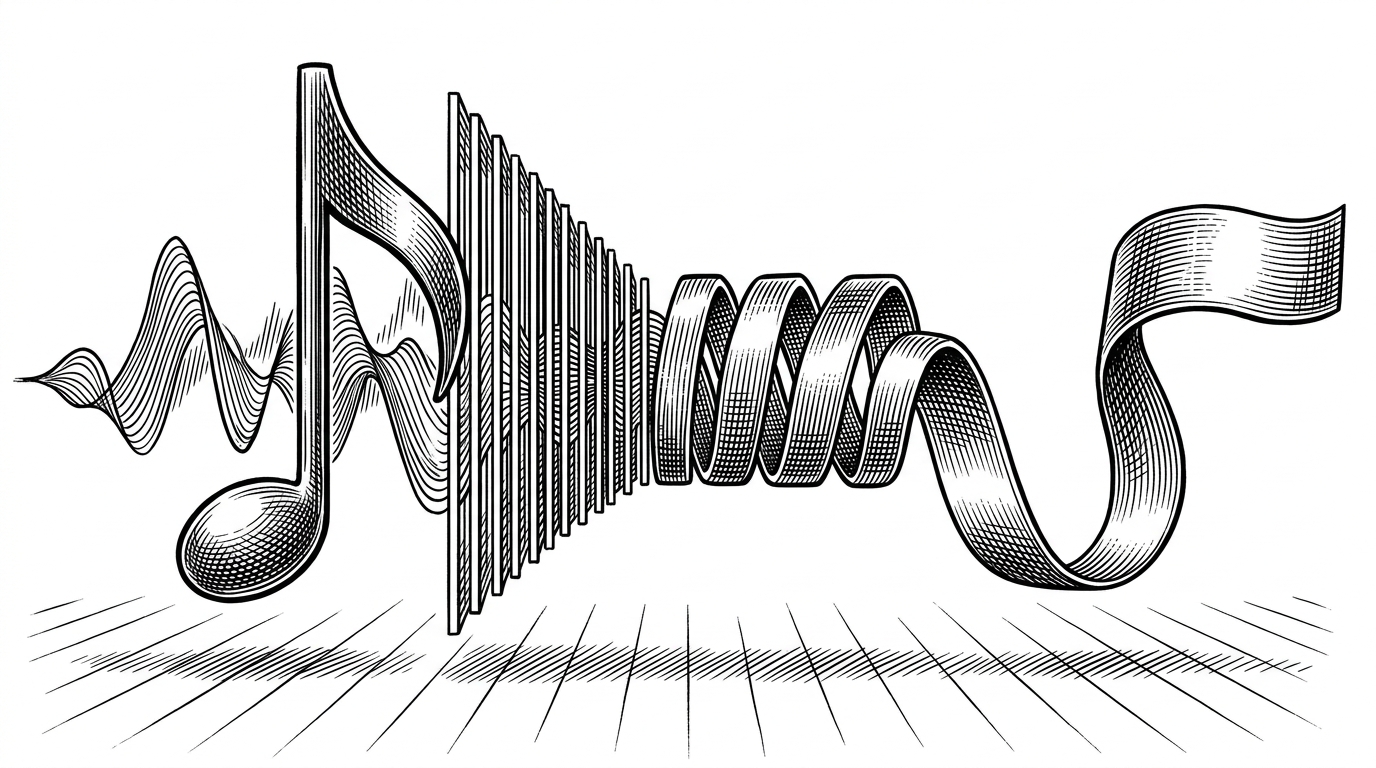
- Gull treats frequency structure as a first-class signal, which lets the codec preserve tone and transient detail without depending on raw waveform modeling alone.
- The repository's manual GAN training loop matters as much as the model, because reconstruction, feature matching, and quantization have to be updated in a very specific order.
- The quantizer is engineered to resist codebook collapse, so bitrate usage stays broad instead of getting trapped in a few overused vectors.
- Gull sits between codec and generator, which makes super-resolution and elastic inference feel like properties of one system rather than bolt-on extras.
Most neural codecs promise the same thing: fewer bits, less damage. Gull-Codec-Training is interesting because it shows how that promise is actually built. Instead of treating audio as a flat waveform, it pushes the model toward frequency structure first, then uses a generative decoder to rebuild the parts compression would normally erase.
We introduce Gull, a generative multifunctional audio codec. Gull is a general purpose neural audio compression and decompression model which can be applied to a wide range of tasks and applications such as real-time communication, audio super-resolution, and codec language models.
Why the frequency-domain choice changes everything
The official Gull project describes it as a general purpose neural audio compression and decompression model. That framing matters because the repo is not just trying to win a bitrate chart. It is trying to make one learned representation useful for communication, super-resolution, and future codec language models.
The implementation leans into that ambition by treating the spectrogram like a living geometry, not a debug view. The encoder uses a time-frequency block, so it can read rhythm and harmony at the same time. That is a different bet from waveform codecs that lean harder on raw temporal continuity.
Inside the training stack
The core of the repo lives in the model and training system, not in a single clever layer. The generator uses a time-frequency encoder, then a residual vector quantizer with exponential moving average updates. The codebook also has a stale-vector reset, so old entries that stop getting used can be replaced by fresh samples instead of quietly wasting capacity.
That is a practical answer to a common VQ problem: codebook collapse. If only a few vectors do all the work, the bitrate becomes lopsided and the model loses expressive range. Gull's reset logic is a small implementation detail with a big consequence, because it keeps the quantizer alive under pressure.
The discriminator is just as opinionated. The multi-frequency discriminator computes STFTs at several window sizes, from short windows that care about transients to long windows that care about tonal stability. In effect, it asks the generator to sound right at multiple resolutions at once, which is exactly what a good codec has to do.
Training is wired through PyTorch Lightning with manual optimization turned on. That matters because the discriminator and generator cannot be updated in a generic one-pass loop. The training step has to sequence the GAN loss, feature matching, reconstruction loss in the frequency domain, and the commitment loss that keeps the quantizer honest.
The data pipeline is built for variation
The dataset code is a clue that this repo is meant for serious training runs, not toy demos. For sources like MUSDB18 and MoisesDB, it can load premixed tracks or create new mixtures from stems on the fly with random SNR scaling. That gives the model a much wider distribution of musical scenes to learn from, which is exactly what a codec needs if it is going to generalize beyond a narrow benchmark.
| System | Representation | What it optimizes for |
|---|---|---|
| Gull | STFT subbands, residual vector quantization, generative decoding | Recovering tone, transient detail, and bitrate flexibility |
| EnCodec | Waveform-based neural codec | A strong baseline for learned audio compression |
| Opus | Traditional low-latency codec | Web-native communication at low bitrate |
| EVS | Speech-oriented standard codec | Telephony-grade voice quality |
The comparison is less about declaring a winner than about showing the shape of the bet. Opus and EVS are standards. EnCodec proved that neural codecs can work in practice. Gull pushes further into frequency-aware generation, and the training repo reveals how much plumbing it takes to make that idea stable.
That is why this repository is worth reading even if you never train it. It shows the moving parts behind a modern audio GAN codec: a frequency-first encoder, a quantizer that defends its own capacity, a discriminator that listens at multiple scales, and a training loop that keeps all of it in balance.