eyrc-25-26_krishi_drone: The Repo That Turns a Nano Drone Into a Control Theory Exam
A ROS 2 greenhouse challenge built around cheap vision localization, dual PID/LQR controllers, and a grading pipeline that forces real understanding.
- Krishi Drone is built as a teaching loop, not a toy stack, so students have to connect perception, control, and evaluation in one system.
- WhyCon gives the drone an indoor position signal cheaply enough to make greenhouse autonomy practical for a classroom competition.
- PID and LQR are presented as two mental models for the same flight problem, which turns implementation into an exercise in control theory.
- The local grader and protected scripts are part of the curriculum design, because the repo rewards solving the problem instead of copying the answer.
A Drone Repo Built Like a Lab
Most drone repos teach one thing well. This one tries to teach the whole stack: simulation, localization, control, and assessment. That is why eyrc-25-26_krishi_drone feels less like a starter kit and more like a lab exercise with guardrails.
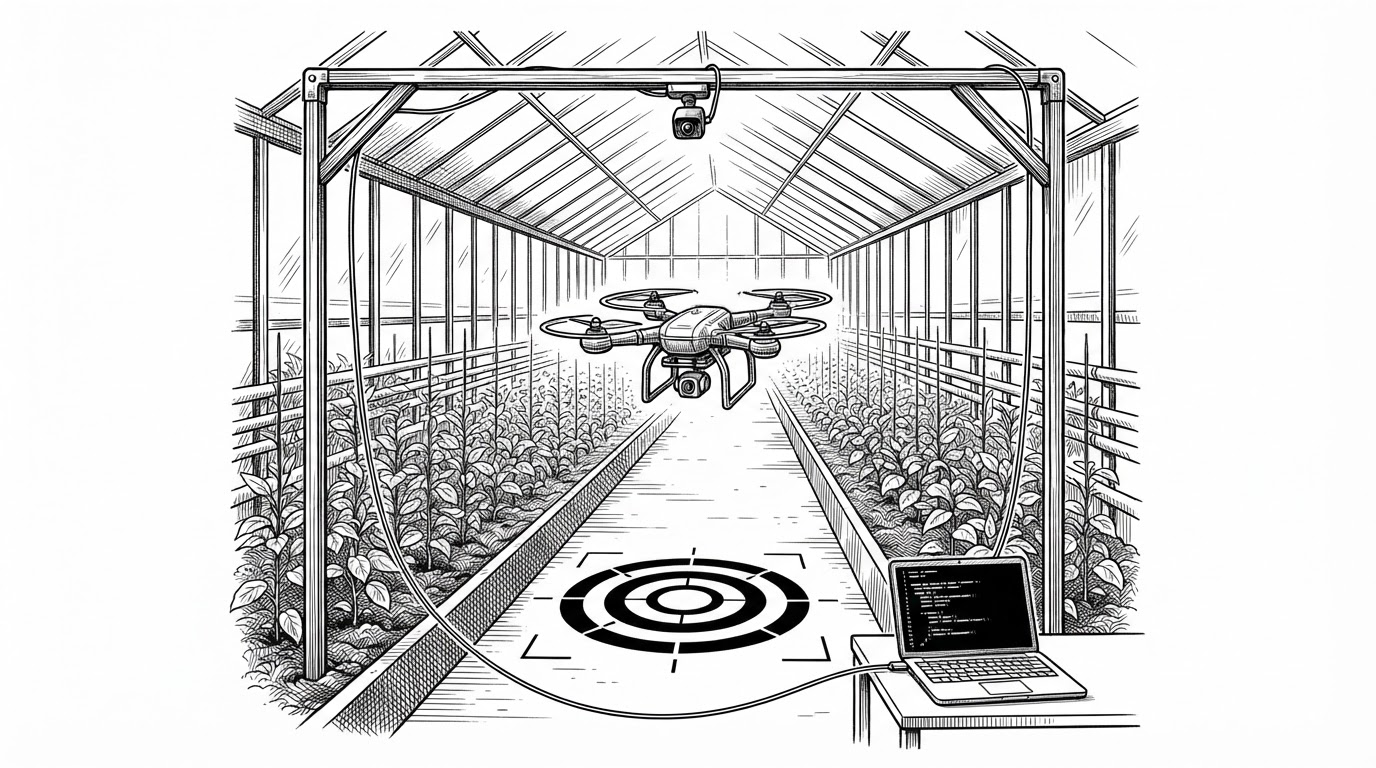
The setting matters. A greenhouse is a constrained world, which is exactly what makes it useful for learning autonomy. Students are not asked to solve flight in the abstract. They are asked to localize a nano drone, stabilize it, find plant targets, and complete a task under a competition rubric.
Yantra's genius has been to to manufacture our own drones and have you guys assemble it and build the drone control system and all that so the knowledge that you acquire in the process is not toy knowledge the knowledge is very real.
That is the core design move. The repository does not hide the system boundaries. It uses them as the lesson.
WhyCon Turns a Camera Into Indoor GPS
WhyCon is the enabling trick. A simple overhead camera watches circular markers and turns visual geometry into a usable pose estimate. In a room like this, that stands in for the expensive positioning systems that real research labs often depend on.
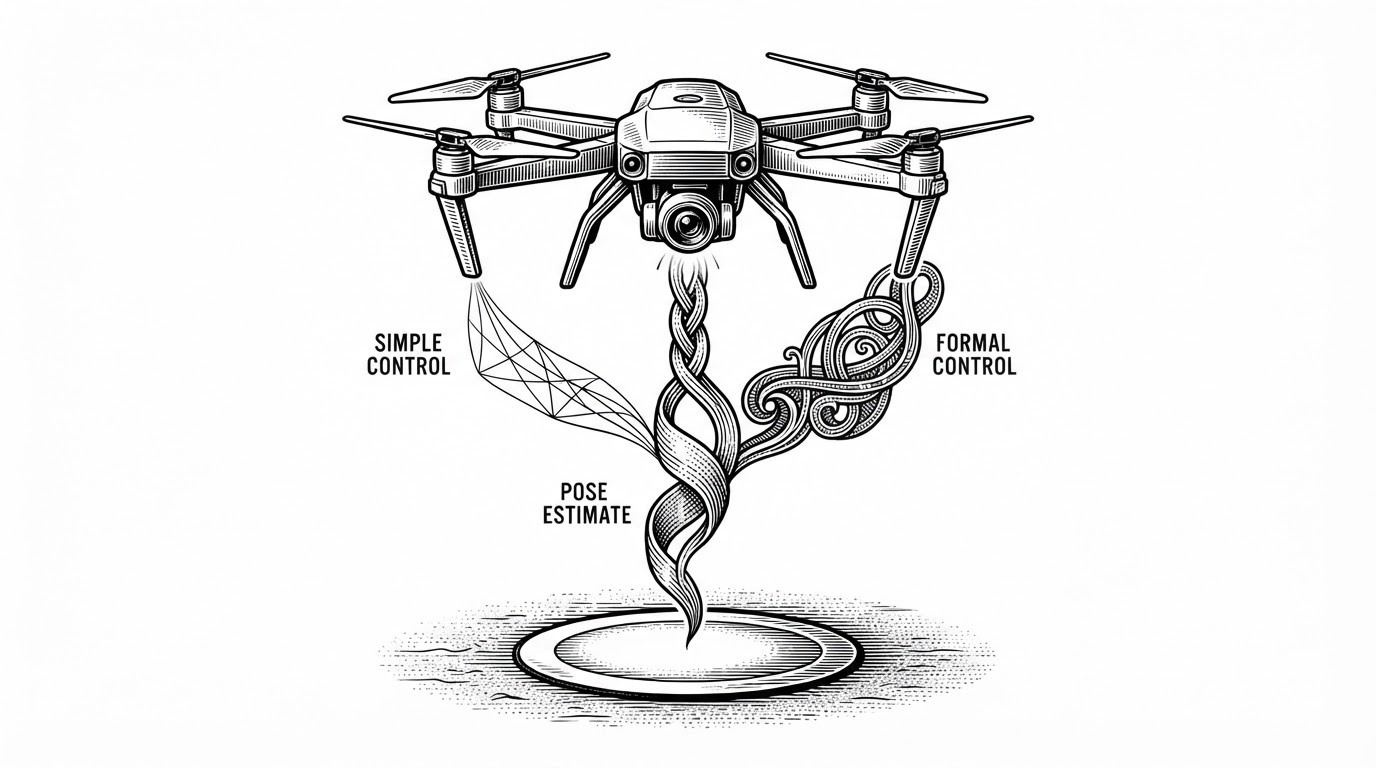
The repository’s architecture reflects that idea. The ROS 2 workspace separates the vision system, controller code, and hardware bridge into distinct packages such as whycon, swift_pico_hw, and crsf-ros2. That separation is what makes the system readable to students, and transferable from simulation to hardware.
Two Controllers, Two Ways to Think
This is where the repo becomes an exam. PID is the familiar feedback loop. LQR is the more formal state-space path, where students have to reason about dynamics instead of only tuning error terms. The repository keeps both alive because they teach different instincts.
| Dimension | PID | LQR |
|---|---|---|
| Mental model | Tuning error, one axis at a time | Modeling state, cost, and optimal correction |
| Student experience | Fast to grasp, easy to test | More mathematical, more revealing |
| Control style | Reactive feedback | Structured state-space control |
| What it teaches | Practical stabilization | System dynamics and trade-offs |
| Best use here | Getting the drone steady quickly | Forcing a deeper control design |
# The essential shape of the loop
pose = get_whycon_pose()
error = target - pose

if mode == 'PID':
    command = pid.update(error)
else:
    state = build_state_vector(pose)
    command = lqr.update(state)

publish_rc_command(command)
The important part is not which one is "better." It is that the repo makes the difference legible. PID teaches intuition. LQR teaches structure. In a classroom, that contrast is the lesson.
The aim here is to design and implement a PID or a LQR control to navigate a quadcopter autonomously through a gamified greenhouse environment as you can see in front of you you have to identify some infected plants in this greenhouse and carry out biopesticide spraying and then return to the home base.
The Grader Is Part of the Curriculum
The local grader is unusual, and that is the point. Obfuscated scripts and protected helpers create a competition environment where students can test offline without turning the reference solution into a shortcut. In other words, the repo is optimized for learning under constraints, not for inspectability at any cost.
That is a deliberate trust mechanism. It keeps the evaluation logic close to the workspace, but not open enough to collapse the competition into cargo-cult copying. For an educational robotics program at scale, that trade-off makes sense.
The Swift Pico Drone is an Unmanned Aerial Vehicle (UAV) developed at e-Yantra. It has a WhyCon marker mounted on top of it to help locate it easily and serve as a feedback mechanism for the control system to control and move the drone.
From Gazebo to a Real Drone
The pedagogical path is staged on purpose. Students begin in Gazebo, where the control loop is safer and easier to debug. Then selected teams move to hardware, where the same ideas have to survive camera noise, radio delay, and a real aircraft that does not forgive sloppy assumptions.
That simulation-to-hardware bridge is why the repo matters. A lot of educational robotics stops at a demo. This one asks whether the mental model still works when the drone leaves the simulator and enters a physical arena.
| Platform | Localization | Learning model | Setup burden | What makes it distinct |
|---|---|---|---|---|
| Krishi Drone | WhyCon overhead camera | Project-based learning with a greenhouse theme | Moderate | Accessible vision-based autonomy for scale |
| Crazyflie | Lighthouse or OptiTrack | Research and prototyping | Higher | Broad ecosystem, strong research pedigree |
| PX4 or HoverGames | Varies by stack | Competition and industry-aligned practice | Moderate to high | Industry relevance and flight-controller depth |
| OptiTrack or Vicon lab | External motion capture | Advanced research | Very high | Precision infrastructure, but expensive and less scalable |
The comparison is not about picking a winner. It is about recognizing the design target. Krishi Drone is trying to make robotics education feel serious without making it inaccessible.
What This Repo Is Really Teaching
On the surface, the repo teaches control, perception, middleware, and integration. Underneath, it teaches a more important skill: how to reason about a system when every layer depends on the others. That is the real autonomy lesson.
The greenhouse theme gives that lesson a shape. The control loop is constrained, the task is meaningful, and the grading is strict. Put together, those choices produce a rare thing in educational robotics: a project that is both approachable and rigorous.