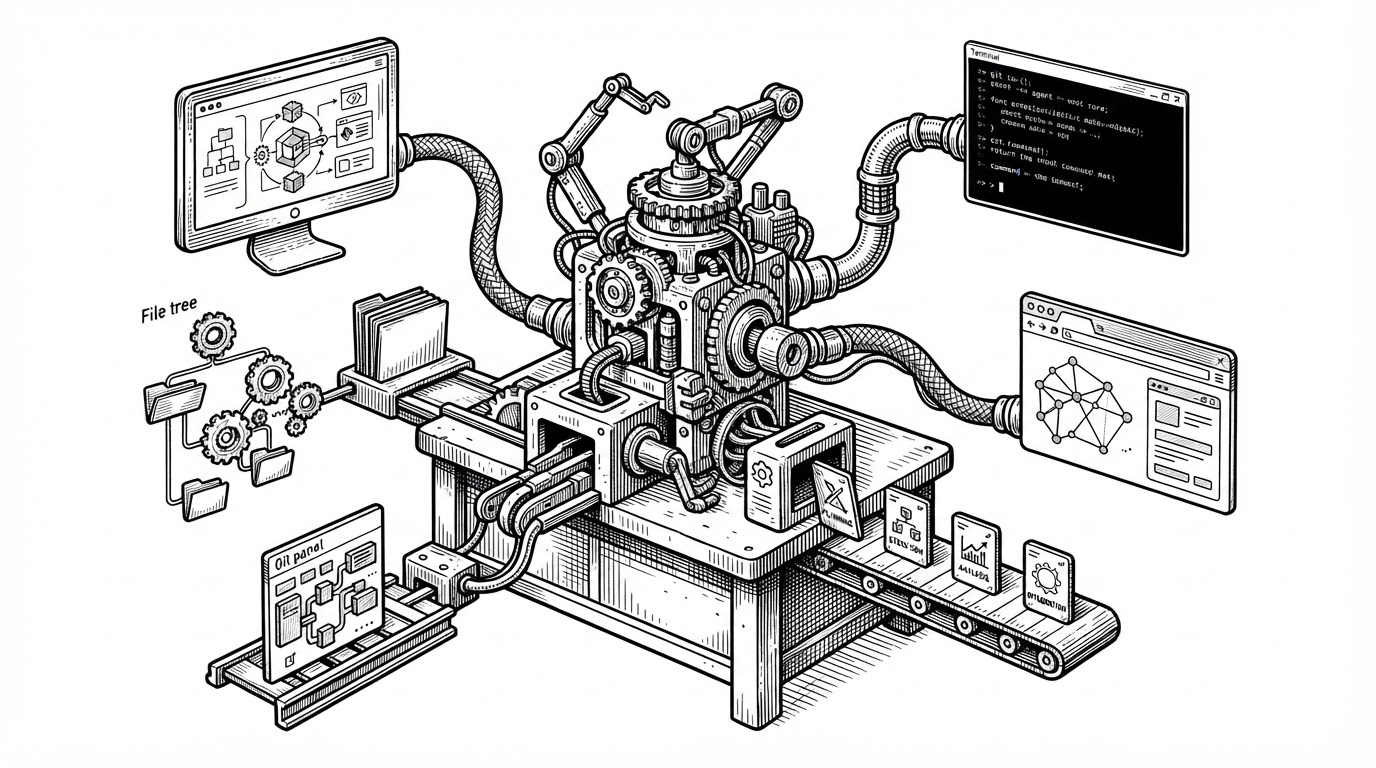
pi-tutorial: The Tutorial That Teaches the Agent to Teach You
A guided onboarding extension for Pi that turns conversation history into state, uses the model as the evaluator, and ends by showing you how to build the next extension.

Here is a little experiment: an interactive pi tutorial. Make an empty folder, then run this: pi -e git:https://t.co/gIUIPBgDMT And give feedback! Reason: pi works best if you have an onboarding buddy. But if you don't have one, maybe pi can be one for you? https://t.co/QptT78I
- pi-tutorial treats onboarding as an extension, not a separate doc, so the lesson and the platform are the same object.
- The model acts as the proctor by judging step completion through a small step registry and a tool call.
- Progress is reconstructed from session history, which makes the conversation log the real source of truth.
- The project shows how a minimal agent can support recursive teaching without adding a separate persistence layer.
A tutorial that ends by explaining itself
Most tutorials tell you what to do. pi-tutorial does something stranger and more useful: it teaches the agent to watch your progress, grade the step, and then teach the next one. The final lesson is not a victory lap. It is a pointer to the extension system itself.
The agent is the grader
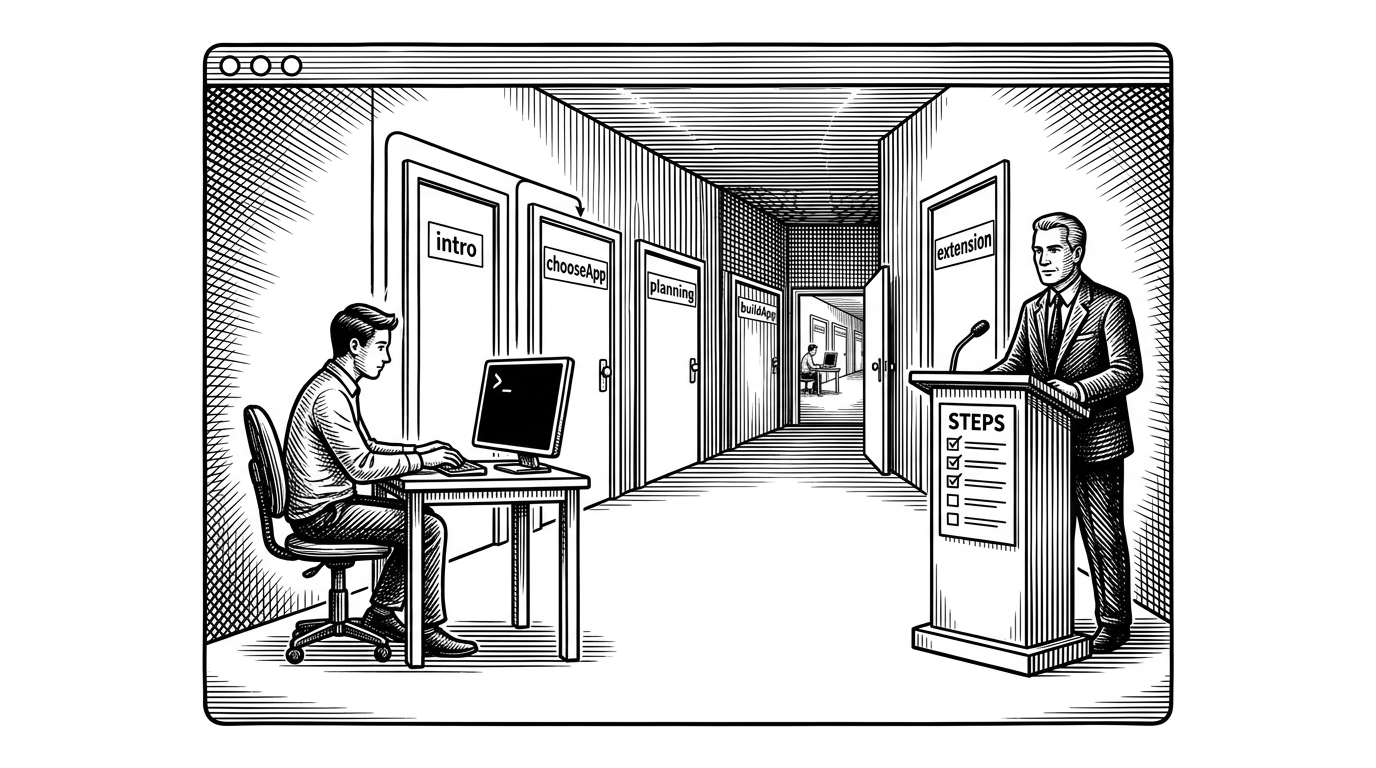
The core move is a tiny one. The tutorial defines a set of named steps, each with a hint and a completion message, then gives the model a tool called mark_step_done. The LLM is not just answering questions. It is deciding when a step is complete.
const STEPS = {
  intro: {
    hint: 'The user understands what Pi is and how the onboarding flow works.',
    completionMessage: 'Intro complete, move to chooseApp.'
  },
  chooseApp: {
    hint: 'The user has picked a small app idea to build.',
    completionMessage: 'Choice made, move to planning.'
  }
};

async function mark_step_done(stepName: string) {
  // Called by the agent when the rubric says the learner is ready.
}
That design does two things at once. It makes onboarding feel conversational, and it avoids a separate persistence system. Instead of saving a progress blob somewhere else, pi-tutorial treats the chat history as the source of truth and reconstructs the tutorial state when needed.
History becomes state
This is the repo’s sharpest idea. The function often described as reconstructCompletedSteps scans ctx.sessionManager.getEntries(), looks for successful mark_step_done events, and rebuilds the current position from that trail. The result is stateful behavior without a dedicated database, file watcher, or checkpoint file.
function reconstructCompletedSteps(entries) {
  const done = new Set();

  for (const entry of entries) {
    if (entry.type === 'tool' && entry.name === 'mark_step_done' && entry.ok) {
      done.add(entry.args.stepName);
    }
  }

  return done;
}
That is a small amount of code with a big consequence. Reload the session and the tutorial does not forget. It replays the record. The conversation is not just a transcript. It is the event log.
Why Pi makes this possible
This repo only works because Pi is built around primitives, not a heavy opinionated app shell. Its extension model, TUI stack, and minimal core make room for workflows that feel like products without needing a separate framework for every idea.
Pi represents a philosophy: coding agents should provide primitives, not opinions. With only 4 tools and the shortest system prompt in the space, it's the anti-bloat alternative to feature-heavy competitors.
| Approach | Progress detection | State location | Reload behavior | Can teach the tool itself? |
|---|---|---|---|---|
| Traditional docs tutorial | Manual reading | None or external notes | User restarts by hand | No |
| File watcher or test flow | Files, tests, or scripts | Disk or CI | Usually brittle | Rarely |
| Static AI prompt | Ad hoc model judgment | Prompt only | Forgets context fast | No |
| pi-tutorial | LLM-assisted completion events | Conversation history | Reconstructed from the session log | Yes |
That comparison is the whole point. The project is not competing with a README. It is proving that a minimal agent can host a guided experience that feels alive, remembers where you are, and teaches you how to extend it.
What this approach beats, and what it risks
The upside is obvious once you see it. The tutorial adapts to the learner, survives reloads, and avoids a pile of scaffolding. The trade-off is just as real: if the model is the grader, the rubric has to be clear, and borderline completions can feel fuzzy.
That is not a bug in the design. It is the design. The tutorial is deliberately model-mediated, so the lesson is conversational rather than mechanical. You get flexibility, but you also accept judgment.
A blueprint for agentic onboarding
The deeper lesson is larger than Pi. Any agentic tool can borrow this pattern: make the tutorial a living workflow, let the model evaluate progress, and let the session itself carry the memory. That turns onboarding into part of the product instead of an afterthought.